

Neurosurgery and Neurology · Jaipur Hospital
Degenerative Spine Surgery in Jaipur
Back and leg pain limiting your day? Get a clear assessment and a simple plan from our surgical team.
- Serving Jaipur since 1991 (35 years)
- NABH accredited
- 24×7 emergency & ICU
- Cashless: RGHS, MAA Yojana, CGHS + 22 insurers
- Operation time
- 1 to 3 hours
- Anaesthesia
- General anaesthesia
- Recovery
- Walking same/next day, return to desk work in 2 to 4 weeks
- Price
- ₹1,20,000 to ₹3,50,000typical range in India; ask us for an estimate
Pain that stops you
Back or leg pain makes simple tasks hard
Standing, walking, or sitting for long becomes difficult. Pain travels down the leg. Numbness or weakness may appear. Daily work and sleep suffer.
-
Disc prolapse
A disc fragment presses on a nerve root, causing sharp leg pain and numbness.
-
Stenosis
The spinal canal narrows, squeezing nerves and causing heaviness or weakness on walking.
-
Spondylolisthesis
One vertebra slips forward, leading to back pain and nerve compression.
-
Conservative care failed
Medicines, injections, and physiotherapy have not given lasting relief.
Without surgery, 20% to 60% of patients with cervical myelopathy deteriorate neurologically over time.
Why Jaipur Hospital
You worry the pain will never settle, that you will lose income, and that surgery might leave you worse.
Your care plan
Your first steps with us
- 1 Call or visit OPD for neurosurgeon consultation
- 2 Get scans and tests done in-house
- 3 Review options and receive a cost estimate
- 4 Have surgery and recover with guided physiotherapy
How the operation is done
Surgery is performed under general anaesthesia. The surgeon uses a microscope or endoscope through a small incision to free the nerve and, if needed, stabilise the segment. Operation time is usually 1 to 3 hours.
-
Microdiscectomy
Microscopic removal of the herniated disc fragment through a small incision to relieve nerve pressure.
-
Laminectomy / Decompression
Removal of bone and thickened ligament to widen the spinal canal for stenosis.
-
TLIF / PLIF Fusion
Fusion with cages and screws from the back or side for instability or spondylolisthesis.
-
Endoscopic Discectomy
Full-endoscopic removal of the disc fragment via a transforaminal or interlaminar route for select herniations.
Why patients trust us
- 1991 Serving Jaipur for 35 years
- NABH Accredited hospital
- 1 Neurosurgery and Neurology consultants
- 24×7 Emergency, ICU and ambulance
- 25 Cashless schemes and insurers
What research shows about this treatment
-
Surgery superior for moderate to severe myelopathy
Surgical intervention has shown to be superior for moderate to severe CSM compared to nonoperative care.
-
Greater improvement with surgery for disc herniation
Carefully selected patients who underwent surgery for lumbar disc herniation achieved greater improvement than nonoperatively treated patients.
-
Significant treatment effects at follow-up
An as-treated analysis showed significant surgical treatment effects for bodily pain, physical function, and disability index scores.
If it is left untreated
Without decompression, nerve compression can lead to progressive weakness, numbness, and loss of bladder or bowel control. The condition often worsens in a stepwise fashion over years.
Life after treatment
Most people walk the same or next day and return to desk work in a few weeks with guided rehab.
-
Walk early
Most patients start walking on the same day or the next day after surgery.
-
Return to work
Desk work usually resumes in 2 to 4 weeks; heavier work takes longer.
-
Less leg pain
Leg pain often improves quickly; back discomfort settles over weeks.
-
Guided rehab
Our physiotherapy team gives you a home exercise plan and follows up in OPD.

Frequently asked questions
Questions patients ask about degenerative spine surgery
Which problems are assessed under degenerative spine surgery?
In short
Degenerative spine surgery at Jaipur Hospital assesses disc prolapse, spinal stenosis, and spondylolisthesis. These conditions involve wear and tear of the discs, narrowing of the spinal canal, and slipping of one vertebra over another. The surgical team evaluates each problem with clinical examination and imaging to decide if microscopic or minimally invasive surgery is suitable.
In detail
Disc prolapse occurs when the soft centre of a disc pushes through a tear and presses on a nerve root, causing leg pain or weakness.
Spinal stenosis is a narrowing of the spinal canal from thickened ligaments, bone spurs, or disc bulges that compress the nerves. Spondylolisthesis means one vertebra slips forward on the one below, leading to instability and nerve compression.
Evidence from the North American Spine Society guideline and SPORT trial data supports surgical decompression for confirmed disc herniation with radiculopathy and for stenosis with neurogenic claudication. Fusion with instrumentation is considered when instability such as spondylolisthesis is present.
The choice between microdiscectomy, laminectomy, TLIF or PLIF fusion, or endoscopic discectomy depends on the level, severity, and pattern of compression seen on MRI and CT.
A common belief
Many people think any back pain needs fusion.
What actually happens
In fact, only certain patterns of nerve compression or instability on MRI match the surgical indications. The surgeon matches the technique to the exact problem.
Your next step at Jaipur Hospital
Your surgeon will review your symptoms, examination findings, and imaging at the OPD consultation. If surgery is advised, you can expect a 1 to 3 hour operation under general anaesthesia, a 2 to 4 night stay, and walking the same or next day. Desk work usually resumes in 2 to 4 weeks. The typical price range is ₹1,20,000 to ₹3,50,000.
How will the doctor decide which tests I need for degenerative spine surgery?
In short
The doctor at Jaipur Hospital decides tests based on your symptom pattern, clinical examination findings, and the suspected level of nerve compression. A detailed history of pain distribution, weakness, and walking distance guides the choice of imaging. Plain X-rays are usually done first to assess alignment and instability. MRI is the main test to visualise disc prolapse, stenosis, and nerve root compression.
In detail
Clinical examination includes testing muscle power, reflexes, sensation, and gait. If radiculopathy is suspected, MRI of the relevant spinal region (cervical, thoracic, or lumbar) shows the disc fragment, canal narrowing, and nerve root compression.
For stenosis, MRI confirms ligamentum flavum hypertrophy, facet hypertrophy, and canal diameter. If spondylolisthesis is suspected, standing flexion-extension X-rays assess dynamic instability. CT scan may be added for bony detail, especially for surgical planning of fusion. In cervical myelopathy, the modified JOA scale grades severity.
The NASS guideline and ERAS consensus recommend preoperative optimisation including nutritional evaluation and patient education. Blood tests (CBC, coagulation, renal function, infection markers) are routine before anaesthesia.
The surgeon correlates imaging findings with your symptoms; incidental findings on MRI that do not match the clinical picture are not operated on.
A common belief
Patients often ask for every scan.
What actually happens
Unnecessary tests add cost and delay without changing the plan. The surgeon orders imaging that answers a specific clinical question, not routine screening.
Your next step at Jaipur Hospital
Bring any previous imaging and reports to your OPD visit. The surgeon will order only the tests needed for your specific problem. Most patients need MRI and basic blood work. CT or flexion-extension X-rays are added for fusion planning. After tests are done, the surgeon explains the findings and discusses treatment options.
How soon should I expect improvement after degenerative spine surgery?
In short
At Jaipur Hospital, most patients notice reduced leg pain within the first few days after degenerative spine surgery. Back or neck discomfort from the incision typically improves over two to four weeks. The speed of recovery depends on the specific procedure, the number of levels treated, and your general health before the operation.
In detail
Microdiscectomy and endoscopic discectomy usually give the fastest relief because they target a single compressed nerve root through a small incision. Decompression for stenosis may take longer as the nerve recovers from chronic pressure.
Fusion procedures such as TLIF or PLIF involve bone healing, so meaningful improvement in back pain often appears after six to twelve weeks.
Evidence from the Spine Patient Outcomes Research Trial shows that carefully selected surgical patients achieve greater improvement in pain and function than non-operative groups at six weeks and beyond, although both groups continue to improve over months. Your surgeon will set realistic milestones at each follow-up visit.
Your next step at Jaipur Hospital
Plan to walk on the day of surgery or the next morning, and expect discharge after two to four nights. Desk work often resumes in two to four weeks; heavier duties may need eight to twelve weeks. Attend all physiotherapy sessions and keep your follow-up appointments so the team can track nerve recovery and wound healing.
Do the scan findings explain my symptoms for degenerative spine surgery?
In short
MRI or CT findings must match your symptoms before degenerative spine surgery is offered at Jaipur Hospital. A disc prolapse or stenosis seen on imaging but not causing matching pain, numbness, or weakness may not need surgery. Your surgeon correlates clinical examination with scans to confirm the relevant level.
In detail
Studies show asymptomatic disc herniations are common in adults over thirty. The NASS guideline for lumbar disc herniation with radiculopathy stresses that imaging alone does not dictate surgery; clinical correlation is essential.
For stenosis, the degree of canal narrowing on MRI is weighed against walking distance and neurogenic claudication symptoms. For spondylolisthesis, dynamic X-rays assess instability. Only when imaging, examination, and history align is surgery recommended.
A common belief
Many people have disc bulges on MRI with no pain.
What actually happens
Operating on an incidental finding can expose you to risk without benefit.
Your next step at Jaipur Hospital
Bring all recent films and reports to your appointment. The surgeon will review them with you and explain which findings are relevant.
How can I decide whether to seek advice about microdiscectomy for slipped disc?
In short
Consider seeking advice about microdiscectomy at Jaipur Hospital if you have had leg-dominant pain (sciatica) for more than six weeks despite physiotherapy and medicines, and your MRI shows a disc herniation compressing the nerve root that matches your symptoms. Progressive leg weakness or cauda equina symptoms warrant urgent consultation.
In detail
Microdiscectomy is a microscopic procedure to remove the herniated fragment through a small incision. Evidence from randomised trials shows surgery provides faster and greater relief of leg pain and disability compared to continued non-operative care at early follow-up, with benefits persisting long-term.
However, non-operative patients also improve over time. The choice depends on how much your pain limits function, your willingness to wait, and surgical risks. The North American Spine Society guideline supports surgery for persistent, disabling radiculopathy with concordant imaging.
A common belief
Some patients rush to surgery at two weeks; others endure a year of severe sciatica.
What actually happens
Guidelines suggest a six-week trial of non-operative care unless red flags exist. The decision balances suffering, natural history, and surgical benefit.
Your next step at Jaipur Hospital
Track your pain scores, walking distance, and medication use for a few weeks. If daily activities remain severely limited, request a surgical opinion. Bring your MRI films and reports.
What changes in strength, sensation, speech, vision, or bladder control need urgent assessment?
In short
You need urgent assessment at Jaipur Hospital if you develop new or worsening weakness in the arms or legs, numbness in the saddle area (inner thighs and buttocks), loss of bladder or bowel control, difficulty starting or stopping urination, sudden gait imbalance, or any change in speech, vision, or hand coordination. These suggest spinal cord or cauda equina compression requiring immediate imaging and possible emergency decompression.
In detail
Cauda equina syndrome and progressive myelopathy are neurosurgical emergencies. Evidence indicates that 20 to 60 percent of patients with cervical spondylotic myelopathy deteriorate neurologically over time without surgical intervention. Delay in decompression can lead to long-term neurological deficit.
Saddle anaesthesia, urinary retention, and bilateral leg weakness are classic red flags for cauda equina syndrome. Upper motor neuron signs such as hyperreflexia, spasticity, and Babinski response suggest cord compression. Any of these findings warrant same-day evaluation in the emergency department.
Your next step at Jaipur Hospital
If you notice any of these symptoms, go directly to the 24-hour emergency department at Jaipur Hospital. Do not wait for an OPD appointment. Bring any previous MRI or X-ray films. The on-call neurosurgery or orthopaedic team will arrange urgent MRI and surgical review. Early decompression offers the most suitable chance of neurological recovery.
Which symptoms should prompt me to see a specialist for degenerative spine problems?
In short
You should see a specialist at Jaipur Hospital if you have persistent back or neck pain with pain radiating down the leg or arm, numbness or tingling in the limbs, weakness in the legs or feet, difficulty walking or standing for long, or heaviness in the legs that improves with bending forward. These suggest nerve compression from disc prolapse, stenosis, or spondylolisthesis.
In detail
Radiating pain (sciatica or brachialgia) follows a nerve root pattern and often worsens with coughing, sneezing, or sitting. Neurogenic claudication from stenosis causes leg heaviness, pain, or numbness after walking a certain distance, relieved by sitting or bending forward.
Weakness such as foot drop or difficulty lifting the toes signals significant nerve root compression. The NASS guideline recommends imaging-confirmed correlation between symptoms and MRI findings before surgery is considered. Conservative measures like physiotherapy, analgesics, and activity modification are usually tried first.
If symptoms persist beyond 6 to 12 weeks or worsen despite non-operative care, a surgical opinion is appropriate. The SPORT trial showed that carefully selected patients who underwent surgery for lumbar disc herniation achieved greater improvement than non-operatively treated patients at long-term follow-up.
A common belief
People often wait until they cannot walk at all.
What actually happens
Early specialist review when conservative treatment fails after 6 to 12 weeks leads to better surgical timing and outcomes. Ignoring weakness can make recovery harder.
Your next step at Jaipur Hospital
Keep a note of when symptoms started, what makes them better or worse, and any treatments tried so far. Bring prior MRI or X-ray films to the OPD. The surgeon will examine reflexes, muscle power, and sensation, then advise if further imaging or an operation is needed.
How will the results change my care plan for degenerative spine surgery?
In short
Test results at Jaipur Hospital directly shape your care plan by confirming the exact level and severity of nerve compression, the presence of instability, and whether findings match your symptoms. If MRI shows disc prolapse or stenosis at the level that fits your clinical picture, surgical decompression becomes an option. If imaging is normal or findings do not match symptoms, non-operative care continues.
In detail
The NASS guideline emphasises that surgery is recommended only when imaging-confirmed pathology correlates with radiculopathy or neurogenic claudication. For disc prolapse, a fragment compressing the nerve root on MRI supports microdiscectomy or endoscopic discectomy.
For stenosis, canal narrowing with ligamentum flavum hypertrophy and matching claudication symptoms supports laminectomy or decompression. For spondylolisthesis, dynamic X-rays showing translation >3 mm or angulation >10 degrees with corresponding symptoms may lead to TLIF or PLIF fusion.
If MRI shows incidental degeneration at other levels without symptoms, those levels are not treated. Blood test abnormalities may delay surgery until corrected. The ERAS protocol includes preoperative education, nutritional optimisation, and multimodal analgesia planning based on the planned procedure.
The surgeon discusses the expected operation time (1 to 3 hours), hospital stay (2 to 4 nights), and recovery timeline (walking same or next day, desk work in 2 to 4 weeks) once the plan is finalised.
A common belief
Patients often assume any MRI abnormality needs fixing.
What actually happens
Incidental degeneration at asymptomatic levels is common and should not be operated on. The surgeon treats the clinical picture, not the scan alone.
Your next step at Jaipur Hospital
After reviewing your reports, the surgeon explains which findings are relevant and which are incidental. You will receive a clear recommendation: continued physiotherapy, injection, or a specific operation. The typical price range for surgery is ₹1,20,000 to ₹3,50,000. Ask for a detailed estimate at the consultation.
What should I do if symptoms persist or worsen after degenerative spine surgery?
In short
If your leg pain, numbness, or weakness returns or gets worse after degenerative spine surgery at Jaipur Hospital, contact your surgical team promptly. New fever, wound redness, swelling, or leaking fluid also need urgent review. Sudden difficulty passing urine, loss of bowel control, or saddle-area numbness require immediate emergency assessment.
In detail
Recurrent disc herniation occurs in a small percentage of patients after microdiscectomy. Scar tissue (epidural fibrosis) can cause persistent nerve irritation. After fusion, adjacent-level degeneration may produce new symptoms over time. Infection, haematoma, or implant issues are rare but serious.
Evidence indicates that 20% to 60% of cervical myelopathy patients deteriorate without surgery, so new or worsening neurological signs after any spine procedure must be investigated quickly with clinical examination and repeat imaging.
A common belief
Some patients think lingering back ache means the surgery failed.
What actually happens
Often it is normal post-operative soreness or muscle deconditioning. True recurrence or new compression needs imaging to confirm before any revision is planned.
Your next step at Jaipur Hospital
Keep your discharge summary and medication list handy. For wound concerns or fever, call the hospital or visit the 24-hour emergency department. For new or worsening nerve symptoms, request an urgent outpatient review. Do not wait for the next scheduled follow-up if you notice red-flag signs.
Which symptoms suggest pressure on the spinal cord or urgent nerve damage?
In short
Symptoms that suggest spinal cord compression or urgent nerve injury include difficulty walking, frequent falls, clumsy hands, numbness in both legs or the saddle area, loss of bladder or bowel control, and new onset of erectile dysfunction. At Jaipur Hospital, these red-flag signs prompt immediate neurosurgical or orthopaedic assessment.
In detail
Cervical or thoracic cord compression (myelopathy) often presents with gait imbalance, hyperreflexia, and sensory loss in a stocking-glove pattern. Cauda equina syndrome from massive lumbar disc herniation causes saddle anaesthesia, urinary retention, and bilateral leg weakness.
Evidence indicates that 20% to 60% of myelopathy patients deteriorate without surgery, and nationwide data shows higher spinal cord injury rates with conservative management. Progressive neurological deficit is a recognised indication for urgent decompression to halt further damage.
A common belief
People often attribute leg heaviness or urinary urgency to ageing or prostate issues.
What actually happens
These can be early signs of cord or cauda equina compression that require urgent MRI and possible surgery within hours.
Your next step at Jaipur Hospital
If you notice any of these symptoms, do not wait for a routine appointment. Attend the 24-hour emergency department at Jaipur Hospital or call for an ambulance. Early imaging and surgical decompression improve the chance of neurological recovery.
FAQ library
Questions and answers about degenerative spine surgery
When you contact us
Get your assessment and plan
Contact Jaipur Hospital for a neurosurgeon consultation, in-house tests, clear options, a cost estimate, and cashless scheme help.
- A consultation with a neurosurgeon in the OPD
- Your scans and reports reviewed, with tests done in-house if you need them (laboratory, X-ray and imaging)
- Your options explained in plain words, including whether you need surgery at all
- A cost estimate before you decide
- Help with cashless treatment under RGHS, MAA Yojana, CGHS and empanelled insurers and TPAs
- Follow-up visits after your treatment
Overview
Degenerative Spine Surgery: what to know
What Degenerative Spine Surgery Treats
- Disc prolapse
- Disc fragment presses on a nerve root
- Stenosis
- Narrowing of the spinal canal
- Spondylolisthesis
- One vertebra slips forward over the one below
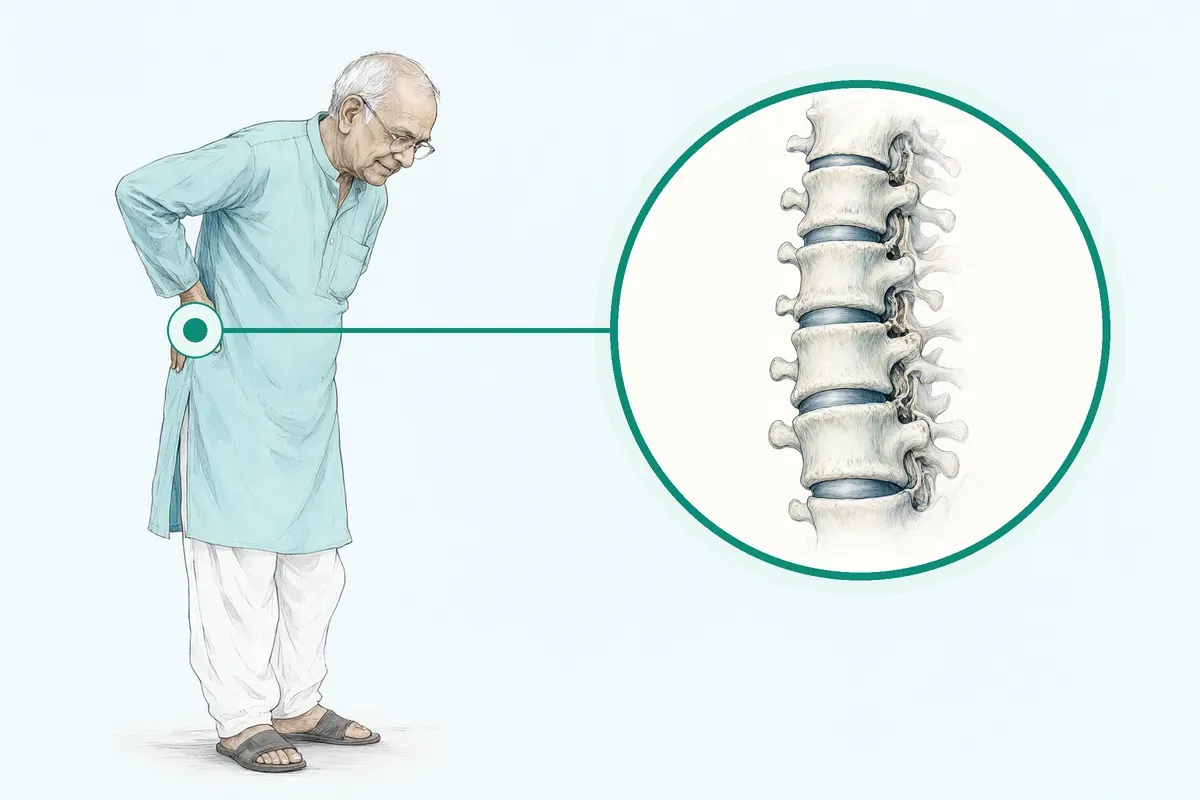
Degenerative spine surgery addresses wear and tear changes in the spine that press on nerves or the spinal cord. The spine is made of bones called vertebrae with soft discs between them that act as cushions. Over time, discs can lose water and height, bulge or rupture, and the joints at the back of the spine can enlarge.
Ligaments may thicken. These changes narrow the space for nerves and the spinal cord. When a disc fragment presses on a nerve root, it is called a disc prolapse or herniation. Narrowing of the spinal canal is called stenosis. When one vertebra slips forward over the one below, it is called spondylolisthesis.
All three can cause pain, numbness, weakness, or trouble walking. Surgery aims to remove the pressure and, if needed, stabilise the segment.
Symptoms and Warning Signs That Need Urgent Care
- Loss of bladder or bowel control Or numbness in saddle area
- Rapidly worsening weakness In an arm or leg
- Inability to walk or stand
- Severe pain after fall or injury In neck or back
Common symptoms include:
- Back or neck pain that travels down the leg or arm
- Numbness or tingling in the hands or feet
- Weakness such as foot drop or difficulty gripping
Stenosis often causes heaviness or pain in the legs after walking a short distance that improves with sitting or bending forward. Spondylolisthesis may cause mechanical back pain and nerve symptoms if the slipped bone pinches a nerve. Some people develop clumsiness, difficulty with buttons, or unsteady walking when the spinal cord is compressed in the neck.
Warning signs that need the same day evaluation at an emergency department:
- Sudden loss of bladder or bowel control, or numbness in the saddle area (inner thighs, buttocks, genitals)
- Rapidly worsening weakness in an arm or leg
- Inability to walk or stand
- Severe neck or back pain after a fall or injury
These suggest cauda equina syndrome or acute spinal cord compression and need immediate imaging and possible urgent decompression.
Causes and Who Is at Higher Risk
- Age over 50
- Main risk factor for degenerative changes
- Heavy lifting and vibration
- Repetitive strain speeds up wear and tear
- Obesity
- Adds load on the spine
- Smoking
- Reduces blood supply to discs
- Previous spine injury or surgery
- Increases risk of further degeneration
- Diabetes
- Affects nerve health
The main cause is age related wear and tear. Discs dry out and lose height, facet joints develop arthritis, and ligaments thicken. These changes narrow the spinal canal and the openings where nerves exit. Some people are born with a narrower canal, which makes symptoms appear earlier.
Factors that increase the risk or speed up the process:
- Age over 50 years
- Repetitive heavy lifting, vibration, or prolonged sitting
- Obesity, which adds load on the spine
- Smoking, which reduces blood supply to discs
- Previous spine injury or surgery
- Family history of degenerative spine disease
- Conditions such as diabetes that affect nerve health
Congenital short pedicles can make the cervical canal narrow from birth.
How Degenerative Spine Conditions Are Diagnosed
- MRI
- Shows discs, nerves, cord, and soft tissue
- CT scan
- Detailed bone anatomy for surgical planning
- X-rays
- Standing and bending views show alignment and instability
- Nerve studies
- Distinguish nerve root compression from peripheral neuropathy
Diagnosis starts with a detailed history and a physical examination. The doctor checks your walking, balance, reflexes, muscle strength, and sensation. Specific movements such as bending forward, backward, and to the sides help locate the level of compression. Provocative tests like straight leg raise or Spurling's test can reproduce arm or leg symptoms.
Imaging confirms the level and severity:
- MRI is the main test. It shows discs, nerves, the spinal cord, ligaments, and soft tissue compression clearly.
- CT scan gives detailed bone anatomy and is useful for surgical planning, especially for fusion.
- X-rays taken standing and bending forward and backward show alignment, instability, and slippage.
- In some cases, nerve conduction studies or electromyography help distinguish nerve root compression from peripheral neuropathy.
The Nurick grade and modified Japanese Orthopaedic Association (mJOA) score are used to grade myelopathy severity when the cord is involved.
Non Surgical Treatment Options and When Surgery Is Advised
Most people with disc prolapse or stenosis improve without surgery.
First line options include:
- Activity modification
- Physiotherapy to strengthen core and back muscles
- Pain relief with anti inflammatory medicines or neuropathic pain agents
Epidural steroid injections can reduce nerve inflammation and give a window for rehabilitation. A cervical collar or lumbar brace may be used for short periods.
Surgery is considered when:
- Conservative measures have been tried for 6 to 12 weeks without meaningful relief
- There is progressive weakness, numbness, or gait disturbance
- Imaging shows significant compression of the spinal cord (myelopathy) or cauda equina
- Pain is severe and limits daily function despite medication and therapy
- Instability is documented on dynamic X-rays, as in spondylolisthesis with movement
Studies show that carefully selected patients who undergo surgery for lumbar disc herniation achieve greater improvement in pain and function than those managed non operatively, and the benefit persists at long term follow up.
For cervical spondylotic myelopathy, the natural history shows that 20% to 60% of patients deteriorate neurologically over time without surgery. Surgical intervention eliminates the chances of further neurological deterioration and is superior for moderate to severe myelopathy.
The decision is made jointly by you, your surgeon, and often a neurologist, based on symptoms, examination, imaging, and your overall health.
Preparing for Degenerative Spine Surgery
Do
- Recent blood tests, ECG, chest X-ray
- Tell surgeon about all medicines
- Fast from midnight before surgery
- Have an attendant stay with you
Avoid
- Do not change medicines without asking
Your surgeon will ask for recent blood tests, an ECG and a chest X-ray to check that you are fit for general anaesthesia. An MRI or CT scan of the affected level is reviewed again to confirm the plan. Tell your surgeon about every medicine you take, especially blood thinners, diabetes tablets or insulin, and any supplements.
You may be asked to stop blood thinners a few days before the operation. Do not change any medicine without asking your doctor first. You will fast from midnight on the night before surgery; clear water is usually allowed up to two hours before you come to the operating theatre.
Bring your regular medicines, a list of allergies, your insurance or scheme cards, comfortable clothes and a pair of non-slip slippers. An attendant should stay with you during the admission. Jaipur Hospital has a 24-hour laboratory and imaging unit on site, so any last-minute tests can be done quickly.
How Degenerative Spine Surgery Is Done
The operation is performed under general anaesthesia and usually takes one to three hours. Your surgeon will choose the technique that matches your imaging and symptoms. Microdiscectomy uses a microscope and a small incision to remove the herniated disc fragment pressing on the nerve. Laminectomy or decompression removes bone and thickened ligament to widen the spinal canal in stenosis.
TLIF or PLIF fusion places a cage and screws between the vertebrae to stabilise a segment that has slipped, as in spondylolisthesis. Endoscopic discectomy uses a tiny camera and instruments through a keyhole incision for select disc herniations.
On the day of surgery you are taken to a modular operation theatre, positioned face down on a special frame, and the skin is cleaned and draped. The surgeon makes the planned incision, performs the decompression or fusion, and closes the wound with stitches or staples. A drain may be left for a few hours.
You then go to the recovery area and later to a ward bed. The neurosurgery and orthopaedics teams work together at Jaipur Hospital, and the intensive care unit is available if needed.
Risks and Possible Complications of Degenerative Spine Surgery
All operations carry some risk.
Common early issues include:
- Wound pain
- Bruising
- Temporary numbness around the incision
Infection at the wound site occurs in a small number of patients and is usually treated with antibiotics. A dural tear with cerebrospinal fluid leak is reported in studies and may need a stitch or a short period of bed rest. Nerve root injury is rare but can cause new weakness or numbness.
In fusion surgery, the bone may not join solidly, which is called non-union; smoking and diabetes increase this chance. Implants can loosen or break over time. Deep vein thrombosis and pulmonary embolism are uncommon; you will wear compression stockings and may receive blood-thinning injections to lower the risk.
General anaesthesia carries its own small risks such as allergic reaction or chest infection. Your anaesthetist will discuss these with you before the operation. The surgical team follows ERAS-based protocols to reduce complications and speed recovery.
Recovery and Aftercare After Degenerative Spine Surgery
- Same day or next morning Start walking with help
- Within 24 hours Drain removed if placed
- Two to four nights Typical hospital stay
- About two weeks Stitches or staples removed
- First four to six weeks Avoid heavy lifting, bending, twisting, prolonged sitting
- Two to four weeks Desk work often resumed
Most patients start walking with help on the same day or the next morning. A physiotherapist will show you how to move safely, roll in bed and use a walker if needed. Pain is managed with tablets and sometimes a short course of intravenous medicine. The drain, if placed, is usually removed within 24 hours.
You can eat and drink normally once you are fully awake. Hospital stay is typically two to four nights. Before discharge you will get advice on wound care, signs of infection, and a home exercise programme. Stitches or staples are removed after about two weeks at a follow-up visit.
For the first four to six weeks avoid:
- Heavy lifting
- Bending forward
- Twisting
- Prolonged sitting
Desk work can often be resumed in two to four weeks, while manual work may need eight to twelve weeks. Your surgeon will guide you on driving, usually once you are off strong painkillers and can turn comfortably. Attend all follow-up appointments so the team can check wound healing, nerve recovery and fusion progress if applicable.
Call the hospital or visit the 24×7 emergency department if you develop increasing wound redness, swelling, fluid leak, fever, new leg weakness, or loss of bladder or bowel control.
Results of Degenerative Spine Surgery: What Studies Show
- Greater improvement in leg pain, back pain and disability scores at long-term follow-up Lumbar disc herniation
- Better walking distance and leg symptoms with decompression vs conservative treatment Spinal stenosis
- Surgery halts neurological decline in majority; without surgery 20 to 60 percent worsen over time Cervical myelopathy
- Occurs in a minority after microdiscectomy Recurrent disc herniation
In studies of patients with lumbar disc herniation and radiculopathy, those who had surgery reported greater improvement in leg pain, back pain and disability scores than those who continued non-operative care at long-term follow-up. The benefit was most clear for sciatica bothersomeness and patient satisfaction.
For spinal stenosis with neurogenic claudication, decompression surgery leads to better walking distance and leg symptoms compared with continued conservative treatment. In degenerative spondylolisthesis, adding fusion to decompression reduces the chance of later instability but involves a longer operation and recovery.
For cervical spondylotic myelopathy, surgical decompression halts neurological decline in the majority of patients, although some residual disability may remain. Studies show that without surgery, 20 to 60 percent of myelopathy patients worsen over time. Recurrent disc herniation at the same level occurs in a minority of patients after microdiscectomy.
Adjacent segment degeneration may develop years later after fusion, but not everyone needs further surgery. Minimally invasive endoscopic approaches have shown good outcomes at five years in selected cases. Your surgeon will discuss the expected benefit for your specific condition.
Cost and Insurance for Degenerative Spine Surgery in Jaipur
The typical price range for degenerative spine surgery at Jaipur Hospital is ₹1,20,000 to ₹3,50,000. The final amount depends on the type of procedure, the number of levels operated, the implants used, the length of stay and whether you need intensive care.
The estimate usually covers:
- The operation
- Anaesthesia
- Standard ward stay
- Basic medicines
- Routine investigations
Advanced imaging such as MRI or CT, special implants, and physiotherapy sessions may be billed separately. Jaipur Hospital accepts RGHS, MAA Yojana, CGHS and a panel of private insurers and TPAs. Most insurance companies in India cover spine surgery as a medically necessary treatment.
Bring your scheme or policy documents at admission so the billing team can verify coverage and process cashless or reimbursement claims. The hospital has an in-house pharmacy and diagnostic laboratory, which helps keep additional costs predictable. Ask the admissions desk for a detailed estimate before you plan the surgery.