

Orthopaedics · Jaipur Hospital
Bone and Joint Infection in Jaipur
Persistent bone or joint infection? We assess, plan, and treat with surgery and antibiotics.
- Serving Jaipur since 1991 (35 years)
- NABH accredited
- 24×7 emergency & ICU
- Cashless: RGHS, MAA Yojana, CGHS + 22 insurers
- Operation time
- 1 to 3 hours (staged)
- Anaesthesia
- Spinal or General anaesthesia
- Recovery
- IV antibiotics 4 to 6 weeks, full recovery 3 to 6 months
- Price
- ₹1,00,000 to ₹3,50,000typical range in India; ask us for an estimate
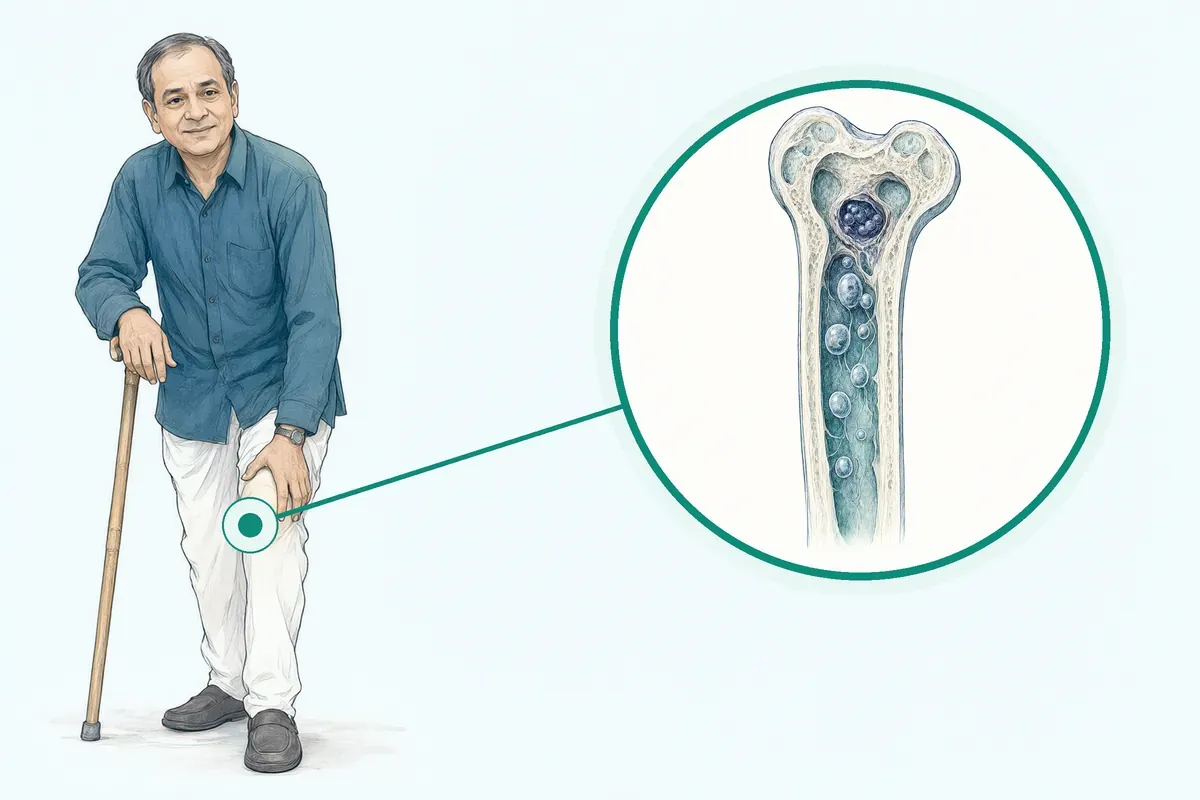
Infection deep in bone or joint
Pain, swelling, and fever that will not settle with medicines alone
Bacteria can form a protective layer called a biofilm on bone or implants. This makes them hard to reach with antibiotics given by mouth or drip. The infection becomes chronic, causing ongoing pain, drainage, and loss of function.
-
Biofilm blocks antibiotics
Bacteria in biofilm show 10 to 1000 times more resistance than free-floating bacteria.
-
Implants can harbour infection
About 50% of device-related infections involve biofilms on implants like joint prostheses.
-
Delay risks joint damage
Cartilage destruction and long-term joint dysfunction can occur if treatment is not started within 24 to 48 hours.
-
Chronic infection limits work
Osteomyelitis after open tibial fracture accounts for long absenteeism from work.
Approximately 80% of chronic and recurrent microbial infections in the human body are due to bacterial biofilm.
Why Jaipur Hospital
You worry that the infection will spread, that you will lose months of earnings, and that repeated surgeries will drain your savings.
Your care plan
Your first steps with us
- 1 Call or visit OPD for surgeon consultation and review of scans
- 2 Admit for staged surgical debridement under spinal or general anaesthesia
- 3 Receive IV antibiotics in hospital, then switch to oral at home per plan
- 4 Attend follow-up visits for wound check, blood tests, and physiotherapy
How the operation is done
Surgery removes dead bone, infected tissue, and any loose implant. The cavity is washed out. Dead space is managed with muscle flaps or antibiotic beads. External fixation may be used for stability. Operation takes 1 to 3 hours, often in stages.
-
Septic Arthritis Arthroscopic Washout
Keyhole lavage and debridement for native joint infection; allows visualisation and drainage.
-
Chronic Osteomyelitis Debridement (Saucerisation)
Radical removal of dead bone (sequestrectomy) and management of the resulting cavity.
-
Prosthetic Joint Infection (DAIR/Exchange)
Debridement with implant retention (DAIR) or staged removal and re-implantation of the prosthesis.
-
Ilizarov/External Fixation for Infected Nonunion
Circular or monolateral frame for bone transport and compression-distraction to fill bone defects.
Why patients trust us
- 1991 Serving Jaipur for 35 years
- NABH Accredited hospital
- 5 Orthopaedics consultants
- 24×7 Emergency, ICU and ambulance
- 25 Cashless schemes and insurers
What research shows about this treatment
-
11.5 days mean hospital stay
Overall mean length of hospitalisation for septic arthritis in published series.
-
6 to 12 weeks antibiotic course
Recommended total duration of therapy for prosthetic joint infection after appropriate surgery.
-
13 to 15% treatment failure
Standard IV therapy failed in 14.6% and oral therapy in 13.2% in the OVIVA trial of 1054 patients.
If it is left untreated
Without timely surgery and antibiotics, the infection can destroy cartilage and bone, leading to stiff or unstable joints. Bacteraemia may develop, risking sepsis. Chronic drainage sinuses can form.
Life after treatment
Most people regain joint movement and return to daily activities after completing antibiotics and physiotherapy.
-
Infection controlled
Wound heals, drainage stops, and inflammatory markers return to normal.
-
Movement returns
Physiotherapy helps restore range of motion and strength over 3 to 6 months.
-
Back to work
Most people resume usual activities once the antibiotic course finishes and the bone is stable.
-
Long-term monitoring
Periodic OPD reviews and blood tests help catch any recurrence early.
Frequently asked questions
Questions patients ask about bone and joint infection
Which problems are assessed under bone and joint infection?
In short
At Jaipur Hospital, bone and joint infection assessment covers native septic arthritis, chronic osteomyelitis, prosthetic joint infection, and infected nonunion. The surgical team evaluates the joint or bone involved, the duration of infection, and whether implants are present. This guides the choice of debridement technique and antibiotic plan.
In detail
Septic arthritis is usually monoarticular, most often affecting the knee, hip, shoulder, ankle, elbow, or wrist. Chronic osteomyelitis involves dead bone (sequestrum) and soft-tissue loss. Prosthetic joint infection may be early (within weeks of surgery), late acute, or chronic.
Infected nonunion combines bone healing failure with persistent infection. Each pattern needs a specific surgical approach such as arthroscopic washout, saucerisation, DAIR, staged exchange, or Ilizarov fixation.
Your next step at Jaipur Hospital
You will attend the orthopaedics OPD for clinical examination and basic blood tests. The surgeon then orders imaging and joint aspiration as needed. A care plan is discussed within the same visit.
How will the doctor decide which tests I need?
In short
At Jaipur Hospital, the surgeon selects tests based on your history, examination findings, and the suspected type of infection. Blood tests including CRP, ESR, and procalcitonin are usually first. Synovial fluid analysis with Gram stain, culture, and cell count is essential for joint infections. Imaging such as X-ray, MRI, or CT helps define bone and soft tissue involvement.
In detail
Evidence shows CRP and ESR are each more than 90% sensitive for septic arthritis with low cutoffs. Procalcitonin has higher specificity. Synovial fluid white cell count below 50,000 per microlitre does not exclude infection.
For prosthetic joints, the team may use isotope scans or PET-CT to distinguish infection from aseptic loosening. In chronic osteomyelitis, MRI defines the extent of dead bone and soft tissue envelope. Blood cultures are taken when bacteraemia is suspected.
Your next step at Jaipur Hospital
Tests are coordinated during your OPD visit or admission. Results usually return within 24 to 48 hours. The surgeon reviews them to confirm diagnosis, identify the organism, and plan the surgical approach and antibiotic regimen.
How soon should I expect improvement after surgical debridement and antibiotic management for bone and joint infection?
In short
After surgical debridement and antibiotic management at Jaipur Hospital, early signs such as reduced fever and pain often appear within the first few days. Measurable improvement in inflammatory markers typically occurs over the first two weeks of intravenous antibiotics.
In detail
Evidence shows that in native joint infections, antibiotics are usually given parenterally for at least two weeks and the joint is monitored for clinical response. In the OVIVA trial, standard IV therapy began within seven days of surgery and continued for at least six weeks.
If the patient's condition responds adequately after five days of treatment, gentle mobilisation of the infected joint may begin. However, ongoing inflammation can blunt medication activity, so inflammatory markers such as CRP and procalcitonin are tracked rather than relying on symptoms alone.
A common belief
Many people think the wound closing means the infection is gone.
What actually happens
In reality, biofilm-protected bacteria need weeks of antibiotics, and markers can normalise before the infection is fully eradicated.
Your next step at Jaipur Hospital
You will stay in hospital for seven to fourteen nights for staged admissions and receive IV antibiotics for four to six weeks. Full recovery takes three to six months. Your surgeon will review blood tests and wound healing at each follow-up.
When does a fever need testing or hospital assessment during bone and joint infection treatment?
In short
A temperature of 38°C or higher during or after treatment for bone and joint infection at Jaipur Hospital should prompt immediate contact with your surgical team. Fever may signal persistent or new infection, especially in the first six weeks of antibiotic therapy. Do not self-medicate; urgent blood cultures and inflammatory marker tests are often needed.
In detail
Evidence shows that ongoing fever beyond five days of appropriate antibiotics suggests treatment failure. In septic arthritis, failure to respond within five to seven days — with continued synovial purulence or positive cultures — warrants reassessment.
Inflammatory markers such as CRP and procalcitonin are more specific than white cell counts for detecting active infection. Biofilm-related infections can cause intermittent low-grade fever even when the wound looks healed.
Your next step at Jaipur Hospital
Keep a digital thermometer at home and record readings twice daily. If fever reaches 38°C or you feel unwell with chills, rigors, or wound changes, call the hospital or attend the emergency department. Bring your antibiotic chart and recent test results.
How can I decide whether to seek advice about osteomyelitis treatment?
In short
Seek advice about osteomyelitis treatment at Jaipur Hospital if you have persistent bone pain, fever, swelling over a bone, a draining sinus tract, or a previous fracture or surgery that has not healed. Risk factors include diabetes, recent trauma, open fractures, or immunosuppressive medication. Early evaluation prevents long-term bone damage and loss of function.
In detail
Evidence shows osteomyelitis often follows open tibial fractures and leads to long absenteeism. Biofilms on dead bone protect bacteria, making antibiotics alone insufficient. Surgical debridement removes infected tissue and dead bone. The protocol uses staged debridement with 4 to 6 weeks IV antibiotics.
Delayed treatment risks chronic infection, deformity, and amputation. The surgical team assesses imaging, blood markers, and tissue cultures to plan care.
A common belief
Many ignore chronic bone pain hoping it settles, but biofilms make these infections tough to clear without surgery.
What actually happens
Delay leads to more bone loss and harder treatment.
Your next step at Jaipur Hospital
If you notice ongoing bone pain, fever, or a wound that will not heal, do not wait. Contact Jaipur Hospital for an orthopaedic opinion. Initial visit includes examination, X-rays or MRI, and blood tests. The surgeon will explain options and expected timeline.
How will treatment affect my walking, movement, or independence after bone and joint infection surgery?
In short
Treatment for bone and joint infection at Jaipur Hospital temporarily reduces walking and movement. Most patients need crutches, a walker, or wheelchair for several weeks after surgery. Independence returns gradually as wounds heal, antibiotics finish, and physiotherapy progresses. The extent depends on the joint involved, surgery type, and whether reconstruction or external fixation was needed.
In detail
Our usual protocols show hospital stay of 7 to 14 nights and full recovery in 3 to 6 months. Evidence indicates aggressive physical therapy is required for maximum post-infection function. Weight-bearing is restricted until clinical signs of synovitis resolve and bone stability is confirmed.
Patients with Ilizarov or external fixation for infected non-union follow a specific distraction and compression schedule. The surgical team and physiotherapists design a stepwise mobilisation plan. Outpatient antibiotic therapy allows earlier home-based recovery.
A common belief
People often expect to walk normally soon after stitches come out.
What actually happens
But the bone and soft tissue need protected loading. Physiotherapy is not optional — it is essential to regain strength and prevent stiffness. Skipping it leads to long-term limitation.
Your next step at Jaipur Hospital
Discuss your home environment and support system before surgery. Arrange for an attendant to assist initially. Follow the prescribed physiotherapy programme and attend all follow-ups for X-rays and blood tests.
Which symptoms should prompt me to see a specialist?
In short
At Jaipur Hospital, you should see a specialist if you have an acutely painful, swollen joint with fever, especially the knee, hip, shoulder, ankle, elbow, or wrist. Persistent drainage from a sinus near a previous fracture or implant, worsening pain at a joint replacement, or a fracture that fails to heal with signs of infection also need prompt evaluation.
In detail
More than half of patients with septic arthritis report joint swelling, pain, and fever. Native joint infections most commonly affect the knee. In prosthetic joints, early infection may present with wound issues or acute swelling, while late infection often shows as increasing pain and loosening.
Chronic osteomyelitis can cause intermittent sinus discharge, bone pain, and low-grade fever. Risk factors include diabetes, rheumatoid arthritis, immunosuppressive medication, recent joint surgery, and age over 80 years.
Your next step at Jaipur Hospital
Visit the orthopaedics OPD for clinical assessment and blood tests such as CRP and ESR. The surgeon may arrange joint aspiration or imaging within the same visit. Early diagnosis within 24 to 48 hours reduces the risk of long-term joint damage.
How will the results change my care plan?
In short
At Jaipur Hospital, test results directly guide the surgical technique, antibiotic choice, and duration of therapy. Positive cultures with sensitivities allow targeted antibiotics. Imaging defines the extent of debridement needed and whether implant retention, exchange, or external fixation is appropriate. Inflammatory marker trends monitor response.
In detail
Evidence shows initial antibiotic choices are empirical based on local resistance patterns. Once culture results arrive, therapy is narrowed. If inflammatory markers such as CRP and procalcitonin do not fall after 5 days, the surgical plan is reassessed.
In prosthetic joint infection, the DAIR procedure (debridement, antibiotics, implant retention) is considered only if the implant is stable, symptoms are under 3 weeks, and no sinus tract exists. Otherwise, staged exchange is planned.
For chronic osteomyelitis, MRI findings determine the need for saucerisation, dead space management, and possible free flap or Ilizarov reconstruction.
Your next step at Jaipur Hospital
You will discuss results with the surgeon at follow-up, usually within a week. The plan may shift from observation to surgery, or from implant retention to exchange, based on findings. IV antibiotics typically continue for 4 to 6 weeks, with full recovery over 3 to 6 months.
What should I do if symptoms persist or worsen after bone and joint infection treatment?
In short
If pain, swelling, fever, or wound discharge return or increase after treatment at Jaipur Hospital, contact your surgical team immediately. Do not wait for the next scheduled visit. Early reassessment prevents deeper infection and further surgery. Your surgeon may order repeat cultures, imaging, or blood tests to guide the next step.
In detail
Evidence shows that if a joint does not improve after five days of appropriate antibiotics — with ongoing fever, persistent purulence, or positive cultures — the therapeutic approach must be reassessed.
Inflammatory markers such as CRP and procalcitonin are more reliable than white cell counts for detecting ongoing infection. Recurrence rates in chronic osteomyelitis remain significant, and biofilm persistence can cause late flare-ups even after apparent healing.
Your next step at Jaipur Hospital
Keep a record of temperature, wound appearance, and pain scores. Bring this to your follow-up. If you notice spreading redness, new sinus formation, or sudden joint instability, go to the emergency department. Do not stop antibiotics without advice.
Which tests are useful at different stages of bone and joint infection?
In short
At Jaipur Hospital, diagnosis starts with blood tests — CRP, ESR, procalcitonin, and blood cultures — plus joint aspiration for Gram stain, cell count, and culture. Imaging such as X-ray, MRI, or CT defines bone and soft tissue involvement. During treatment, serial CRP and procalcitonin guide antibiotic duration. Repeat aspiration or biopsy may be needed if progress stalls.
In detail
Evidence shows ESR and CRP are each more than 90% sensitive for septic arthritis with low cut-offs. Procalcitonin above 0.5 ng/mL has higher specificity. Synovial fluid analysis is the cornerstone; a white cell count below 50,000 does not exclude infection.
For prosthetic joints, intra-operative tissue cultures are more reliable than pre-operative aspirates. In chronic osteomyelitis, MRI defines the extent of dead bone and soft tissue envelope. Ongoing inflammation can blunt antibiotic activity, so inflammatory markers are monitored weekly.
Your next step at Jaipur Hospital
Expect blood tests at admission, then weekly during IV antibiotics. Imaging repeats at six weeks and three months. If markers plateau or rise, your surgeon may order repeat aspiration, PET-CT, or synovial biopsy. Keep all reports for each visit.
FAQ library
Questions and answers about bone and joint infection
When you contact us
Get your assessment and plan
Contact Jaipur Hospital for an OPD consultation with an orthopaedic surgeon, in-house tests, a clear explanation of options, a cost estimate, and help with cashless schemes.
- A consultation with an orthopaedic surgeon in the OPD
- Your scans and reports reviewed, with tests done in-house if you need them (laboratory, X-ray and imaging)
- Your options explained in plain words, including whether you need surgery at all
- A cost estimate before you decide
- Help with cashless treatment under RGHS, MAA Yojana, CGHS and empanelled insurers and TPAs
- Follow-up visits after your treatment
Overview
Bone and Joint Infection: what to know
What bone and joint infection is and how it happens
- up to 1,000 times more resistant Biofilm resistance
- About 80% Chronic infections linked to biofilms
Bone and joint infection means bacteria have entered a bone (osteomyelitis) or a joint (septic arthritis) and started to grow. In a joint the infection acts like a closed abscess; antibiotics alone cannot clear it. Bacteria often reach the joint through the bloodstream from an infection elsewhere in the body. Staphylococcus aureus and Streptococcus species are the most common causes.
Once bacteria settle on bone or on an implant they build a protective slime called a biofilm. The biofilm matrix shields the bacteria from your immune system and makes them up to 1,000 times more resistant to antibiotics than free-floating bacteria. About 80% of chronic and recurrent infections in the body are linked to biofilms. This is why bone and joint infections tend to become long-standing and need both surgery and prolonged antibiotics.
Symptoms and warning signs that need urgent care the same day
More than half of people with septic arthritis notice joint swelling, joint pain and fever.
The knee is the joint most often affected, followed by:
- The hip
- Shoulder
- Ankle
- Elbow and wrist
The joint becomes acutely painful without any injury and may feel hot and stiff. In native joint infection, delay beyond 24 to 48 hours can lead to cartilage destruction and lasting joint dysfunction. A delay in diagnosis and treatment can also result in serious morbidity and mortality.
If you have a suddenly painful, swollen joint with fever, go to the emergency department the same day. If you have a joint replacement and develop new pain, swelling, warmth or a wound that leaks fluid, seek care immediately.
Causes and who is at higher risk
Infection can start after an open fracture, after joint replacement surgery, or spread through the blood from another site. Bacteria form biofilms on implants such as joint prostheses, making the infection harder to eradicate.
Risk factors for septic arthritis include:
- Age over 80 years
- Diabetes mellitus
- Rheumatoid arthritis
- Recent joint surgery
- Hip or knee prosthesis
- Skin infection and use of immunosuppressive medicines
People with extensive periarticular osteomyelitis, low white cell counts or other immunosuppressive states are at higher risk of treatment failure. The presence of dead or necrotic tissue around the joint can create "safe havens" where bacteria escape antibiotics. Repeated short courses of antibiotics can encourage resistance.
How bone and joint infection is diagnosed: examination and tests
- more than 90% ESR and CRP sensitivity
- 0.5 ng/mL or higher Procalcitonin cut-off
The doctor will examine the joint for swelling, warmth, pain on movement and reduced range of motion. Blood tests include ESR and CRP; both are more than 90% sensitive for septic arthritis when low cut-offs are used. Procalcitonin with a cut-off of 0.5 ng/mL or higher has higher specificity than CRP. Blood cultures are taken when bloodstream infection is suspected.
Synovial fluid is aspirated and sent for:
- Gram stain
- Aerobic and anaerobic cultures
- White cell count with differential
A white cell count below 50,000 per µL does not rule out septic arthritis. Imaging such as X-ray or MRI is used to check for bone involvement. If fungal or mycobacterial infection is possible, a synovial biopsy may be needed. Inflammatory markers (CRP, procalcitonin, ESR) are tracked to judge response to treatment. If the joint does not improve after 5 days of appropriate antibiotics, the plan is reassessed.
Treatment options without surgery and when surgery is advised
- Start antibiotics based on local resistance IV for at least 2 weeks for native joint infection
- Switch to oral antibiotics when responding Total course 2 to 6 weeks usually
- Prosthetic joint options DAIR or exchange DAIR for early infection stable implant no sinus
Antibiotics are started empirically based on local resistance patterns. For native joint infections, intravenous antibiotics are usually given for at least 2 weeks. Oral antibiotics can be used in most cases once the infection is responding, because they are not inferior to intravenous therapy. The total antibiotic course typically ranges from 2 to 6 weeks, though some infections need longer.
Surgery is advised when antibiotics and repeated needle drainage do not clear the infection after 5 to 7 days, when the joint is difficult to aspirate (for example the hip), or when nearby soft tissue is infected. Arthroscopic washout lets the surgeon see inside the joint, drain pus, debride tissue and break down adhesions.
For prosthetic joint infection, debridement with implant retention (DAIR) may be tried if the infection is early (within 3 weeks of symptoms or 30 days of surgery), the implant is stable and there is no sinus tract.
If DAIR fails or the infection is chronic, the implant is removed and a new one is placed either in one stage or two stages. For chronic osteomyelitis with bone loss, radical debridement (saucerisation) and dead space management are done, sometimes with external fixation such as an Ilizarov frame for bone transport. Your surgeon will advise which technique suits your situation.
Preparing for bone and joint infection surgery
Before surgery you will attend a pre-anaesthesia check in the OPD.
The team usually asks for:
- Blood counts
- Kidney and liver function tests
- Blood sugar
- A coagulation profile
If you have a joint replacement, recent X-rays or an MRI help plan the procedure. Bring a list of every medicine you take, especially blood thinners, steroids, or drugs that affect immunity. Your surgeon will tell you which ones to stop and when. Fasting is usually six hours for solids and two hours for clear fluids before the anaesthetic.
Pack comfortable clothes, an extra set of undergarments, any walking aid you use, and your regular medicines in their original packets. An attendant should plan to stay with you during the admission.
How bone and joint infection surgery is done
The operation takes one to three hours and is often done in stages. You will receive spinal or general anaesthesia. The surgical team chooses the technique that fits your infection:
- Septic arthritis arthroscopic washout: small cuts are made to wash out the joint and remove infected tissue.
- Chronic osteomyelitis debridement (saucerisation): dead bone is removed and the cavity is managed to allow healing.
- Prosthetic joint infection (DAIR or exchange): the implant is cleaned and kept, or removed and replaced in one or two stages.
- Ilizarov or external fixation for infected nonunion: a frame is fixed to the bone to stabilise it and, if needed, slowly move bone segments to fill a gap.
Your surgeon will explain which option suits you and why. On the day of surgery you are taken to a modular operation theatre. After the procedure you go to the recovery area and then to a ward or the ICU depending on your condition.
Risks and possible complications of bone and joint infection surgery
All surgery carries risk. In studies of chronic osteomyelitis treated with debridement and free tissue transfer, about 10% of patients needed an urgent return to theatre for flap problems. Most of those flaps were saved with one or two extra operations. In one series a single flap failed and required three further procedures and a 90-day stay.
Some patients needed removal of metalwork or revision of a custom implant later on. Biofilms on bone or implants can make bacteria up to 1,000 times more resistant to antibiotics than free-floating bacteria, which is why infection can persist or come back. Delay in starting the right treatment can lead to lasting joint damage.
Your team monitors flaps closely and acts early if there is any sign of trouble, because early salvage keeps the hospital stay shorter and reduces further surgery.
Recovery and aftercare after bone and joint infection surgery
You will stay in hospital for seven to 14 nights, often in staged admissions. Intravenous antibiotics continue for four to six weeks; the team may switch you to oral antibiotics early if you are stable and your inflammatory markers are improving.
In the OVIVA trial, patients who moved to oral therapy after a short IV course did as well as those who stayed on IV drugs. Gentle movement of the joint usually starts once pain and swelling settle, often after five days of treatment. Most people need regular physiotherapy to regain strength and range of motion. Full recovery takes three to six months.
Call the hospital or visit the emergency department if you develop:
- A new fever
- Increasing wound redness or discharge
- Sudden joint pain
- If you feel unwell
The 24×7 emergency department and in-house pharmacy at Jaipur Hospital are available for any urgent concern.
Results of bone and joint infection surgery
- 74% early, 49% late acute, 44% chronic DAIR healing rates
- 70% to 90% One-stage exchange success
In a series of 60 patients who had debridement and free flap cover for chronic osteomyelitis, none had a recurrence of infection at a median follow-up of about two years.
For prosthetic joint infection treated with debridement and implant retention (DAIR), healing rates of 74% have been reported in early infections, 49% in late acute infections, and 44% in chronic infections. One-stage exchange with antibiotic cement has shown success in 70% to 90% of cases.
In a study comparing six weeks versus twelve weeks of antibiotics for prosthetic joint infection, the failure rate was 18% with six weeks and 9% with twelve weeks. Shorter IV courses followed by oral therapy have been shown to be non-inferior to longer IV treatment.
Your surgeon will discuss the expected outcome for your specific situation, including the chance that further surgery may be needed.
Cost and insurance for bone and joint infection surgery in Jaipur
The typical price range for surgical debridement and antibiotic management of bone and joint infection in India is ₹1,00,000 to ₹3,50,000. The final amount depends on the type of procedure, the implants or external fixators used, the length of stay, the antibiotics required, and whether staged admissions are needed. Jaipur Hospital is a NABH-accredited multispeciality hospital established in February 1991.
It accepts:
- RGHS
- MAA Yojana
- CGHS
- A panel of private insurers and TPAs
The hospital has an in-house pharmacy, diagnostic laboratory, imaging, modular operation theatres, ICU, and 24×7 emergency and ambulance services. Ask the admissions desk for an estimate based on your planned treatment.