

Sports Injury · Jaipur Hospital
Muscle and Tendon Injuries in Jaipur
Sudden pain or nagging tendon trouble? Get a clear diagnosis and a step-by-step plan.
- Serving Jaipur since 1991 (35 years)
- NABH accredited
- 24×7 emergency & ICU
- Cashless: RGHS, MAA Yojana, CGHS + 22 insurers
- Treatment length
- Varies by grade and location
- Anaesthesia
- General or regional for surgical repair
- Recovery
- 3 weeks to 6 months based on severity
- Price
- ₹10,000 to ₹2,50,000typical range in India; ask us for an estimate
Pain that stops you moving
A tear or tendinopathy makes simple moves hurt — walking, lifting, sleeping on that side
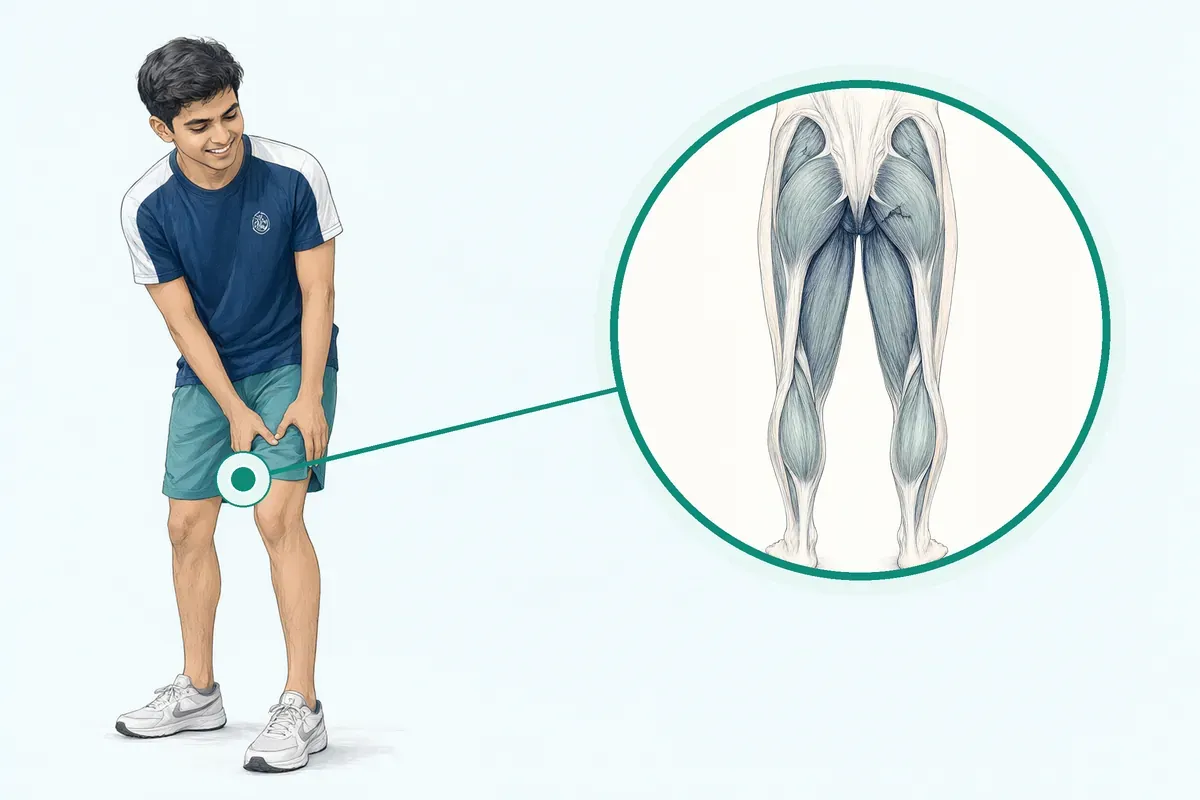
Muscle and tendon injuries range from a mild strain that aches after activity to a complete rupture that leaves you unable to bear weight. The pain often spreads, strength drops, and the joint feels unstable. Without the right loading plan, the tissue can heal poorly and the problem comes back.
-
Sharp pain during sprint or stretch
A sudden pop or stab in the back of the thigh, calf or shoulder during high-speed effort.
-
Deep ache that worsens with load
Morning stiffness and pain that increases when you run, jump or lift overhead.
-
Weakness and giving way
The leg or arm feels unreliable; you cannot push off or press up with confidence.
-
Recurrent flare-ups
Previous tears make the same spot vulnerable again, often with less force than before.
Up to 45% of patients do not respond to isolated eccentric exercises alone.
Why Jaipur Hospital
You worry that the pain will linger, that you will lose fitness or work days, and that surgery might be pushed on you without a clear reason.
Your care plan
Your first steps with us
- 1 Call or visit OPD for specialist assessment
- 2 Get imaging and labs done in-house same day
- 3 Review options: rehab, injection or surgical repair
- 4 Start your guided rehab plan with follow-up visits
How the operation is done
For complete ruptures or tears that do not heal with rehab, surgery reattaches the tendon to bone or repairs the muscle belly. The surgeon makes an incision, checks surrounding tissue, sutures the torn ends, and immobilises the joint. Surgery typically takes 30 minutes to over an hour depending on injury extent.
-
Progressive Loading Programme
Eccentric exercises, isometrics and sport-specific drills to rebuild tendon capacity step by step.
-
PRP / Autologous Blood Injection
Ultrasound-guided injection of your own blood products for chronic tendinopathy or partial tears.
-
Open or Endoscopic Tendon Repair
Surgical reattachment for acute complete ruptures of Achilles, patellar or rotator cuff tendons.
-
Muscle Belly Repair
Direct repair of high-grade hamstring or quadriceps tears with significant retraction.
Why patients trust us
- 1991 Serving Jaipur for 35 years
- NABH Accredited hospital
- 1 Sports Injury consultants
- 24×7 Emergency, ICU and ambulance
- 25 Cashless schemes and insurers
What research shows about this treatment
-
Up to 45% do not respond to isolated eccentric training
Nearly half of patients with Achilles or patellar tendinopathy need a different loading approach.
-
Grade 1 heals in under a week; Grade 2–3 take months
Low-grade strains recover quickly, while higher grades and surgical cases need several months of guided rehab.
-
PRP improved VISA scores by 25 points at 12 weeks vs 5 for dry needling
In patellar tendinopathy, PRP showed greater early improvement, though differences narrowed by 26 weeks.
If it is left untreated
Untreated tears can lead to lasting weakness, muscle atrophy, altered joint mechanics and a high risk of re-injury. Chronic tendinopathy often limits sport and daily activity for months or years.
Life after treatment
Most people return to their usual activities with a structured rehab plan. Strength and confidence rebuild gradually.
-
Walk and run without a limp
Progressive loading restores push-off power and stride symmetry over weeks to months.
-
Lift and reach overhead again
Rotator cuff and shoulder tendon rehab rebuilds controlled movement for work and sport.
-
Sleep on the affected side
Night pain usually settles as tendon load tolerance improves with guided exercise.
-
Lower re-injury risk
Completing neuromuscular and sport-specific drills addresses the deficits that drive recurrence.
Frequently asked questions
Questions patients ask about muscle and tendon injuries
Which problems are assessed under muscle and tendon injuries?
In short
At Jaipur Hospital, the muscle and tendon injury service assesses acute and chronic tears of the hamstring, quadriceps, calf and rotator cuff, as well as tendinopathy of the Achilles, patellar and proximal hamstring tendons. The team grades each injury from minor strain to complete rupture and checks for associated bone avulsion or nerve involvement.
In detail
Evidence shows hamstring strain injuries are common in sport and are classified into three grades: grade 1 is a minor strain, grade 2 a partial tear, and grade 3 a complete tendon avulsion. Achilles and patellar tendinopathy are overuse injuries frequent in athletes.
Proximal hamstring tendinopathy develops from chronic overuse without a single inciting event. Acute tears often occur during high-speed running or excessive lengthening, while higher-grade injuries can result from a slip causing forced hip flexion with knee extension.
Anatomical factors such as biarticular muscle architecture and dual innervation of biceps femoris influence injury patterns. A thorough history and examination are essential to rule out other causes of posterior thigh pain.
Your next step at Jaipur Hospital
Your surgeon will perform a clinical assessment and may order ultrasound or MRI to confirm the grade and location of the tear. This first visit usually takes 30 to 45 minutes. Bring any previous imaging and a list of current medicines.
How will the doctor decide which tests I need for my muscle or tendon injury?
In short
At Jaipur Hospital, the surgeon selects tests based on the injury location, suspected grade, and whether the presentation is acute or chronic. Ultrasound and MRI are the main imaging tools for muscle and tendon pathology, while X-ray is used when a bony avulsion or fracture is suspected.
In detail
Magnetic resonance imaging and ultrasound are effective for identification of hamstring strains and tendinopathy. An X-ray will show any damage to the bones where the tendon connects, and some hamstring injuries happen alongside broken bones.
For patellar tendinopathy, a thorough examination is required to diagnose contributing factors, and imaging helps confirm tendon structure changes. The surgeon also considers that asymptomatic tendon pathology may exist in people who have pain from other sources, so imaging findings must correlate with clinical signs. The choice between ultrasound and MRI depends on the need for dynamic assessment versus detailed soft-tissue characterisation.
Your next step at Jaipur Hospital
Imaging is usually arranged within a few days of the consultation. Results are reviewed at a follow-up visit where the surgeon finalises the treatment plan, whether conservative loading, PRP injection, or surgical repair.
How soon should I expect improvement after the chosen treatment for a muscle or tendon injury?
In short
Improvement timelines vary widely based on injury grade, location, and whether treatment is surgical or non-surgical. At Jaipur Hospital, Grade 1 strains often improve within a week, while Grade 2 and 3 injuries or post-surgical recoveries typically take several weeks to months before you notice consistent functional gains.
In detail
Evidence shows that lower-grade hamstring tears may feel better in less than a week, but Grade 2 and 3 injuries can take up to several months.
After surgical repair, the tendon or muscle is immobilised initially, then loaded progressively; meaningful strength and pain reduction usually appear after six to twelve weeks of supervised rehabilitation.
For chronic tendinopathy treated with progressive loading programmes such as heavy-slow resistance or eccentric-concentric protocols, studies report VISA score improvements at twelve weeks, though some patients respond earlier.
Up to 45 percent of patients may not respond to isolated eccentric training alone, so programmes are adjusted. Healing is not linear; symptoms may fluctuate as load increases.
A common belief
A common mistake is expecting pain to disappear before strength returns.
What actually happens
In tendinopathy, pain can persist even as the tendon gets stronger. Studies show VISA scores improve at twelve weeks with proper loading, not days. Rushing back because pain is low often leads to re-injury.
Your next step at Jaipur Hospital
Your physiotherapist will set weekly milestones for range of motion, strength, and pain during activity. You should track function rather than daily pain. If there is no measurable progress at six weeks for non-surgical cases or twelve weeks post-surgery, the plan is reviewed.
Can this injury heal with rehabilitation, or is an operation worth considering?
In short
Many muscle and tendon injuries heal well with a structured rehabilitation programme alone, especially Grade 1 and 2 strains and chronic tendinopathy. At Jaipur Hospital, the decision for surgery is based on tear grade, retraction, functional demands, and response to non-operative care over time.
In detail
Evidence supports progressive loading programmes — eccentric-concentric, heavy-slow resistance, and sport-specific drills — as first-line treatment for most hamstring, quadriceps, calf, and rotator cuff injuries. Up to 45 percent of patients may not respond to isolated eccentric training, so programmes are individualised.
Complete tendon ruptures (Achilles, patellar, rotator cuff) and high-grade muscle tears with significant retraction usually require surgical repair because the ends cannot approximate naturally.
If three to six months of supervised rehabilitation fails to restore function, surgery such as open or endoscopic repair or tendon graft may be discussed. The surgeon weighs the natural history, your goals, and the rehabilitation burden of each option.
A common belief
A common belief is that surgery makes you stronger faster.
What actually happens
In reality, surgery adds immobilisation and a longer rehab. Studies show heavy-slow resistance loading gives equal or better long-term outcomes for many partial tears. Surgery is reserved for when anatomy won't heal functionally on its own.
Your next step at Jaipur Hospital
Your initial consultation includes grading by clinical exam and imaging, a trial of guided rehabilitation with clear milestones, and a shared decision on surgery if indicated.
How can I decide whether to seek advice about hamstring strain treatment?
In short
You should seek advice if hamstring pain lasts more than a few days, if you cannot put weight on the leg, or if you feel a sudden pop with severe pain and weakness. At Jaipur Hospital, the orthopaedic and sports injury team can grade the injury and start the right treatment early. Prompt assessment prevents a minor strain from becoming a chronic problem.
In detail
Evidence indicates that hamstring strain injuries are common in sports and are graded from one to three based on how much the muscle or tendon is torn.
Grade 1 is a minor strain, grade 2 a partial tear, and grade 3 a complete tear where tendons are torn away from the bone.
A healthcare provider can usually diagnose a hamstring injury with a physical exam, and imaging such as MRI or ultrasound shows the extent of injury. Risk factors include older age, previous injury, strength imbalances, flexibility deficits, and fatigue.
Running, especially high-speed running or excessive lengthening, is a primary cause. Sudden increases in activity level also raise risk.
If symptoms persist beyond a few days, or if you have severe pain or cannot move the leg, you should visit a healthcare provider or go to the emergency room.
Conservative management involves a rehabilitation protocol that gradually increases intensity and range of motion, progressing to sport-specific and neuromuscular control exercises. Eccentric strengthening is used for proximal hamstring tendinopathy.
A common belief
Many athletes try to run through hamstring pain, thinking it will settle on its own.
What actually happens
Evidence shows that delayed care turns acute strains into chronic tendinopathy and raises re-injury risk. A quick clinical exam and, if needed, an ultrasound or MRI tells you the exact grade so you get the right loading programme from day one.
Your next step at Jaipur Hospital
If your hamstring pain does not settle within a few days, or if you have significant weakness, bruising, or difficulty walking, book an appointment at Jaipur Hospital. The team will examine you, arrange imaging if needed, and give you a graded rehabilitation plan. Early guidance shortens recovery and lowers re-injury risk.
Can I continue any training safely while I recover from a muscle or tendon injury?
In short
Whether you can train during recovery depends on the injury type, grade, and stage of healing. At Jaipur Hospital, your surgeon and physiotherapist will define which movements and loads are safe at each phase. Many patients keep cardiovascular fitness with non-impact activities while protecting the injured tissue.
In detail
Evidence shows that conservative management of hamstring strains involves a rehabilitation protocol that gradually increases intensity and range of motion, progressing to sport-specific and neuromuscular control exercises.
For tendinopathy, isolated eccentric training has been the dominant strategy, but eccentric-concentric and heavy-slow resistance loading are also effective. Studies report that up to 45 percent of patients may not respond to isolated eccentric training alone.
The primary mechanism linked to improved outcomes in both Achilles and patellar tendon rehabilitation is improved neuromuscular performance such as torque, work, and endurance. Heavy-slow resistance loading in the patellar tendon was associated with reduced Doppler area and greater collagen turnover.
In the Achilles tendon, imaging changes did not consistently correlate with clinical outcomes. Rehabilitation can be slow and sometimes frustrating. Common pitfalls include unrealistic rehabilitation time frames and overreliance on passive treatments.
Your team will prescribe cross-training options such as swimming, cycling, or upper-body ergometry that maintain fitness without overloading the healing tendon or muscle.
A common belief
A common mistake is either stopping all exercise or pushing through pain.
What actually happens
Evidence shows that complete rest leads to atrophy and eccentric weakness, while overloading delays healing. The right approach is a structured programme that loads the tendon progressively, often using heavy-slow resistance or eccentric-concentric work, while you maintain cardiovascular fitness with safe cross-training.
Your next step at Jaipur Hospital
At each follow-up, the physiotherapy team will update your allowed activities and load targets. You will receive a written weekly plan that shows which exercises to do, which to avoid, and when to progress.
Which symptoms should prompt me to see a specialist?
In short
You should see a specialist at Jaipur Hospital if you have persistent pain in the back of the thigh, calf, shoulder or knee that lasts more than a few days, pain that radiates toward the groin or buttock, noticeable weakness when using the affected limb, or swelling and bruising after a sudden injury during sport or a fall.
In detail
Common hamstring injury symptoms include pain that may spread from the back of the leg into the groin, buttock or other parts of the leg. Grade 2 and grade 3 strains usually cause a loss of strength in the affected hamstring.
Proximal hamstring tendinopathy often presents without a specific inciting event and produces deep buttock pain worsened by sitting or running.
Patellar tendinopathy is characterised by pain localised to the inferior pole of the patella that increases with demand on the knee extensors such as jumping or squatting. Achilles tendinopathy typically causes morning stiffness and load-related pain at the mid-portion or insertion of the tendon. If symptoms persist beyond a few days, a healthcare provider should evaluate them.
Your next step at Jaipur Hospital
At the consultation, the surgeon will take a detailed history, perform a physical examination, and decide whether imaging such as ultrasound or MRI is needed. Early grading helps choose between conservative loading programmes and surgical repair.
How will the results change my care plan for a muscle or tendon injury?
In short
At Jaipur Hospital, imaging results confirm the grade and location of the tear, which directly determines whether you follow a progressive loading programme, receive an ultrasound-guided PRP injection, or are referred for open or endoscopic surgical repair. The plan is tailored to the specific tissue involved and your functional goals.
In detail
Evidence shows conservative management of hamstring strains involves a rehabilitation protocol that gradually increases intensity and range of motion, progressing to sport-specific and neuromuscular control exercises. Eccentric strengthening exercises are used for proximal hamstring tendinopathy.
For chronic tendinopathy or partial tears, PRP or autologous blood injection under ultrasound guidance is an option. Acute complete ruptures of the Achilles, patellar or rotator cuff tendons typically require open or endoscopic tendon repair.
High-grade hamstring or quadriceps tears with retraction may need muscle belly repair. If insufficient healthy tendon remains, a tendon graft from another part of the body such as the foot or toe may be used. Imaging does not correlate with return to play, so clinical milestones guide progression.
Your next step at Jaipur Hospital
After results are discussed, the surgeon and physiotherapy team will set a timeline: grade 1 injuries may improve in under a week, grade 2 and 3 injuries can take several months, and surgical recovery ranges from three weeks to six months.
What should I do if symptoms persist or worsen during treatment for a muscle or tendon injury?
In short
If pain, swelling, or weakness does not improve or gets worse after starting treatment, contact your treating clinician promptly. At Jaipur Hospital, the orthopaedic and physiotherapy team will reassess the injury grade, review imaging if needed, and adjust the rehabilitation load or consider further interventions such as injection therapy or surgical referral.
In detail
Persistent symptoms may indicate that the initial grade was underestimated, that a concurrent pathology such as a stress fracture or referred pain exists, or that the loading programme is too aggressive or too passive.
Evidence highlights common pitfalls including unrealistic rehabilitation time frames and overreliance on passive treatments. If a progressive loading programme has been followed for twelve weeks without measurable functional improvement, guidelines suggest re-evaluation. Worsening neurology, increasing night pain, or inability to bear weight warrants urgent review.
The team may repeat ultrasound or MRI, modify exercises, add isometric holds for pain modulation, or discuss PRP injection for chronic tendinopathy. In cases of failed non-operative management, surgical options are discussed.
A common belief
Many patients continue the same exercises hoping it will turn around, but evidence shows overreliance on passive treatment and unrealistic time frames are common pitfalls.
What actually happens
If twelve weeks of proper loading yield no functional gain, the diagnosis or programme needs to change, not just the effort.
Your next step at Jaipur Hospital
Do not push through sharp or increasing pain. Keep a simple log of exercise dosage, pain during and after sessions, and functional ability. Share this at your next review. If you cannot attend in person, a teleconsultation can guide immediate modifications.
Does the scan show a partial tear, complete tear, or wear-related change in my muscle or tendon?
In short
MRI and ultrasound effectively identify the extent of muscle and tendon injury, distinguishing partial tears, complete tears, and degenerative tendinopathy. At Jaipur Hospital, the radiology and orthopaedic teams correlate imaging findings with your clinical examination to grade the injury accurately and guide treatment.
In detail
Imaging shows fibre disruption, fluid signal, retraction distance, and tendon thickness. A partial tear involves only a portion of the tendon or muscle fibres; a complete tear shows full-thickness disruption with or without retraction.
Wear-related change — tendinopathy — appears as tendon thickening, altered signal, and sometimes neovascularisation on Doppler. Evidence notes that asymptomatic tendon pathology can exist on scans, so findings must match your symptoms and examination.
MRI and ultrasound have not demonstrated correlation with return-to-play timing alone; clinical milestones drive progression. Your surgeon will explain the images, show you the relevant slices, and relate them to the expected recovery pathway.
A common belief
Patients often focus on the scan grade alone.
What actually happens
But studies show imaging does not predict return to play; function does. An asymptomatic person can have a 'tear' on MRI. We treat you, not the image. The scan guides the plan; your milestones guide the pace.
Your next step at Jaipur Hospital
Bring any prior scans to your appointment. If new imaging is needed, it can be done on-site. The report will be discussed in plain language with a clear treatment implication.
FAQ library
Questions and answers about muscle and tendon injuries
When you contact us
Get your assessment and plan
Contact Jaipur Hospital for an OPD consultation with a sports injury specialist, in-house scans, clear options, a cost estimate and cashless scheme support.
- A consultation with a sports injury specialist in the OPD
- Your scans and reports reviewed, with tests done in-house if you need them (laboratory, X-ray and imaging)
- Your options explained in plain words, including whether you need surgery at all
- A cost estimate before you decide
- Help with cashless treatment under RGHS, MAA Yojana, CGHS and empanelled insurers and TPAs
- Follow-up visits after your treatment
Overview
Muscle and Tendon Injuries: what to know
What muscle and tendon injuries are and how they happen
Muscle and tendon injuries happen when fibres are stretched beyond their limit or loaded too quickly. A strain is an overstretch without a full tear; a tear means some or all fibres have ruptured. Hamstring injuries are also called pulled or torn hamstrings.
They are grouped into three grades: Grade 1 is a minor strain, Grade 2 is a partial tear, and Grade 3 is a complete tear where the tendon pulls away from the bone. Tendinopathy is a painful overuse condition of the tendon itself, common in the Achilles and patellar tendons among athletes. Proximal hamstring tendinopathy develops from chronic overuse rather than a single event.
Symptoms and warning signs that need urgent care the same day
- Severe pain Pain that is very strong
- Cannot move leg Unable to move the leg at all
- Cannot put weight on leg Unable to stand on the leg
Common symptoms include pain at the back of the thigh that may spread into the groin, buttock or lower leg. Grade 2 and Grade 3 strains usually cause a noticeable loss of strength in the injured muscle.
Patellar tendinopathy typically gives pain at the lower tip of the kneecap that worsens when you load the knee extensors, such as when squatting or jumping. Proximal hamstring tendinopathy often starts without a clear injury moment. Go to the emergency department the same day if you have severe pain or cannot move or put weight on the leg at all.
Causes and who is at higher risk
Acute hamstring strains often happen during high-speed running or when the muscle is stretched too far, such as during a sudden lunge or a fall that forces the leg into a split position. Suddenly increasing your activity level is one of the most common triggers. Running is the primary activity linked to hamstring strain injuries.
Anatomical factors such as the biarticular nature of the hamstrings, dual nerve supply, fibre type mix, muscle architecture and pelvic tilt can increase strain on the muscle. Eccentric contraction under load plays a key role in how these injuries occur.
Reported risk factors include:
- Older age
- A previous hamstring injury
- Ethnicity
- Strength imbalances
- Limited flexibility
- Fatigue
A past injury raises the chance of a new one, though the exact reason is not fully understood. The high rate of recurrence suggests our understanding of re-injury risk is still incomplete.
How muscle and tendon injuries are diagnosed: examination and tests
- History and examination First steps to confirm diagnosis
- X-ray Shows bone injuries at tendon attachment
- MRI or ultrasound Shows extent of muscle strains and tendon tears
A thorough history and physical examination are the first steps to confirm the diagnosis and rule out other causes of posterior thigh or anterior knee pain. A healthcare provider can usually diagnose a hamstring injury by examining you. Imaging adds detail: X-rays show bone injuries where the tendon attaches, and some hamstring injuries occur alongside fractures.
MRI and ultrasound are effective for seeing the extent of muscle strains, tendon tears and tendinopathy. These scans help grade the injury and guide treatment planning. Asymptomatic tendon changes can appear on imaging, so findings must match your symptoms.
Treatment options without surgery, and when surgery is advised for muscle and tendon injuries
Low-grade (Grade 1) hamstring injuries can often be managed at home with rest, ice, compression, elevation and gentle stretching that progresses to easy exercises. Higher-grade injuries (Grades 2 and 3) need more structured care. Conservative management follows a rehabilitation protocol that gradually increases intensity and range of motion, then progresses to sport-specific and neuromuscular control exercises.
Eccentric strengthening is used for proximal hamstring tendinopathy. For Achilles and patellar tendinopathy, isolated eccentric training has been the mainstay, but up to 45% of patients may not respond to it alone. Heavy-slow resistance (HSR) loading and combined eccentric-concentric programmes (Silbernagel combined) show equivalent or better evidence and higher patient satisfaction in the short term.
Improved neuromuscular performance such as torque, work and endurance is the mechanism most consistently linked to better outcomes in both tendons. Imaging changes do not always match symptom improvement, especially in the Achilles tendon.
PRP injections have mixed results in studies; one trial showed greater early improvement in patellar tendinopathy VISA scores at 12 weeks compared to dry needling alone, but the difference was not maintained at 26 weeks.
Surgery is considered for acute complete ruptures of the Achilles, patellar or rotator cuff tendons, and for high-grade hamstring or quadriceps tears with retraction where the muscle belly has pulled back. If the native tendon is too damaged, a graft from another part of the body may be used. The joint is immobilised after repair to allow healing.
Surgery typically takes around 30 minutes if no other structures are damaged, longer if the injury is more extensive. Rehabilitation after surgery is slow and can be frustrating; recovery ranges from a few weeks for Grade 1 to several months for higher grades or after surgery. Injured hamstrings often tighten as they heal, so flexibility work is important.
Common pitfalls include unrealistic time frames and overreliance on passive treatments. Your surgeon will advise which technique suits your injury.
Preparing for muscle and tendon injury surgery
Do
- List all medicines Include blood thinners, painkillers, supplements
- Stop certain medicines As advised by surgeon a few days before
- Fast for six hours No food or drink before surgery
- Bring documents Insurance cards, scheme papers, photo ID
- Bring an attendant Family member to help after discharge
Your surgeon will ask for a list of all medicines you take, including blood thinners, painkillers and any supplements. Some medicines may need to be stopped a few days before the operation. You will have routine blood tests and may need an X-ray or MRI if recent images are not available.
The anaesthesia team will review your health and explain whether general or regional anaesthesia is planned. You must not eat or drink for at least six hours before the scheduled time. Wear loose clothing that can fit over a bandage or brace.
Bring your insurance cards, any scheme documents such as RGHS, MAA Yojana or CGHS papers, and a photo ID. An attendant should come with you to help after discharge.
How muscle and tendon injury surgery is done
- Admission and anaesthetic You are admitted and given anaesthetic
- Open or endoscopic repair Single incision or keyhole with camera
- Torn ends stitched Strong sutures join tendon ends
- Graft if needed Tendon from another body part if ends cannot join
- Joint immobilised Splint or brace applied after repair
The operation depends on the tendon or muscle involved and whether the tear is complete or partial. For acute complete ruptures of the Achilles, patellar or rotator cuff tendons, your surgeon may advise an open repair or an endoscopic (keyhole) repair. In an open repair, a single incision is made over the damaged tendon.
The torn ends are identified, freshened and stitched together with strong sutures. In an endoscopic repair, two or three small cuts are used and a camera guides the instruments. For high-grade hamstring or quadriceps tears where the muscle belly has retracted, a muscle belly repair is performed.
If the tendon ends cannot be joined directly, a tendon graft taken from another part of your body, such as the foot or toe, may be used. For chronic tendinopathy or partial tears that have not improved with loading programmes, an ultrasound-guided injection of platelet-rich plasma or autologous blood may be offered instead of open surgery.
On the day of surgery, you are admitted, the anaesthetic is given, and the procedure typically takes 30 minutes to over an hour depending on the extent of damage. The joint is then immobilised in a splint or brace and you are moved to the recovery area.
Risks and possible complications of muscle and tendon injury surgery
All operations carry some risk.
Common surgical risks include:
- Wound infection
- Bleeding
- Stiffness
- Numbness around the scar
The repaired tendon can re-rupture, especially if the rehabilitation programme is progressed too quickly. Studies note that unrealistic rehabilitation time frames and overreliance on passive treatments are common pitfalls that can lead to poor outcomes.
After a hamstring injury, the muscle may heal with altered structure and function, which can cause eccentric weakness, atrophy of the previously injured muscle and a change in the angle of peak knee flexor torque. In studies of loading programmes for tendinopathy, up to 45 percent of patients may not respond to isolated eccentric training.
No adverse events were reported in some trials of structured rehabilitation, but individual responses vary. Your surgeon will discuss the specific risks that apply to your injury and the planned technique.
Recovery and aftercare after muscle and tendon injury surgery
- Hospital stay Few hours up to two nights
- First weeks Physiotherapy with protected movement
- Grade 1 recovery May improve in less than a week
- Grade 2 and 3 recovery Can take several months
- After surgery Recovery is longer if surgery was needed
After surgery you will stay in hospital for a few hours up to two nights, depending on the procedure and your comfort. The operated limb is kept in a splint or brace. Pain is managed with regular medication. You will be taught how to move with crutches or a frame if you cannot put weight on the leg.
Before discharge, the nursing team will explain wound care, signs of infection and when to return for a wound check. In the first weeks, you attend physiotherapy at the hospital. The programme follows a progressive loading approach: early protected movement, then isometric and eccentric exercises, and later sport-specific drills. Rehabilitation can be slow and sometimes frustrating.
Lower-grade tears heal faster; grade 1 injuries may improve in less than a week, while grade 2 and grade 3 injuries can take several months. Recovery is longer if surgery was needed. Injured muscles often tighten as they heal, so flexibility work is important.
Call the hospital or visit the emergency department if you develop increasing pain, swelling, redness, fever, numbness or if you cannot move the limb at all.
Results of muscle and tendon injury treatment in studies
In studies of Achilles and patellar tendinopathy, both traditional eccentric loading and heavy-slow resistance loading yield positive and lasting clinical results. Heavy-slow resistance tends to be associated with greater patient satisfaction at 12 weeks, though the difference narrows by one year.
For patellar tendinopathy, one trial showed that ultrasound-guided dry needling plus platelet-rich plasma improved Victorian Institute of Sports Assessment scores by a mean of 25.4 points at 12 weeks compared with 5.2 points for dry needling alone. At around 26 weeks, the dry needling group had improved significantly more than the PRP group.
Lysholm knee scores were not significantly different between groups at 12 weeks. In Achilles tendinopathy, improved imaging findings such as reduced tendon diameter or Doppler signal do not consistently correlate with better symptoms. For hamstring injuries, a systematic review of 78 studies involving 71,324 athletes recorded 8,319 injuries and 967 recurrences, indicating a high rate of re-injury.
The response to intervention programmes is mixed with varied levels of success reported. Improved neuromuscular performance such as torque, work and endurance is the mechanism most consistently linked to better clinical outcomes in both Achilles and patellar tendon rehabilitation. Your surgeon will explain what results are realistic for your specific injury and the chosen treatment.
Cost and insurance for muscle and tendon injury treatment in Jaipur
The typical price range for surgical repair in India is ₹10,000 to ₹2,50,000. The final cost depends on the type of surgery, the tendon or muscle involved, whether a graft is needed, the length of hospital stay and the implants used. Jaipur Hospital is a NABH-accredited multispeciality hospital established in February 1991.
It accepts:
- RGHS
- MAA Yojana
- CGHS
- A panel of private insurers and TPAs
The hospital has 24×7 emergency and ambulance services, in-house pharmacy, diagnostic laboratory and imaging, modular operation theatres and a dedicated physiotherapy department. Ask the admissions team for an estimate based on your planned procedure and your insurance or scheme coverage.