
Orthopaedics · Jaipur Hospital
Revision Knee Replacement in Jaipur
Your knee replacement has failed. We assess the cause and give you a clear plan.
- Serving Jaipur since 1991 (35 years)
- NABH accredited
- 24×7 emergency & ICU
- Cashless: MAA Yojana + 32 insurers
- Operation time
- 2.5 to 4 hours
- Anaesthesia
- Spinal or epidural, sometimes general anaesthesia
- Recovery
- Protected weight-bearing 6 weeks, desk work in 8 to 12 weeks
- Price
- ₹2,50,000 to ₹5,50,000typical range in India; ask us for an estimate
When a knee replacement fails
Pain, swelling or giving way after your first knee replacement
A failed implant can cause constant pain, a feeling of instability, swelling that will not settle, or difficulty putting weight on the leg. Infection may show as warmth, redness or a wound that leaks. These problems affect sleep, walking and daily work.
-
Persistent pain at rest
Deep ache that continues day and night, not relieved by usual medicines.
-
Knee feels loose or gives way
You cannot trust the joint on stairs or uneven ground.
-
Swelling that will not go down
The knee stays puffy despite rest, ice and elevation.
-
Signs of infection
Redness, warmth, wound discharge or fever around the operated knee.
-
Shortened leg or deformity
The operated leg looks shorter or the knee sits at an odd angle.
Infection causes more than a quarter of all revision knee surgeries.
Why Jaipur Hospital
You worry that another operation means more months off your feet and a bill you cannot predict.
Your care plan
Your first steps with us
- 1 Call or visit OPD for surgeon assessment
- 2 Review scans and plan the revision surgery
- 3 Admit for surgery and protected weight-bearing
- 4 Discharge with physiotherapy and follow-up schedule
How revision knee replacement is done
The old implant is removed, bone loss is rebuilt and a new revision prosthesis is fixed. Surgery usually takes two and a half to four hours under spinal or epidural anaesthesia.
-
Modular revision implants
Stems, cones and augments rebuild bone loss so the new implant has solid support.
-
Constrained condylar knee
A hinged design compensates for damaged ligaments and gives stability when soft tissues are weak.
-
Two-stage revision for infection
First an antibiotic spacer is placed to clear infection, then a new implant is fitted weeks later.
Why patients trust us
- 1991 Serving Jaipur for 35 years
- NABH Accredited hospital
- 4 Orthopaedics consultants
- 24×7 Emergency, ICU and ambulance
- 33 Cashless schemes and insurers
What studies show about revision outcomes
-
3 to 6 months for return to work and normal activities
Most patients in revision studies resume work and daily activities within this window.
-
2.26 times higher infection risk after revision than primary surgery
Patients having revision arthroplasty face more than double the infection risk of a first replacement.
-
14.4% mean mortality after two-stage revision for knee infection
Large series report mortality between 1.7% and 34% after two-stage knee revision for infection.
If it is left untreated
Without revision, a loose implant wears more bone, making later surgery harder. Infection can spread to the bloodstream and become life-threatening. Instability leads to falls and fractures.
Life after revision knee replacement
Most people walk with aids at first, then regain independence over months.
-
Walking without aids
Most people move from walker to stick to unaided walking over three to six months.
-
Return to desk work
Office-based work is usually possible by eight to twelve weeks after surgery.
-
Sleep without knee pain
Night pain that kept you awake typically settles as the joint heals.
-
Daily activities resume
Shopping, cooking and light household tasks become manageable again.
Meet the team
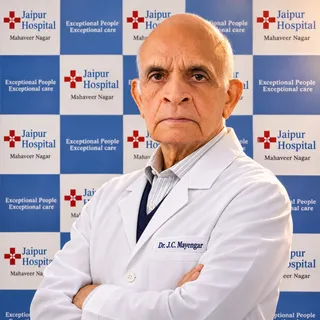
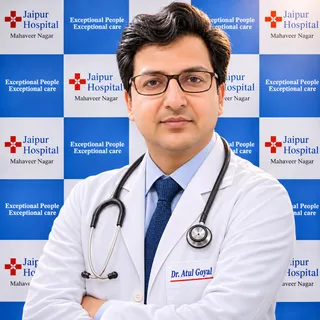
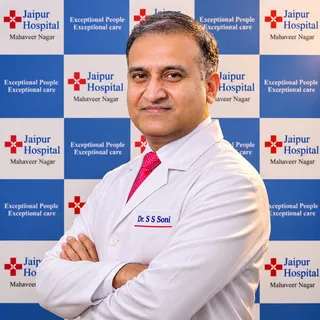
Your orthopaedics doctors
Explore our orthopaedic hospital in Jaipur: every treatment, the doctors and what to expect at your visit.

Frequently asked questions
Questions patients ask about revision knee replacement
What is revision knee replacement?
In short
Revision knee replacement is surgery to remove a worn-out or failed knee implant and put in a new one. At Jaipur Hospital our surgical team performs this operation when the original joint replacement loosens, wears out, becomes infected or breaks. The procedure usually takes two and a half to four hours under spinal or epidural anaesthesia.
In detail
A first knee replacement can last many years but implants may loosen, the plastic insert can wear down, or infection can develop around the prosthesis.
Revision surgery is more complex than the original operation because the surgeon must remove the old components, manage bone loss and rebuild the joint with modular revision implants that have stems, cones or augments.
If ligaments are deficient a constrained condylar knee (hinged implant) may be used. For deep infection a two-stage revision with an antibiotic spacer is often planned. Hospital stay is typically five to eight nights.
A common belief
Many people think a knee replacement lasts forever.
What actually happens
In reality implants can loosen, wear out or become infected years later. Revision surgery is more complex because the surgeon must remove old parts, rebuild bone and often use specialised modular implants or a hinged design for stability.
Your next step at Jaipur Hospital
After surgery you will use a walker or crutches with protected weight-bearing for about six weeks. Desk work can often resume in eight to twelve weeks. Full recovery continues for several months with guided physiotherapy. The typical cost range in India is ₹2,50,000 to ₹5,50,000.
Which specialist should I see for a failed or painful knee replacement?
In short
You should see an orthopaedic surgeon who specialises in revision knee replacement. At Jaipur Hospital the orthopaedics department includes surgeons trained in complex revision procedures using modular implants, constrained condylar knees and two-stage revision for infection. They manage bone loss, ligament deficiency and infected prostheses.
In detail
Revision knee surgery is more demanding than primary replacement. The surgeon must remove well-fixed components, reconstruct bone defects with stems, cones and augments, and address ligament instability with hinged implants if needed. For infection a two-stage exchange with an antibiotic spacer is often required.
These decisions need a surgeon experienced in revision techniques and perioperative infection management. The orthopaedic team at Jaipur Hospital works with anaesthesia, critical care, physiotherapy and the in-house laboratory to plan and execute the operation.
A general orthopaedic surgeon may refer you to a revision specialist if the case involves severe bone loss, recurrent infection or multiple previous revisions.
A common belief
Not every orthopaedic surgeon performs complex revisions.
What actually happens
Primary knee replacement is straightforward but revision requires removing fixed implants, rebuilding bone with stems and cones, and managing infection with spacer exchanges. A surgeon without revision experience may not have the implant systems or the surgical plan for severe bone loss or recurrent infection. Choosing a revision specialist reduces the risk of further failure.
Your next step at Jaipur Hospital
Call the orthopaedic OPD at Jaipur Hospital to schedule an appointment with a revision knee surgeon. Bring your previous operation notes, implant records and recent X-rays. The surgeon will examine you, order blood tests and imaging, and discuss the surgical plan.
What treatment options are available for my situation?
In short
Treatment depends on the cause. Options include irrigation and debridement with implant retention for early infection, one-stage exchange revision, two-stage revision with an antibiotic spacer for established infection, or revision with modular implants, cones, augments or a constrained condylar knee for loosening, wear or instability. Jaipur Hospital offers these surgical options.
In detail
For acute infection within weeks of onset, debridement and polyethylene exchange may retain the fixed components.
Chronic infection with mature biofilm usually needs a two-stage revision: the implant is removed, an antibiotic-loaded cement spacer is placed, intravenous antibiotics are given for several weeks, and a new implant is inserted after infection markers normalise.
One-stage exchange removes and replaces the implant in a single operation, selected for certain organisms and soft-tissue conditions. Aseptic loosening or instability is revised with modular components that rebuild bone loss and a hinged implant if ligaments are deficient.
A common belief
There is no single fix.
What actually happens
The choice depends on infection status, bone loss, ligament integrity and your overall health. Two-stage revision gives lower reinfection rates for chronic infection but takes longer.
Your next step at Jaipur Hospital
The surgeon explains the recommended approach, expected hospital stay of five to eight nights, protected weight-bearing for six weeks and return to desk work in eight to twelve weeks. Risks include infection, blood clots, nerve or vessel injury, stiffness and dislocation.
What can I safely do at home to manage symptoms before revision knee replacement?
In short
Before revision knee replacement at Jaipur Hospital, you can manage symptoms with prescribed pain relief, ice packs for swelling, gentle range-of-motion exercises within comfort, and using a walking aid to reduce load on the knee. Avoid activities that increase pain or instability.
In detail
Symptom control focuses on reducing inflammation and protecting the joint. Paracetamol or NSAIDs as advised by your doctor help pain and swelling. Ice applied for 15 to 20 minutes several times a day reduces effusion. Keep the knee elevated when sitting.
Gentle exercises like ankle pumps and heel slides maintain muscle tone without stressing the implant. A stick or walker offloads the joint and lowers fall risk. Do not massage a hot, swollen knee if infection is suspected.
Keep the skin clean and watch for wound changes, fever or increasing redness. These measures are temporary; they do not fix a loose or infected implant.
A common belief
Home care only eases symptoms.
What actually happens
It cannot tighten a loose implant or clear an infection. Some patients delay too long, hoping exercises will fix the problem. That usually leads to more bone loss and a harder operation.
Your next step at Jaipur Hospital
Track your symptoms daily: pain level, swelling, temperature and walking distance. Share this record with your surgeon at the next visit. If pain worsens suddenly, you develop fever or the knee gives way, seek medical attention promptly.
How do I know whether I am ready for joint replacement?
In short
You may be ready for joint replacement when knee pain, stiffness and swelling limit daily activities despite trying other treatments. At Jaipur Hospital, the orthopaedic team assesses your symptoms, imaging and overall health to decide if revision knee replacement is appropriate. The decision is based on how much the joint problem affects your quality of life.
In detail
Evidence shows that severe symptoms making it hard to move or use the knee are the main reason a healthcare provider recommends knee replacement. For revision surgery, the surgeon also evaluates why the previous implant failed — such as loosening, wear, instability or infection.
Your bone quality, ligament status, medical conditions and ability to undergo anaesthesia and rehabilitation are reviewed. Studies indicate that most people who have knee replacement experience reduced pain, improved mobility and better quality of life, and the implant usually lasts many years. The team explains the expected benefits and the recovery commitment so you can make an informed choice.
A common belief
Many people wait until they can barely walk, but earlier evaluation helps preserve bone and muscle, making recovery smoother.
What actually happens
The decision is not based on age alone — it is about how much the knee limits your life.
Your next step at Jaipur Hospital
If your knee symptoms are restricting work, sleep or independence, book a consultation at Jaipur Hospital. The surgeon will examine you, review your X-rays and any previous records, and discuss whether revision knee replacement fits your goals. You will receive a typical cost range and a clear recovery timeline.
How will treatment affect my walking, movement, or independence?
In short
After revision knee replacement at Jaipur Hospital, you will use a walker or crutches for protected weight-bearing for six weeks. Desk work usually resumes in eight to twelve weeks. Most people return to normal activities by three to six months, though full recovery can take longer depending on bone and soft-tissue healing.
In detail
Evidence shows most patients are encouraged to walk with a walker or crutches the same day or next day after revision surgery. The first one to two weeks are the most difficult and painful. Physical therapy typically begins around two weeks.
Recovery timelines vary from person to person. In studies, most people feel comfortable returning to work and normal activities at three to six months. Revision surgery involves more bone work and soft-tissue dissection than primary replacement, so regaining full strength and confidence takes time. The surgeon will give you a customised recovery plan.
A common belief
Revision surgery is bigger than the first replacement.
What actually happens
The first two weeks are the hardest, and muscle strength returns slowly. Pushing too early can compromise the fixation.
Your next step at Jaipur Hospital
Arrange for an attendant to help at home for the first two weeks. Follow the physiotherapy schedule and weight-bearing instructions closely. Your first post-operative review is at two weeks. To get a personalised recovery timeline, book a consultation at Jaipur Hospital by calling 0141-2551500 or 7414 001 001.
Which symptoms or changes should prompt me to seek medical advice?
In short
You should see a doctor if your replaced knee develops new or worsening pain, swelling, warmth, redness, a feeling of instability or giving way, reduced movement, or if you cannot put weight on the leg. Fever or chills with a painful knee also need urgent review. Jaipur Hospital evaluates these symptoms in the orthopaedic OPD.
In detail
Pain that does not settle, especially at rest or night, can mean the implant has loosened or an infection is present. Swelling and warmth suggest inflammation or infection. Instability or giving way may indicate ligament deficiency or component malposition.
A sinus or wound discharge strongly suggests deep infection. Early infections often show clear signs of inflammation, while delayed infections can present with subtle pain and early loosening caused by low-virulence organisms. In studies, periprosthetic joint infection is a devastating complication associated with substantial morbidity.
A common belief
People often think a painful knee replacement is just normal wear, but it can signal loosening, infection or ligament failure.
What actually happens
Early infections show obvious inflammation; delayed infections may only cause subtle pain and loosening. Ignoring these signs lets bone loss and infection worsen.
Your next step at Jaipur Hospital
Do not wait for symptoms to become severe. Contact Jaipur Hospital for an orthopaedic appointment. The surgeon will examine your knee, order blood tests such as CRP and ESR, and may arrange X-rays or a joint aspiration. Early diagnosis improves the chance of saving the joint.
What will the doctor ask and check at the first visit?
In short
The surgeon will ask about the onset and pattern of pain, swelling, fever, previous surgeries, implant details, any wound healing problems, and your general health including diabetes, rheumatoid arthritis and medications. Jaipur Hospital follows a structured assessment. The knee is examined for range of motion, stability, alignment, warmth, effusion and wound scars.
In detail
The history helps distinguish mechanical loosening from infection. Early infections show clear inflammatory signs; delayed infections present with subtle pain and loosening. The surgeon checks for risk factors such as diabetes, obesity, previous joint surgery and immunosuppression.
In studies, combined ESR above 30 mm/hr and CRP above 10 mg/L gives high sensitivity for infection but low specificity. The surgeon will also ask about recent dental, urinary or skin infections that could seed the joint through the bloodstream.
A common belief
Patients often expect just an X-ray, but the history and examination guide which tests are needed.
What actually happens
The surgeon looks for infection signs, mechanical loosening and risk factors like diabetes or previous surgery. Blood markers CRP and ESR are used together because neither alone is specific enough.
Your next step at Jaipur Hospital
Bring your old operation notes, implant stickers and any recent X-rays or blood reports. The surgeon will likely order fresh blood tests (CRP, ESR), knee X-rays and possibly a joint aspiration. Plan for a follow-up once results are available.
Can this problem improve without a procedure or operation?
In short
Mechanical loosening, wear, instability or fracture will not improve without surgery. Early infection caught within a few weeks may sometimes be controlled with debridement and antibiotics while keeping the implant, but this is still a surgical procedure. Chronic infection with mature biofilm requires implant removal. Jaipur Hospital assesses each case to see if non-operative management has any role.
In detail
In studies, early (immature) biofilm can be eradicated without removing the prosthesis only if symptoms persist less than 3 weeks (haematogenous) or infection manifests less than 4 weeks after surgery (perioperative). Beyond that, mature biofilm forms and the implant must be changed.
Antibiotics alone cannot penetrate mature biofilm effectively. Non-operative measures such as activity modification, walking aids and pain relief may ease symptoms temporarily but do not fix the underlying problem. Delaying needed revision can increase bone loss and make later surgery more difficult.
A common belief
Patients often try painkillers and physiotherapy hoping to avoid surgery, but these only mask symptoms.
What actually happens
Mature biofilm on the implant cannot be cleared by antibiotics alone. Waiting too long lets bone loss worsen, making revision harder. The surgeon will tell you if a short trial of non-operative care is reasonable.
Your next step at Jaipur Hospital
If you have a painful or unstable knee replacement, see the surgeon promptly. The team will tell you whether any non-surgical period is safe or whether surgery should be planned soon.
Are there foods, activities, or habits I should change before revision knee replacement?
In short
Before revision knee replacement at Jaipur Hospital, stop smoking, limit alcohol, and keep diabetes well controlled. Eat a balanced diet with adequate protein to support healing. Avoid high-impact activities, deep knee bends and heavy lifting. Your surgeon may ask you to stop certain supplements or blood-thinning medications before surgery. Fasting for 12 hours is required on the day of the operation.
In detail
Evidence identifies diabetes mellitus, obesity (BMI over 35), rheumatoid arthritis, ASA score above 2, male gender, alcohol abuse and urinary tract infection as factors associated with higher infection risk after joint arthroplasty. Smoking impairs wound healing and increases complication rates.
Glycaemic control, skin decontamination and decolonisation are enhanced preoperative prevention measures. A unit increase in BMI raises infection risk. Steroid use history is linked to higher periprosthetic joint infection rates.
Intra-articular steroid injections were not significantly associated with increased infection risk, but the surgeon will review all medications. Preoperative optimisation of nutrition, haemoglobin and medical conditions reduces postoperative complications.
A common belief
Many patients think only the surgery matters, but smoking, high sugar and excess weight directly raise infection and wound-healing risks.
What actually happens
Optimising these before surgery improves outcomes.
Your next step at Jaipur Hospital
In the weeks before surgery, focus on protein-rich meals, blood sugar control if diabetic, and smoking cessation. Stop herbal supplements and blood thinners only when the surgeon advises. Complete any dental work to avoid bacteraemia. Attend the pre-anaesthesia check and bring a list of all medicines.
FAQ library
Questions and answers about revision knee replacement
When you contact us
Get a clear plan and cost estimate
Contact Jaipur Hospital for an OPD consultation where your scans are reviewed, options explained and a cost estimate given before you decide.
- A consultation with an orthopaedic surgeon in the OPD
- Your scans and reports reviewed, with tests done in-house if you need them (laboratory, X-ray and imaging)
- Your options explained in plain words, including whether you need surgery at all
- A cost estimate before you decide
- Help with cashless treatment under MAA Yojana, various government health care schemes and empanelled insurers and TPAs
- Follow-up visits after your treatment
Read more
Read more about revision knee replacement
- When is knee replacement advised after non-surgical care
Doctors usually suggest knee replacement when pain and stiffness stop you from doing everyday tasks and other treatments no longer help.
- What affects knee replacement cost and insurance cover
Explains the factors that change knee replacement cost and how Ayushman Bharat and private insurance work for the surgery.
- Floor sitting, kneeling and prayer after knee replacement
What to expect for cross-legged sitting, kneeling for namaz or puja, and using an Indian toilet after knee replacement surgery.
- Walking aids, stairs and physio after knee replacement
Week-by-week guide to walker, stick, stairs and home exercises after knee replacement surgery. A patient guide from Jaipur Hospital, Jaipur.
- Normal pain versus warning signs after knee replacement
A day-by-day guide to post-op pain, swelling, wound changes and red-flag symptoms so you know when to call the hospital or go to the emergency department.
- Partial versus total knee replacement: how surgeons choose
Your doctor will explain which option fits your knee. A patient guide from Jaipur Hospital, Jaipur. Explained in plain words for patients and families.
Overview
Revision Knee Replacement: what to know
What revision knee replacement is and how it happens
- Purpose
- Replace a worn-out or failed implant
- Why it is needed
- Implant loosens, wears out, breaks or gets infected
- Complexity
- More complex than the first operation
- Duration
- Usually two and a half to four hours
Revision knee replacement is surgery to remove a worn-out or failed knee implant and put in a new one. A first knee replacement replaces damaged cartilage and bone with prosthetic implants made of metal and plastic. Over time the implant can loosen, wear out, break or become infected.
When that happens the knee may hurt, swell, feel unstable or become stiff. The surgeon then takes out the old parts, rebuilds any bone loss and fits a new revision implant.
Revision surgery is more complex than the first operation. It often takes longer because the old implant must be removed carefully, bone defects are common and the new components may need stems, cones or augments to achieve stability. The operation usually lasts between two and a half and four hours.
Spinal or epidural anaesthesia is typical; sometimes general anaesthesia is used. After surgery you are watched in a recovery area for a few hours until the anaesthesia wears off safely.
Symptoms of a failing knee replacement and warning signs that need urgent care
- Infection signs Warmth, redness, wound discharge or sinus
- Deep infection Fever and chills
- Fracture or dislocation Sudden inability to bear weight, popping or deformity after a fall
Common signs that a knee replacement may be failing include:
- Pain that does not settle
- Swelling
- Stiffness
- A feeling that the knee is giving way
Infection can cause warmth, redness, wound discharge or a sinus that leaks fluid. Fever and chills may appear with a deep infection. A sudden inability to bear weight, a popping sensation or visible deformity after a fall can mean a fracture around the implant or dislocation. If you notice any of these, contact your surgeon or go to the emergency department the same day.
After revision surgery you will feel pain, especially in the first few weeks of recovery. Your surgeon will suggest a combination of prescription pain medication, over-the-counter NSAIDs and paracetamol. Call your surgeon or healthcare provider right away if you develop increasing redness, worsening swelling, wound discharge, fever above 38°C, calf pain or shortness of breath.
Causes and who is at higher risk
- Implant loosening
- Occurs over years of use
- Plastic wear
- Insert wears down with time
- Component breakage
- Parts can break
- Obesity
- BMI 35+ raises risk by about 50%; BMI 40+ nearly four times
- Smoking
- Nearly doubles infection risk
A knee replacement can fail for several reasons. The implant may loosen over years of use, the plastic insert can wear down, or the components can break. Infection is a major cause. Around two thirds of periprosthetic joint infections come from bacteria introduced during the original operation.
Early infections show clear signs of inflammation and are usually caused by aggressive bacteria. Delayed infections present with subtle pain and early loosening and are caused by low-virulence organisms. Bacteria can also reach the joint through the bloodstream from skin, respiratory, urinary or gut infections. Direct spread from a nearby infection is another route.
Once bacteria stick to the implant they form a biofilm that protects them from antibiotics and the immune system. Mature biofilms take about four weeks to develop. The most common organisms are coagulase-negative staphylococci and Staphylococcus aureus.
Certain factors raise the risk of infection and failure. Male gender, older age, alcohol abuse, an ASA score above 2, use of a surgical drain, diabetes, urinary tract infection and rheumatoid arthritis have all been linked to higher infection rates after joint replacement.
Obesity increases risk: a BMI of 35 or more raises it by about 50 percent, and a BMI of 40 or more by nearly four times. Smoking nearly doubles the risk. Diabetes raises the risk of superficial wound infection about two and a half times. Previous joint surgery or a prior revision also increases the chance of infection.
How revision knee replacement is diagnosed: examination and tests
- Joint aspiration
- Fluid sent for cell count, culture and alpha defensin
- Alpha defensin test
- Result in about ten minutes; high specificity
- Sonication
- Improves culture sensitivity of removed implant
- Tissue cultures
- Three to five samples incubated up to 14 days
- X-ray
- Assesses loosening, bone loss and component position
If you have symptoms of a failed or infected knee replacement, you should see an orthopaedic surgeon who specialises in joint replacements. The surgeon will ask about your symptoms, examine the knee for swelling, warmth, range of movement and stability, and check any wound. Blood tests usually include C-reactive protein (CRP) and erythrocyte sedimentation rate (ESR).
CRP is inexpensive and rapid but not specific for infection because it also rises during healing after surgery. The combination of ESR above 30 mm per hour and CRP above 10 mg per litre has high sensitivity but low specificity.
Joint aspiration is often done to send fluid for cell count, culture and alpha defensin testing. A leukocyte count above 2,000 per microlitre with 70 percent granulocytes suggests infection. The alpha defensin lateral flow test gives a result in about ten minutes and has high specificity. Sonication of the removed implant improves culture sensitivity compared with standard tissue culture.
Three to five tissue samples are taken during surgery for culture, and cultures are incubated for up to 14 days to catch slow-growing organisms. Imaging such as X-ray helps assess loosening, bone loss and component position. No single test gives perfect accuracy, so the surgeon combines all findings.
Treatment options without surgery and when revision surgery is advised
Non-surgical management may be tried when the implant is stable and infection is not confirmed.
This can include:
- Activity modification
- Walking aids
- Physiotherapy to maintain strength and range of motion
- Pain relief with simple analgesics
If infection is suspected, antibiotics alone are rarely enough once a mature biofilm has formed. For acute infections caught very early (symptoms less than three weeks for blood-borne spread or less than four weeks after surgery), a washout with implant retention may be attempted.
Surgery is advised when the implant is loose, broken, causing persistent pain or instability, or when infection is confirmed and cannot be controlled without removing the implant.
Options include a one-stage exchange where the old implant is removed and a new one put in during the same operation, or a two-stage exchange with an antibiotic-loaded spacer placed first and the new implant inserted weeks later after the infection is cleared. Two-stage exchange gives a lower rate of recurrent infection.
In complex cases with severe bone loss, modular revision implants with stems, cones and augments are used, or a hinged constrained condylar knee for ligament deficiency. Salvage procedures such as joint fusion or amputation are considered only when other options are not possible. Total antibiotic treatment after revision surgery usually does not exceed twelve weeks.
Preparing for revision knee replacement
Before the operation your surgeon will review your medical history and the details of your previous knee replacement. Blood tests, a chest X-ray and an ECG are usually done to check your fitness for anaesthesia.
If you take blood-thinning medicines, diabetes tablets or insulin, or any supplements, tell your doctor so the doses can be adjusted or stopped for a few days. You will be asked to fast for about 12 hours before the surgery.
Bring:
- Your current medicines
- Any recent imaging reports
- Comfortable clothing for the hospital stay
An attendant can stay with you in the room.
How revision knee replacement is done
- Anaesthesia Spinal, epidural or general anaesthesia
- Remove old implants Take out old parts and any damaged bone or cement
- Choose new implants Based on findings during surgery
- Bone loss Use modular revision implants with stems, cones or augments
- Weak ligaments Use a constrained condylar knee that works like a hinge
- Infection Two-stage revision with antibiotic spacer first, then new implants later
The operation takes between two and a half and four hours under spinal or epidural anaesthesia; general anaesthesia is used sometimes. Your surgeon removes the old implants and any damaged bone or cement. The choice of new implants depends on what is found during surgery. Modular revision implants with stems, cones or augments are used when there is bone loss.
A constrained condylar knee, which works like a hinge, is chosen when the ligaments are too weak or damaged to hold a standard implant.
If infection is the cause, a two-stage revision is often planned: the first operation removes the infected parts and places an antibiotic-loaded spacer, and the second operation, after the infection has cleared, puts in the new implants. The surgeon will explain which approach suits your situation.
Risks and possible complications of revision knee replacement
- Infection
- Higher risk than after a first knee replacement
- Blood clots
- In leg veins or lungs; reduced with medication and early movement
- Nerve or blood vessel injury
- Uncommon but possible due to previous surgery
- Stiffness
- May need extra physiotherapy or manipulation under anaesthesia
- Hospital-acquired infections
- Pneumonia and others are possible
Complications after revision surgery can include:
- Infection
- Blood clots
- Dislocation or damage to the joint
- Nerves or blood vessels
- Joint stiffness
In studies, the risk of infection after a revision is higher than after a first knee replacement. Blood clots in the leg veins or lungs are a known risk, so blood-thinning medication and early movement are used to reduce it. Nerve or blood vessel injury is uncommon but can happen because the tissues have been operated on before.
Stiffness may need extra physiotherapy or, rarely, a manipulation under anaesthesia. Pneumonia and other hospital-acquired infections are also possible. Your surgical team will discuss the risks that apply to you.
Recovery and aftercare after revision knee replacement
- Hospital stay Five to eight nights
- Start walking Same day or next day with walker or crutches
- Most difficult period First one to two weeks
- Protected weight-bearing About six weeks
- Physiotherapy Begins within two weeks; continues for several months
- Desk work Eight to twelve weeks
You will usually stay in hospital for five to eight nights. Most patients start walking with a walker or crutches on the same day or the next day. The first one to two weeks are often the most difficult and painful; your doctor will prescribe pain medication to manage this. Protected weight-bearing is advised for about six weeks.
Physiotherapy usually begins within two weeks and continues for several months. Desk work can often be resumed in eight to twelve weeks, but full recovery may take up to a year. Your first follow-up appointment is typically two weeks after discharge to check the wound.
Call the hospital sooner if you develop increasing redness, swelling, wound discharge, fever, sudden severe pain, or calf swelling and shortness of breath.
Results of revision knee replacement
In studies, most people who have a knee replacement have reduced pain, better movement and improved quality of life for at least ten to fifteen years. Revision surgery aims to restore function when the first implant has failed, but the results can be less predictable than a first replacement.
Infection remains a major reason for further surgery; two-stage revision for infection gives a lower rate of recurrent infection than trying to keep the original implants. Mortality after two-stage revision for knee infection has been reported at around four percent at one year in large studies.
Your surgeon will discuss what outcome you can reasonably expect based on the reason for revision, your bone quality and your general health.
Cost and insurance for revision knee replacement in Jaipur
The typical price range for revision knee replacement in India is ₹2,50,000 to ₹5,50,000. The final cost depends on the type of revision implants needed, whether one or two stages are required, the length of hospital stay, and any additional treatments such as intensive care or infection management. Jaipur Hospital is a NABH-accredited multispeciality hospital.
It accepts MAA Yojana, various government health care schemes and a panel of private insurers and TPAs. The hospital has a 24×7 emergency department, ICU, in-house pharmacy, laboratory and X-ray, modular operation theatres and a canteen with dietary meals. For an estimate, contact the hospital on 0141-2551500, 0141-2554139 or 7414 001 001, or email [email protected].