
Orthopaedics · Jaipur Hospital
Total Knee Replacement in Jaipur
Knee pain limiting daily life? Get a clear assessment and surgical plan.
- Serving Jaipur since 1991 (35 years)
- NABH accredited
- 24×7 emergency & ICU
- Cashless: MAA Yojana + 32 insurers
- Operation time
- 1.5 to 2.5 hours
- Anaesthesia
- Spinal or epidural anaesthesia
- Recovery
- Walk with aid in 1 day, desk work in 4 to 6 weeks
- Price
- ₹1,80,000 to ₹3,50,000typical range in India; ask us for an estimate
Knee pain stops daily life
Severe knee arthritis makes walking, climbing stairs and sleeping difficult
Cartilage wears away, causing bone-on-bone pain, stiffness and swelling that do not improve with medicines or exercises.
-
Pain at rest and night
Aching knee pain that continues while sitting or lying down and disturbs sleep.
-
Stiffness limits movement
Unable to bend or straighten the knee fully; difficulty sitting on low chairs or using stairs.
-
Medicines no longer help
Painkillers and anti-inflammatory drugs give little relief or cause stomach problems.
-
Walking aids are not enough
A stick or walker is now needed for short distances inside the home.
Osteoarthritis causes joint dysfunction, pain, stiffness and loss of valued activities such as walking.
Why Jaipur Hospital
You worry that surgery means months off work and a long, painful recovery you cannot afford.
Your care plan
Your first steps with us
- 1 Call or visit OPD for surgeon consultation
- 2 Complete pre-operative tests and fitness review
- 3 Undergo surgery with spinal anaesthesia
- 4 Begin walking with aid the next day
How the operation is done
The surgeon removes damaged cartilage and bone, then fits a metal and plastic prosthesis. Spinal or epidural anaesthesia is used. Surgery typically takes 1.5 to 2.5 hours.
-
Cemented prosthesis
Fixed with bone cement; commonly chosen for older patients or weaker bone.
-
Uncemented prosthesis
Porous surface allows bone to grow into the implant; often used for younger, active patients.
Why patients trust us
- 1991 Serving Jaipur for 35 years
- NABH Accredited hospital
- 4 Orthopaedics consultants
- 24×7 Emergency, ICU and ambulance
- 33 Cashless schemes and insurers
What research shows about this treatment
-
10 to 15 years
Most people have improved knee function for at least 10 to 15 years after knee replacement.
-
Reduced pain and better mobility
Studies report most patients experience reduced pain, increased ability to move and improved quality of life.
-
Effective for advanced damage
Total joint replacement effectively relieves pain in persons with advanced symptoms and structural damage.
If it is left untreated
Without surgery, knee arthritis typically worsens, leading to increasing pain, loss of mobility and higher risk of falls. Reduced activity is linked to a 20 percent higher age-adjusted mortality.
Life after treatment
Most people walk with an aid within a day and return to desk work in 4 to 6 weeks. Full recovery continues for up to a year.
-
Walk with aid next day
Most patients stand and walk with a walker or crutches within 24 hours after surgery.
-
Desk work in 4 to 6 weeks
Office workers usually return to sedentary duties after 4 to 6 weeks of rehabilitation.
-
Daily activities with less pain
After recovery, most people manage normal daily tasks with much less knee pain.
-
Low-impact activities possible
Many patients resume cycling, swimming and walking for exercise after full healing.
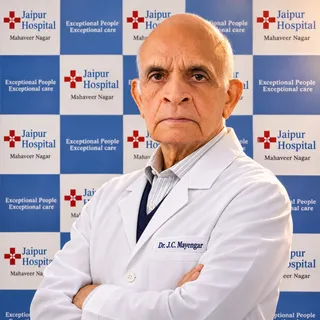
Meet the team
Your orthopaedics doctors
Explore our orthopaedic hospital in Jaipur: every treatment, the doctors and what to expect at your visit.



Frequently asked questions
Questions patients ask about total knee replacement
What is total knee replacement?
In short
Total knee replacement is an operation that replaces the worn surfaces of the knee joint with metal and plastic parts. At Jaipur Hospital, the surgical team performs this procedure for severe arthritis when the joint is badly damaged. The operation usually takes one and a half to two and a half hours under spinal or epidural anaesthesia.
In detail
The surgeon removes damaged cartilage and bone from the thighbone, shinbone and kneecap, then fits a prosthesis made of metal and plastic. Cemented implants are fixed with bone cement and are common for older patients.
Uncemented implants allow bone to grow into the surface and are often chosen for younger, active patients. The technique used depends on your age, bone quality and activity level, which the surgeon will discuss with you.
A common belief
Many people think the whole knee is removed.
What actually happens
In fact, only the damaged surfaces are replaced. The ligaments and muscles are kept, so the knee can move naturally after healing.
Your next step at Jaipur Hospital
Most people stay in hospital for three to five nights and start walking with an aid the next day. Desk work can often resume in four to six weeks. Full recovery takes several months with regular physiotherapy. The typical cost range in India is ₹1,80,000 to ₹3,50,000.
Which specialist should I see for total knee replacement?
In short
You should see an orthopaedic surgeon who specialises in joint replacement surgery. At Jaipur Hospital, the orthopaedics department handles total knee replacement from assessment through surgery and rehabilitation. The surgeon evaluates your symptoms, imaging and overall health to decide if the operation is suitable.
In detail
An orthopaedic surgeon has training in bone and joint conditions, including advanced techniques for knee arthroplasty. They work with anaesthetists, physiotherapists and nursing staff to manage the operation and recovery.
At the first visit, the surgeon checks your knee movement, stability and alignment, reviews X-rays and discusses implant options such as cemented or uncemented prostheses based on your age and bone quality.
A common belief
Some patients go to a general physician or a physiotherapist first.
What actually happens
They can guide you, but only an orthopaedic surgeon can perform the operation and decide on the implant type and surgical plan.
Your next step at Jaipur Hospital
If your general physician or physiotherapist has suggested a knee replacement, ask for a referral to an orthopaedic surgeon. Bring any previous X-rays, MRI reports and a list of medicines. The surgeon will explain the procedure, typical hospital stay of three to five nights and the recovery timeline.
What treatment options are available for severe knee arthritis?
In short
Treatment options range from non-surgical measures to total knee replacement. At Jaipur Hospital, the orthopaedic team follows guidelines that recommend exercise, weight management, education, walking aids, topical or oral NSAIDs and intra-articular steroid injections first. When these no longer control symptoms and X-rays show advanced damage, total knee replacement is discussed.
In detail
Evidence-based guidelines list biomechanical interventions, exercise, self-management, strength training and weight management as appropriate for all knee osteoarthritis patients. For specific sub-groups, paracetamol, duloxetine, oral and topical NSAIDs, capsaicin and cane use are appropriate. Steroid injections give short-term relief.
Treatments of uncertain benefit include glucosamine, hyaluronic acid injections, acupuncture and TENS. Opioids are not recommended. When symptoms are severe and structural damage advanced, total joint replacement effectively relieves pain and improves function. The surgeon may use a cemented or uncemented prosthesis depending on age and bone quality.
A common belief
Many people try supplements like glucosamine or alternative therapies.
What actually happens
Guidelines rate these as uncertain benefit. Opioids are discouraged. The surgeon will guide you through the proven steps before considering replacement.
Your next step at Jaipur Hospital
If non-surgical treatments have not helped, book a consultation at Jaipur Hospital to discuss whether total knee replacement is the next step. The surgeon will review your history, examination and imaging. Typical cost ranges from Rs 1,80,000 to Rs 3,50,000. See costs, insurance and contact details.
What can I safely do at home to manage total knee replacement symptoms?
In short
Before total knee replacement at Jaipur Hospital, you can manage symptoms at home with regular low-impact exercise, weight control if you are overweight, and simple pain relief. Walking on flat ground, cycling on a stationary bike, and water-based exercises keep the joint moving without overloading it. A walking stick or cane reduces the load on the painful knee.
In detail
Evidence-based guidelines recommend exercise (land-based and water-based), strength training, weight management and self-management education as appropriate for all individuals with knee osteoarthritis. Topical or oral NSAIDs can be used if you have no contraindications such as stomach ulcers or kidney disease.
Intra-articular steroid injections give short-term relief, usually a few weeks to a few months. Duloxetine has shown efficacy for some patients. Opioids should be avoided. Heat or cold packs applied for ten to twenty minutes can ease flare-ups.
Keep the leg elevated when sitting to reduce swelling. Do not sit for more than one hour at a time; get up and move gently. These measures do not reverse the damage but can make daily life more comfortable while you wait for surgery.
A common belief
People often try strong painkillers or rest completely.
What actually happens
Opioids are not recommended, and too much rest makes the muscles weaker and the joint stiffer. Movement is medicine, but it must be low-impact.
Your next step at Jaipur Hospital
Continue any prescribed medicines unless your surgeon tells you to stop. Tell the team at Jaipur Hospital about all supplements and over-the-counter drugs you take. The pre-operative check will include blood tests and an X-ray.
If you are planning surgery, the hospital will guide you on fasting for twelve hours before the operation and stopping certain blood thinners.
How does the term TKR relate to total knee replacement?
In short
TKR is the common medical abbreviation for total knee replacement. At Jaipur Hospital, doctors and nurses use TKR in case notes, operation lists and discharge summaries to mean the same procedure: replacing the worn-out surfaces of the thigh bone, shin bone and often the kneecap with metal and plastic components.
In detail
The term comes from the first letters of Total Knee Replacement. It is used interchangeably with TKA (total knee arthroplasty) in orthopaedic practice worldwide.
Both abbreviations describe the same surgery where damaged cartilage and bone are removed and prosthetic implants are fixed, either with cement or by allowing bone to grow into an uncemented surface.
The operation takes one and a half to two and a half hours under spinal or epidural anaesthesia. The typical hospital stay is three to five nights, and the price range in India is ₹1,80,000 to ₹3,50,000.
You will see TKR on consent forms, investigation requests and physiotherapy orders. Knowing the abbreviation helps you read your own records and communicate with the care team.
A common belief
Patients sometimes think TKR is a different or newer type of surgery.
What actually happens
It is not. TKR and TKA are only abbreviations. The surgery, implants, recovery and costs are the same whether the doctor writes TKR, TKA or total knee replacement.
Your next step at Jaipur Hospital
If you see TKR or TKA on any document, they refer to the same total knee replacement surgery. Ask your surgeon at Jaipur Hospital to explain any other abbreviations on your chart. The team will walk you through the consent, the implant choice and the recovery steps.
How do I know whether I am ready for joint replacement?
In short
You may be ready for total knee replacement when knee pain, stiffness, and swelling limit daily activities and do not improve with non-surgical treatments. At Jaipur Hospital, our surgical team assesses your symptoms, examination findings, and X-rays to decide if the procedure is appropriate for you.
In detail
Guidelines indicate that persons with advanced symptoms and structural damage are candidates for total joint replacement. The surgeon looks for persistent pain that interferes with walking, climbing stairs, or sleep, along with X-ray changes such as joint space narrowing and osteophytes.
Non-surgical options like exercise, weight management, NSAIDs, and steroid injections are usually tried first. If these no longer provide adequate relief and your quality of life is significantly affected, surgery becomes a reasonable next step. The decision also considers your general health, bone quality, and ability to participate in rehabilitation.
A common belief
Many people wait until they cannot walk at all.
What actually happens
Earlier surgery, while you still have muscle strength, often leads to a smoother recovery. The surgeon does not operate based on X-rays alone; your symptoms and how they affect your life matter most.
Your next step at Jaipur Hospital
Bring your recent X-rays and a list of treatments you have tried to the consultation. The surgeon will examine your knee, review the images, and discuss whether the expected benefits outweigh the risks for you.
How will treatment affect my walking, movement, or independence?
In short
Total knee replacement aims to relieve pain and restore mobility so you can walk and perform daily activities with less difficulty. At Jaipur Hospital, most patients walk with an aid on the first day after surgery and return to desk work in four to six weeks. Full recovery continues for up to a year.
In detail
Evidence shows that for persons with advanced arthritis, total joint replacement effectively relieves pain and improves function. After surgery, you will use a walker or crutches initially, then progress to a cane, and often walk without support within a few weeks.
Rehabilitation strengthens the muscles and restores range of motion. Most people regain the ability to do normal daily activities, and many return to hobbies such as cycling, golf, or dancing. High-impact activities like running, jumping, and contact sports are usually discouraged to protect the implant.
Your independence improves as pain decreases and movement returns, but the pace depends on your pre-operative condition, commitment to exercises, and home support.
A common belief
Some people expect instant normal walking.
What actually happens
The new joint needs muscle retraining. High-impact sports like running are usually not advised. Independence returns gradually as you do your exercises. The effort you put into rehab decides the speed.
Your next step at Jaipur Hospital
Prepare your home before admission: remove loose rugs, arrange a ground-floor sleeping area if possible, and organise an attendant for the first one to two weeks. Start pre-operative exercises as advised.
Which symptoms or changes should prompt me to seek medical advice for knee arthritis?
In short
You should see a doctor when knee pain, stiffness and swelling do not improve after trying other treatments. At Jaipur Hospital, the orthopaedic team evaluates these symptoms to decide if total knee replacement may help. Pain that limits walking, climbing stairs or getting up from a chair is a common reason people seek advice.
In detail
Osteoarthritis causes the cartilage to wear away, leading to bone rubbing on bone. This produces pain, stiffness after rest, swelling and a grinding sensation.
When these symptoms make daily activities difficult and non-surgical measures such as exercise, weight loss and medicines no longer give enough relief, joint replacement becomes an option. The surgeon will also check for deformity, instability and loss of movement.
A common belief
Some people wait until they cannot walk at all.
What actually happens
Earlier evaluation helps the surgeon plan better and may preserve more bone and muscle, which can make recovery smoother.
Your next step at Jaipur Hospital
If your knee pain wakes you at night, stops you from walking short distances or forces you to give up activities you enjoy, book an appointment. Bring any previous X-rays and a list of medicines you take. The surgeon will examine your knee, review imaging and discuss whether surgery is appropriate.
What will the doctor ask and check at the first visit for knee replacement?
In short
At the first visit, the orthopaedic surgeon will ask about your pain pattern, stiffness, swelling, walking distance and how the symptoms affect daily activities. At Jaipur Hospital, the surgeon also reviews your medical history, previous knee injuries, surgeries and current medicines. A physical examination checks knee movement, stability, alignment and leg length.
In detail
The surgeon will want to know which treatments you have already tried, such as exercises, weight loss, painkillers, walking aids or injections. They assess whether the knee is deformed, unstable or has a fixed flexion contracture.
X-rays are reviewed for joint space narrowing, bone spurs and bone quality. This information helps the surgeon decide if total knee replacement is appropriate and which implant type, cemented or uncemented, may suit you.
A common belief
Patients often expect the surgeon to book surgery immediately.
What actually happens
In reality, the first visit is a detailed assessment to confirm that non-surgical options have been exhausted and that you are fit for the operation.
Your next step at Jaipur Hospital
Bring any previous X-rays, scan reports and a list of all medicines and supplements. The surgeon will explain the operation, typical hospital stay of three to five nights, and the recovery timeline including physiotherapy. You can ask about implant choices, anaesthesia and expected outcomes.
Can severe knee arthritis improve without a procedure or operation?
In short
Non-surgical treatments can reduce pain and improve function for a time, but they do not reverse the structural damage of advanced osteoarthritis. At Jaipur Hospital, the orthopaedic team uses exercise, weight management, walking aids and medicines first. When these no longer help and joint damage is severe, total knee replacement is the option that reliably relieves pain.
In detail
Guidelines recommend biomechanical interventions, exercise, education, weight management and medicines as appropriate for all patients. Steroid injections give short-term relief. These measures can delay surgery and improve symptoms, but they do not regrow cartilage or correct bone deformity.
In studies, total joint replacement effectively relieves pain for advanced disease. Most people who have a knee replacement have reduced pain, increased mobility and improved quality of life. The artificial joint allows normal daily activities with less or no pain.
A common belief
Some people hope supplements or alternative therapies will rebuild cartilage.
What actually happens
Evidence does not support that. Non-surgical care helps manage symptoms, but only joint replacement replaces the damaged surfaces.
Your next step at Jaipur Hospital
If you have tried non-surgical measures and still have limiting knee pain, book a consultation at Jaipur Hospital. The surgeon will assess whether further non-surgical care may help or whether total knee replacement should be considered. Typical cost ranges from Rs 1,80,000 to Rs 3,50,000. See costs, insurance and contact details.
FAQ library
Questions and answers about total knee replacement
When you contact us
Get your surgical plan and cost estimate
Contact Jaipur Hospital for an OPD consultation with an orthopaedic surgeon who will review your scans and explain your options.
- A consultation with an orthopaedic surgeon in the OPD
- Your scans and reports reviewed, with tests done in-house if you need them (laboratory, X-ray and imaging)
- Your options explained in plain words, including whether you need surgery at all
- A cost estimate before you decide
- Help with cashless treatment under MAA Yojana, various government health care schemes and empanelled insurers and TPAs
- Follow-up visits after your treatment
Read more
Read more about total knee replacement
- When is knee replacement advised after non-surgical care
Doctors usually suggest knee replacement when pain and stiffness stop you from doing everyday tasks and other treatments no longer help.
- What affects knee replacement cost and insurance cover
Explains the factors that change knee replacement cost and how Ayushman Bharat and private insurance work for the surgery.
- Floor sitting, kneeling and prayer after knee replacement
What to expect for cross-legged sitting, kneeling for namaz or puja, and using an Indian toilet after knee replacement surgery.
- Walking aids, stairs and physio after knee replacement
Week-by-week guide to walker, stick, stairs and home exercises after knee replacement surgery. A patient guide from Jaipur Hospital, Jaipur.
- Normal pain versus warning signs after knee replacement
A day-by-day guide to post-op pain, swelling, wound changes and red-flag symptoms so you know when to call the hospital or go to the emergency department.
- Partial versus total knee replacement: how surgeons choose
Your doctor will explain which option fits your knee. A patient guide from Jaipur Hospital, Jaipur. Explained in plain words for patients and families.
Overview
Total Knee Replacement: what to know
What total knee replacement is and how knee arthritis develops
- Metal parts
- Thigh and shin components
- Plastic spacer
- High-grade plastic between metal parts
- Fixation
- Cemented or press-fit method
Total knee replacement is surgery to replace the worn surfaces of the knee joint with an artificial joint made of metal and plastic.
The surgeon removes the damaged cartilage and bone from the thighbone, shinbone and sometimes the kneecap, then fits the new parts so the joint can move smoothly again.:
- Thighbone
- Shinbone
- Kneecap
Osteoarthritis is the most common reason people need this operation. It is a condition where the cartilage that cushions the ends of the bones breaks down over time. The changes also affect the bone, the joint lining, ligaments, muscles and fat around the knee, leading to pain, stiffness and loss of function.
The knee is a hinge joint that carries much of your body weight. When the smooth cartilage wears away, the bones rub against each other. This causes pain, swelling and a feeling that the knee may give way. Everyday activities such as walking, climbing stairs or getting up from a chair become difficult.
In some cases, arthritis develops after a fracture or serious ligament injury to the knee. This is called post-traumatic arthritis and can appear years after the original injury.
The artificial joint used in total knee replacement has metal components for the thigh and shin bones and a high-grade plastic spacer between them. The parts are fixed to the bone either with bone cement or by a press-fit method that lets bone grow into the implant surface. Your surgeon will advise which type suits your age, bone quality and activity level.
Symptoms of knee arthritis and warning signs that need same-day care
- Sudden severe pain Cannot bear weight on the leg
- Hot, very swollen knee Red streaks spreading from the knee
- Fever with knee pain Calf painful, swollen and discoloured
- Chest pain or shortness of breath Cough up blood or faint
The main symptoms are knee pain, stiffness and swelling that do not improve with rest, medicines, physiotherapy or walking aids. Pain is often worse after activity or at the end of the day. Stiffness may be most noticeable in the morning or after sitting for a while. You may hear or feel grinding when you move the knee.
As the condition advances, the knee may become bowed or knock-kneed. You might find it hard to straighten the leg fully or to bend it enough to sit cross-legged or use an Indian-style toilet. Walking distance shortens and you may need a stick or walker.
Warning signs that need medical attention on the same day include:
- Sudden severe pain with inability to bear weight
- A hot and very swollen knee
- Red streaks spreading from the knee
- Fever with knee pain
- A calf that becomes painful, swollen and discoloured
These can suggest infection or a blood clot in the leg (deep vein thrombosis).
If you have chest pain, sudden shortness of breath, cough up blood, or faint, call for emergency help immediately. These can be signs of a clot that has travelled to the lungs.
After surgery, contact your surgeon at once if the wound opens or bleeds more, pain does not settle with prescribed medicines, you have no bowel movement after a laxative, or you notice signs of infection such as increasing redness, warmth, pus or fever.
Causes of knee arthritis and who is at higher risk
- Age
- Strongest risk factor
- Excess weight
- Increases load and inflammation
- Previous knee injury
- Fracture, ligament tear or meniscus damage
- Family history
- Parents or siblings with knee replacements
Osteoarthritis develops from a combination of mechanical stress and biological changes in the joint. The cartilage loses its ability to repair itself, and the bone underneath reacts by growing thicker and forming bony spurs called osteophytes.
Age is the strongest risk factor. About one in three people over 75 have symptomatic knee osteoarthritis with X-ray changes. Women are affected more often than men.
Excess body weight increases the load on the knee joint and also promotes low-grade inflammation that damages cartilage. A major knee injury — such as a fracture into the joint, a ligament tear or meniscus damage — raises the risk of arthritis years later.
Genetics plays a part; if your parents or siblings had knee replacements, your chance is higher. Certain occupations that involve repeated kneeling, squatting or heavy lifting also contribute.
People with osteoarthritis often have other health conditions such as diabetes, high blood pressure or heart disease, and tend to be less active overall. Reduced physical activity is linked to a 20 percent higher age-adjusted mortality rate.
How knee arthritis is diagnosed: examination and tests
- History and examination Pain pattern, stiffness, walking distance, range of movement
- Standing X-rays Show joint space narrowing, osteophytes, sclerosis, cysts
- Blood tests if needed Rule out inflammatory arthritis
- MRI or CT rarely Done at imaging centre outside hospital
Your doctor will ask about your pain pattern, stiffness, swelling, walking distance and how the symptoms affect daily life. The examination includes checking for bony enlargement, tenderness, range of movement, stability of the ligaments and how you walk. Pain on internal rotation of the hip can sometimes point to hip arthritis instead of knee arthritis.
X-rays of the knee taken while you are standing are the main test. They show joint space narrowing, osteophytes, bone hardening (sclerosis) and cysts — the classic radiographic signs of osteoarthritis.
Blood tests are not needed to diagnose osteoarthritis but may be ordered to rule out inflammatory arthritis such as rheumatoid arthritis or gout if the picture is unclear.
MRI or CT scans are rarely required for typical osteoarthritis. They may be used if the diagnosis is uncertain or if the surgeon needs more detail for surgical planning. These scans are done at an imaging centre outside the hospital and the reports are reviewed by your surgeon.
The decision for surgery is based on your symptoms, examination findings and X-ray changes together — not on X-rays alone.
Non-surgical treatment options for knee arthritis and when surgery is advised
Guidelines recommend trying non-surgical measures first.
These include:
- Regular exercise — both land-based and water-based
- Strength training
- Weight management if you are overweight
- Education about joint protection
A walking stick or cane can offload the painful side.
Topical NSAID gels or creams are often the first medicine tried. Oral NSAIDs (including COX-2 selective types) are used when topical treatment is not enough, provided you have no stomach, kidney or heart contraindications. Paracetamol, duloxetine and capsaicin cream are options for certain patient profiles.
Intra-articular steroid injections can give short-term pain relief, usually for a few weeks to a few months. They are not a long-term solution and repeated injections are limited.
Treatments such as glucosamine, chondroitin, hyaluronic acid injections, acupuncture, TENS and ultrasound have uncertain benefit and are not routinely recommended. Opioids should be avoided for osteoarthritis.
Surgery is advised when you have advanced structural damage on X-ray and severe symptoms that limit daily life despite a reasonable trial of non-surgical treatments. The decision is shared between you and your surgeon after discussing the expected benefits, risks and the recovery commitment.
In studies, total joint replacement effectively relieves pain and improves function for people with advanced disease. Most people have reduced pain, better mobility and improved quality of life after recovery. The artificial knee typically lasts 10 to 15 years or more.
Preparing for total knee replacement
Do
- List all medicines and supplements
- Stop blood thinners if told
- Bring medicines in original packets
- Bring loose clothing and non-slip footwear
Your surgeon will ask about every medicine and supplement you take. Some medicines, especially blood thinners, may need to be stopped before the operation. You will be told when to stop eating and drinking, usually 12 hours before surgery. Routine blood tests, an ECG and a chest X‑ray are done to check you are fit for anaesthesia.
Bring your regular medicines in their original packets, comfortable loose clothing, non‑slip footwear and any walking aid you already use. An attendant should plan to stay with you during the hospital stay.
How total knee replacement is done
The operation is performed under spinal or epidural anaesthesia and usually takes 1.5 to 2.5 hours. Your surgeon removes the worn ends of the thigh bone and shin bone and replaces them with metal and plastic components.
Two main fixation methods are available: a cemented prosthesis fixed with bone cement, often chosen for older patients, and an uncemented prosthesis designed for bone to grow into the implant, often considered for younger, active patients. Your surgeon will advise which option suits your age, bone quality and activity level.
On the day of surgery you are taken to the modular operation theatre, the anaesthetic is given, and after the procedure you spend a few hours in the recovery room where the team monitors you as you wake up.
Risks and possible complications of total knee replacement
- Infection
- Increased pain, swelling, warmth, redness, pus or fever
- Blood clot in the leg
- Calf, knee, thigh or groin pain, swelling or colour change
- Wound problems
- Wound may open or bleed more than expected
- Pain after surgery
- Especially in the first few weeks
Like all surgeries, knee replacement carries a small risk of complications.
Infection can appear as:
- Increased pain
- Swelling
- Warmth
- Redness
- Red streaks from the wound
- Pus
- Fever
A blood clot in the leg (deep vein thrombosis) may cause calf, knee, thigh or groin pain, swelling or a colour change. The wound may open or bleed more than expected. Pain that does not improve with medicine, inability to pass a bowel movement after a laxative, or sudden chest pain and shortness of breath need urgent attention.
You will feel pain from the surgery itself, especially in the first few weeks. Your surgeon will prescribe a combination of prescription pain medicine, NSAIDs if safe for you, and paracetamol, with clear daily limits.
Recovery and aftercare after total knee replacement
Most people walk with a frame or crutches within one day and stay in hospital for 3 to 5 nights.
You will go home with a bandage and:
- Stitches
- Staples
- Glue
- Tape strips
Stitches or staples are usually removed about two weeks later; glue or tape falls off on its own. Keep the wound clean: wash daily with warm water, pat dry, and change the bandage each day. You may shower after 24 to 48 hours but avoid baths and swimming for two weeks.
Ice the knee for 10 to 20 minutes every 1 to 2 hours for the first three days, keeping the leg raised above heart level. Wear compression stockings if advised to help prevent clots. A blood‑thinning medicine, as a tablet or injection, is often prescribed; follow the safety instructions carefully.
Take pain medicine 30 minutes before exercises to make movement easier. Physiotherapy starts in hospital and continues for months at home or in a clinic to rebuild strength and range of motion. You will likely use a walker, then a cane, and may walk without support after a couple of weeks when comfortable.
Desk work is usually possible in 4 to 6 weeks; heavier jobs may need 4 to 16 weeks off. Do not sit for more than one hour at a time; get up and walk briefly. Prop the leg up when sitting for long periods to reduce swelling. Ask your doctor when you can drive again; it may be several weeks.
Carry a medical alert card about your artificial joint for airport security. Attend all follow‑up appointments and call the hospital if you develop signs of infection, a clot, worsening pain, wound problems or any other concern.
Results of total knee replacement
- Encouraged activities
- Walking, cycling on flat roads, golf with a cart, dancing, hiking
- Discouraged activities
- Jogging, jumping, tennis, contact sports
- Implant lifespan
- Improved function for at least 10 to 15 years
In studies, total joint replacement effectively relieves pain for people with advanced arthritis and structural damage. Most patients have reduced pain, better movement and an improved quality of life.
Many return to activities they had given up, such as:
- Walking
- Cycling on flat roads
- Golf with a cart
- Dancing
- Hiking
High‑impact sports like jogging, jumping, tennis and contact sports are usually discouraged to protect the implant. Knee replacements last a long time; almost everyone has improved knee function for at least 10 to 15 years. The knee continues to improve for up to a year after surgery.
Cost and insurance for total knee replacement in Jaipur
The typical price range in India is ₹1,80,000 to ₹3,50,000. The final cost depends on the type of implant (cemented or uncemented), the length of stay, any additional tests or medicines, and whether you have a single or double knee replacement. Jaipur Hospital is a NABH‑accredited multispeciality hospital established in 1991.
It accepts MAA Yojana, various government health care schemes and a panel of private insurers and TPAs. The hospital has a 24×7 emergency department, ICU, in‑house pharmacy and laboratory, X‑ray and ECG, modular operation theatres and a canteen with dietary meals. For an estimate, contact the hospital on 0141-2551500, 0141-2554139 or 7414 001 001, or email [email protected].