

Plastic Surgery · Jaipur Hospital
Aesthetic Facial Surgery in Jaipur
You want a natural change; we give clear assessment and a safe surgical plan.
- Serving Jaipur since 1991 (35 years)
- NABH accredited
- 24×7 emergency & ICU
- Cashless: RGHS, MAA Yojana, CGHS + 22 insurers
- Operation time
- 1 to 4 hours
- Anaesthesia
- General or Local with sedation
- Recovery
- Social downtime 1 to 2 weeksfinal result 3 to 6 months
- Price
- ₹70,000 to ₹3,50,000typical range in India; ask us for an estimate
Face does not match how you feel
You see changes in the mirror that bother you
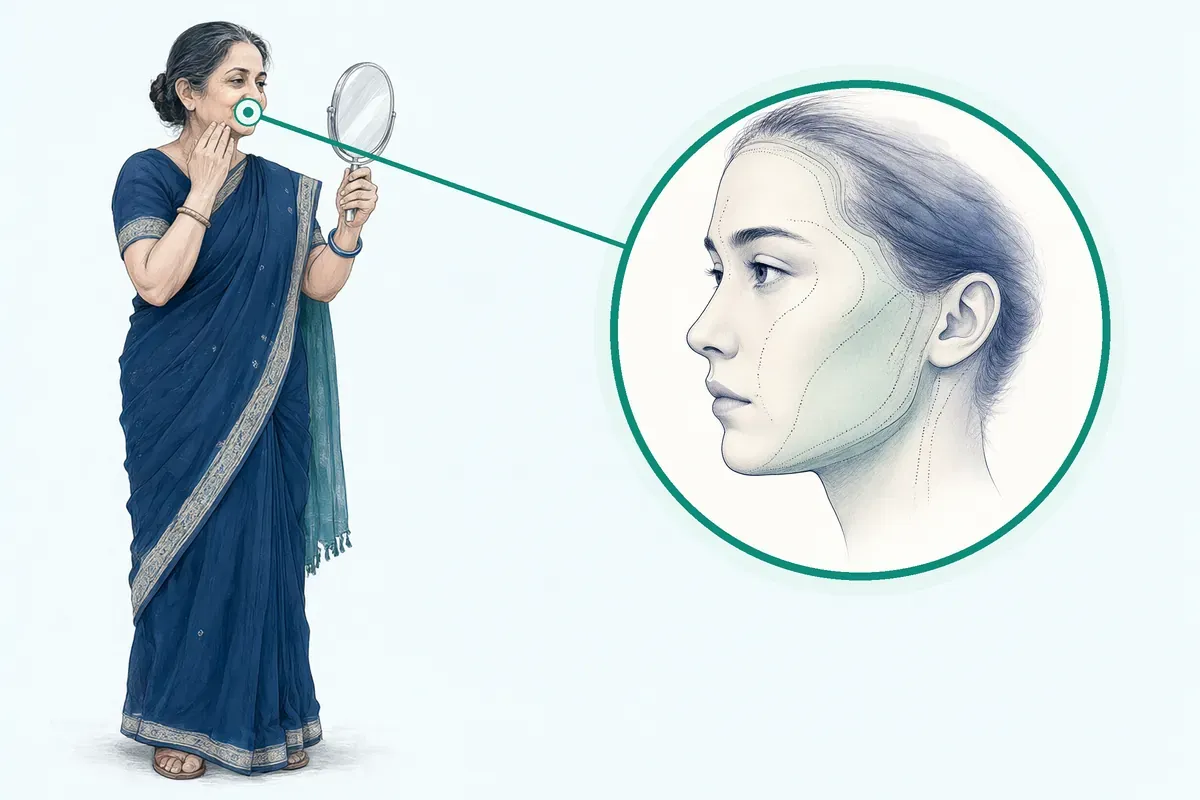
Ageing or inherited features can make the nose, eyelids, jawline or neck look tired, heavy or out of balance. You may feel self-conscious in photos or avoid social events.
-
Nose shape or breathing
A crooked, large or blocked nose affects appearance and airflow.
-
Heavy or hooded eyelids
Excess skin or fat makes eyes look tired and can limit vision.
-
Sagging jawline and neck
Jowls and loose skin blur the jaw and neck contour.
-
Weak chin or prominent ears
A small chin or protruding ears upset facial balance.
Facial bone resorption at the pyriform aperture, maxilla and prejowl mandible reduces structural support and deepens folds with age.
Why Jaipur Hospital
You worry about looking operated on, taking weeks off work, or the final cost running higher than quoted.
Your care plan
Your first steps with us
- 1 Call or visit OPD for a surgeon consultation
- 2 Complete in-house scans and medical fitness checks
- 3 Undergo surgery as daycare or one-night stay
- 4 Attend scheduled follow-ups for suture removal and healing review
How the operation is done
Surgery lasts 1 to 4 hours under general or local anaesthesia with sedation. Incisions are placed in natural creases or inside the nose. You go home the same day or stay one night.
-
Rhinoplasty (Open / Closed)
Reshapes nasal bone and cartilage; can combine functional septal correction for breathing.
-
Blepharoplasty (Upper / Lower)
Removes or repositions excess skin and fat from upper or lower eyelids.
-
Rhytidectomy (Facelift / Neck lift)
Tightens the deeper SMAS layer to correct jowls and neck laxity.
-
Otoplasty / Genioplasty
Pins back prominent ears or augments and reduces the chin with an implant or bone cut.
Why patients trust us
- 1991 Serving Jaipur for 35 years
- NABH Accredited hospital
- 1 Plastic Surgery consultants
- 24×7 Emergency, ICU and ambulance
- 25 Cashless schemes and insurers
What research shows about these procedures
-
1 to 2 weeks social downtime
Most patients return to routine activities within two weeks after facial aesthetic surgery.
-
About 15% revision rate
Roughly 15 in 100 rhinoplasty patients undergo a secondary procedure for minor refinements.
-
Lower lid complications possible
Lower blepharoplasty carries a risk of lid malposition; upper blepharoplasty complications are uncommon with current techniques.
If it is left untreated
Without surgery, structural bone loss and soft-tissue descent continue gradually; eyelid hooding may worsen visual fields, and nasal obstruction can persist, affecting daily comfort.
Life after treatment
Most people see a refreshed, balanced look once swelling settles over months; scars fade in natural creases.
-
Natural-looking contour
Nose, eyes, jaw and neck appear harmonious with the rest of the face.
-
Easier breathing
Functional nasal correction often improves airflow during activity and sleep.
-
Brighter eye appearance
Upper lid skin removal reduces heaviness; lower lid work softens bags and shadows.
-
Confidence in photos
Patients usually feel comfortable in social settings once final healing completes.
Frequently asked questions
Questions patients ask about aesthetic facial surgery
Which problems are assessed under aesthetic facial surgery?
In short
Aesthetic facial surgery at Jaipur Hospital assesses concerns of the nose, eyelids, face and neck. Typical problems include a crooked or large nose, breathing difficulty from a deviated septum, hooded upper eyelids, under-eye bags, jowls, loose neck skin, prominent ears or a weak chin. Your surgeon evaluates both appearance and function during the consultation.
In detail
The assessment covers structural and soft-tissue changes. For the nose, rhinoplasty (open or closed) addresses shape and nasal obstruction, often combined with septoplasty for the septum.
Blepharoplasty (upper or lower) removes excess skin and fat that cause hooding or bags; evidence notes that brow ptosis can worsen upper-lid appearance and may need simultaneous correction. A facelift or neck lift (rhytidectomy) uses SMAS plication to reposition sagging jowls and neck laxity.
Otoplasty pins back prominent ears, while genioplasty augments or reduces the chin.
Studies show facial skeletal resorption in the midface, pyriform aperture and prejowl mandible contributes to ageing stigmata such as deep nasolabial folds and jowls; your surgeon will analyse these areas to plan the appropriate procedure.
A common belief
Many people think only wrinkles are treated, but the assessment also checks nasal airflow, eyelid vision obstruction and skeletal support loss that drives ageing changes.
What actually happens
Ignoring these can lead to incomplete results.
Your next step at Jaipur Hospital
You will attend an OPD consultation where your surgeon examines your face, takes photographs and discusses your goals. Basic investigations such as blood tests and an ECG are arranged if surgery is planned. The typical price range is ₹70,000 to ₹3,50,000 depending on the procedures combined.
How will the doctor decide which tests I need for aesthetic facial surgery?
In short
At Jaipur Hospital, your surgeon orders tests based on the planned procedure, your age and medical history. For most healthy adults, routine pre-operative tests include a complete blood count, basic metabolic panel, coagulation profile, ECG and chest X-ray. Additional tests such as nasal endoscopy, visual field testing or CT scan are requested only when functional issues like nasal obstruction or eyelid-related vision loss are suspected.
In detail
The decision follows a focused clinical assessment. During consultation, the surgeon examines the nose for septal deviation or valve collapse; if breathing difficulty is reported, nasal endoscopy or CT may be needed.
For upper blepharoplasty, visual field testing documents peripheral vision loss from hooded skin, which supports medical necessity. Evidence lists diagnostic costs for complete eye exam, visual field testing, Schirmer's test and eyelid photography. Blood tests screen for anaemia, bleeding risk and infection.
ECG and chest X-ray assess cardiac and pulmonary fitness for anaesthesia. The anaesthesia team reviews all results before clearing you for general or local with sedation. No genetic or advanced imaging is routine unless a specific syndrome or trauma is suspected.
A common belief
Patients often expect a long list of scans.
What actually happens
In reality, tests are targeted: a CT scan is not routine for cosmetic rhinoplasty, and visual field testing is only for functional eyelid complaints. This avoids unnecessary cost and radiation.
Your next step at Jaipur Hospital
Tests are usually done at the in-house laboratory and radiology department on the same day or before admission. Results are reviewed at a pre-anaesthesia check-up. The typical price range for surgery is ₹70,000 to ₹3,50,000; test costs are separate.
How soon should I expect improvement after the chosen aesthetic facial surgery treatment?
In short
After aesthetic facial surgery at Jaipur Hospital, initial improvement is visible once dressings and splints are removed, usually within one week. Social downtime is typically one to two weeks. Swelling and bruising subside over four to six weeks. Final results take three to six months as tissues settle and scars mature. Rhinoplasty tip refinement may continue up to a year.
In detail
Recovery follows a predictable sequence. Evidence describes rhinoplasty swelling stages: immediate post-operative oedema peaks at 48 hours, then gradually declines. By three months, most swelling resolves; subtle tip changes continue to one year. Blepharoplasty bruising lasts 10–14 days; incision lines fade over months.
Facelift bruising and tightness improve over two to three weeks; SMAS healing continues deeper. Asymmetrical swelling — one side more than the other — is normal in early weeks and not a complication. Numbness, tightness and temporary asymmetry are common.
The surgeon reviews you at one week, one month, three months and six months. Return to desk work is usually possible at 10–14 days; heavy lifting and contact sports are avoided for four to six weeks.
A common belief
Patients expect instant results.
What actually happens
Swelling hides the outcome. Asymmetric swelling — one eye or one side of the nose more puffy — scares people but is normal healing. Bruising tracks down the neck after facelift. Numbness lasts months. The face heals in layers: skin first, deep SMAS and bone last. Patience is part of the result.
Your next step at Jaipur Hospital
Plan for one to two weeks off social or work commitments. Keep head elevated, use cold compresses as advised, and attend all follow-ups. Final photographs are taken at six months.
Are my expectations realistic for my anatomy and health regarding aesthetic facial surgery?
In short
Realistic expectations depend on your facial bone structure, skin quality, age and general health. At Jaipur Hospital, the surgeon evaluates these factors during consultation and explains what surgery can and cannot achieve. Evidence shows that skeletal support influences how much change is possible and that results vary between individuals.
In detail
Studies describe how facial bones change with age: the maxilla resorbs, the orbital aperture enlarges and the mandible alters shape. These skeletal changes affect soft-tissue support and limit what lifting or reshaping alone can correct.
Patients with strong skeletal contours tend to show more pronounced improvement. Those with weaker support may need combined approaches. The surgeon assesses your anatomy, reviews medical history and discusses whether your goals align with what is surgically achievable. Computer imaging is a guide, not a promise.
Your next step at Jaipur Hospital
Bring reference photos to your consultation, but understand they illustrate direction, not exact outcome. The surgeon will explain limitations specific to your anatomy.
How can I decide whether to seek advice about rhinoplasty?
In short
Consider seeking advice about rhinoplasty if you are self-conscious about the shape or size of your nose, have breathing difficulty due to a deviated septum, or have had nasal trauma. At Jaipur Hospital, the surgical team evaluates both aesthetic and functional concerns during a consultation.
In detail
Evidence indicates that rhinoplasty is one of the most common cosmetic surgeries, with over 350,000 procedures performed annually in the United States. It can address a dorsal hump, wide or bulbous tip, asymmetry, or a deviated septum that obstructs breathing.
Septoplasty can be combined with rhinoplasty to improve both appearance and function. Good candidates are physically healthy, have realistic expectations, and understand that final results take up to a year.
The surgeon will examine your nose, take photographs, discuss options (open or closed technique), and explain risks such as infection, bleeding, or need for revision. About 15 percent of patients request a follow-up procedure for minor refinements.
If nasal obstruction affects your quality of life, or if the appearance of your nose affects your confidence, a consultation is appropriate.
- About 15 percent of patients request a follow-up procedure for minor refinements.
A common belief
Some people think rhinoplasty is only cosmetic.
What actually happens
It also corrects functional problems like a blocked airway. You do not need to be sure you want surgery — the consultation is for information. The surgeon will explain what is possible and what the recovery involves.
Your next step at Jaipur Hospital
Write down your concerns — breathing, shape, past injury — and bring them to the appointment. The surgeon will assess your nasal structure and advise whether surgery is suitable.
How will appearance, function, and realistic expectations be discussed?
In short
At Jaipur Hospital, your surgeon will discuss appearance, function, and realistic expectations during a detailed consultation that includes facial analysis, photographs, and a review of your medical history.
In detail
The consultation follows a structured process. Your surgeon examines and measures your face, takes standardised photographs, and listens to your concerns about both looks and any functional issues such as breathing difficulty or vision obstruction.
Evidence shows that combining aesthetic and functional goals — for example, septoplasty with rhinoplasty or blepharoplasty with brow lift — often gives the most harmonious result.
The surgeon explains what surgery can achieve, what it cannot, and the typical recovery timeline of one to two weeks for social activities and three to six months for final results. Risks such as asymmetry, swelling, or rare complications like lid malposition are discussed openly.
You are encouraged to ask questions and bring reference photos. The aim is a shared understanding of achievable outcomes before any decision is made.
A common belief
Patients often expect a perfect or instant result.
What actually happens
Evidence shows final results take three to six months, and some asymmetry or swelling is normal during healing. The surgeon discusses these realities upfront so you have a clear, honest picture before deciding.
Your next step at Jaipur Hospital
To start this discussion, book a consultation at Jaipur Hospital. The surgeon will evaluate your facial anatomy, review functional concerns, and outline a personalised plan with a cost estimate within the typical Indian range of ₹70,000 to ₹3,50,000.
Which symptoms should prompt me to see a specialist for aesthetic facial surgery?
In short
You should see a specialist at Jaipur Hospital if you notice a crooked or disproportionate nose, difficulty breathing through the nose, heavy upper eyelids that impair vision, persistent under-eye bags, sagging jowls or neck skin, prominent ears, or a receding chin that bothers you. These signs indicate structural or soft-tissue changes that surgical assessment can address.
In detail
Symptoms reflect underlying anatomy. Nasal obstruction often accompanies a deviated septum or valve collapse, which rhinoplasty and septoplasty can correct together.
Upper eyelid hooding may be worsened by brow ptosis; evidence shows blepharoplasty alone can pull the brow down further if brow position is not evaluated. Lower lid bags and a hollow tear trough relate to fat herniation and midface bone loss.
Jowls and neck laxity develop when the SMAS layer and mandibular support weaken. Prominent ears or chin imbalance are congenital structural variants. A specialist examines each area, measures proportions, and checks for functional impairment such as visual field loss from eyelid skin.
A common belief
Patients often wait until appearance bothers them deeply, but functional signs like breathing difficulty or vision loss from eyelid skin are equally important.
What actually happens
Treating only the look without checking function can miss the real problem.
Your next step at Jaipur Hospital
At the OPD visit, your surgeon will take a focused history, examine the face in repose and animation, and may order photographs or a visual field test for eyelid concerns. No special preparation is needed. If surgery is advised, routine pre-operative tests follow.
How will the results change my care plan for aesthetic facial surgery?
In short
Test results at Jaipur Hospital directly shape whether surgery proceeds, which technique is chosen, and how anaesthesia is planned. Normal results allow the planned procedure to go ahead. Abnormal blood values may delay surgery until corrected. ECG changes may need cardiology clearance. Visual field loss can confirm functional blepharoplasty indication. CT findings may change a closed rhinoplasty to an open approach for better access.
In detail
Each result refines the surgical plan. Haemoglobin below threshold postpones elective surgery to reduce transfusion risk. Coagulation abnormalities prompt haematology review. Positive infection markers require treatment first.
For rhinoplasty, CT imaging reveals the extent of septal deviation, turbinate hypertrophy or valve collapse, guiding the surgeon to combine septoplasty or spreader grafts. For blepharoplasty, visual field testing quantifies superior field defect; if significant, the procedure may be classified as functional, affecting insurance considerations.
Evidence notes insurance may cover blepharoplasty for medical reasons with sub-limits or waiting periods. Facial CT can show midface bone loss or mandibular asymmetry, influencing whether genioplasty or fat grafting is added to a facelift. The anaesthesia choice (general versus local with sedation) also depends on medical fitness and procedure length.
A common belief
Patients often think tests are just a formality.
What actually happens
In fact, a CT showing severe septal deviation changes the operation from simple tip work to full septorhinoplasty. Visual field loss shifts blepharoplasty from cosmetic to functional, which affects insurance coverage.
Your next step at Jaipur Hospital
After tests, you attend a pre-anaesthesia check-up where the anaesthetist reviews results and confirms the plan. Any needed medication adjustments are made. Surgery is then scheduled, typically as daycare or one-night stay.
What should I do if symptoms persist or worsen after aesthetic facial surgery?
In short
If symptoms such as increasing pain, swelling, bleeding, fever or vision changes persist or worsen after aesthetic facial surgery, contact Jaipur Hospital immediately. Your surgical team will assess whether you need an earlier review or urgent care. Do not wait for the next scheduled follow-up if you are concerned.
In detail
After procedures like rhinoplasty, blepharoplasty or facelift, some swelling, bruising and mild discomfort are expected for the first one to two weeks.
Evidence shows that asymmetrical swelling can make one side look different from the other during early healing, and this is a normal part of recovery rather than a complication.
However, signs such as spreading redness, severe pain not relieved by prescribed medication, sudden increase in swelling, discharge from incisions, fever above 38°C, or any change in vision or breathing require prompt medical evaluation.
Lower eyelid surgery carries a higher risk of lid malposition, so any pulling down of the lower lid or difficulty closing the eye should be reported at once. The hospital's 24×7 emergency department is available for urgent assessment.
A common belief
Some swelling and bruising are normal for one to two weeks, and one side may look more swollen than the other.
What actually happens
But spreading redness, severe pain, sudden swelling, discharge, fever or vision changes are not normal and need urgent care.
Your next step at Jaipur Hospital
Keep your follow-up appointments so the surgeon can monitor healing. If you notice any warning signs before your next visit, call the hospital on 0141-2551500 or attend the emergency department. Your attendant should be aware of these red flags.
What qualifications and experience should I look for in the treating surgeon for aesthetic facial surgery?
In short
Look for a surgeon with a recognised postgraduate qualification in plastic surgery (MCh or DNB Plastic Surgery), registration with the National Medical Commission, and specific training in aesthetic facial procedures. At Jaipur Hospital, the surgical team holds these credentials and performs rhinoplasty, blepharoplasty, facelift and related surgeries regularly.
In detail
Aesthetic facial surgery requires detailed knowledge of facial anatomy, ageing changes and surgical techniques.
Evidence highlights that the orbital septum has two layers, the levator aponeurosis width varies, and the oculomotor nerve branches reach the distal third of the levator muscle in most people — anatomical details that affect blepharoplasty safety.
Rhinoplasty involves reshaping bone and cartilage while preserving nasal function. Facelift (rhytidectomy) uses SMAS plication to address jowls and neck laxity. Surgeons should be able to discuss open versus closed rhinoplasty, transcutaneous versus transconjunctival blepharoplasty, and the role of fat grafting or fillers.
Ask about their experience with the specific procedure you want, complication rates, and whether they handle revisions. Membership in professional bodies such as the Association of Plastic Surgeons of India indicates ongoing education.
A common belief
Some practitioners offer facial surgery without formal plastic surgery training.
What actually happens
Facial anatomy is complex — nerve branches, fat compartments, and bone changes with age all affect safety and results. A qualified plastic surgeon understands these layers and can manage complications.
Your next step at Jaipur Hospital
During your consultation, ask the surgeon about their qualifications, number of similar cases performed, and how they manage complications. Request to see anonymised before-and-after photos of patients with similar concerns.
FAQ library
Questions and answers about aesthetic facial surgery
When you contact us
Get your surgical plan and estimate
Contact Jaipur Hospital for an OPD consultation with a plastic surgeon, in-house investigations, a clear explanation of options, a cost estimate and cashless insurance assistance.
- A consultation with a plastic surgeon in the OPD
- Your scans and reports reviewed, with tests done in-house if you need them (laboratory, X-ray and imaging)
- Your options explained in plain words, including whether you need surgery at all
- A cost estimate before you decide
- Help with cashless treatment under RGHS, MAA Yojana, CGHS and empanelled insurers and TPAs
- Follow-up visits after your treatment
Overview
Aesthetic Facial Surgery: what to know
What aesthetic facial surgery is and how it works
- one to four hours Operation time
- same day or one night Hospital stay
- one to two weeks Social downtime
- ₹70,000 to ₹3,50,000 Cost range in India
Aesthetic facial surgery is a group of operations that reshape the nose, eyelids, face and neck to improve appearance. The procedures change the underlying bone, cartilage, muscle, fat and skin so the face looks more balanced or refreshed. Rhinoplasty reshapes the nose and can also improve breathing when the nasal septum is deviated.
Blepharoplasty removes or repositions excess skin and fat from the upper or lower eyelids. A facelift or neck lift tightens the deeper SMAS layer to correct jowls and neck laxity. Otoplasty pins back prominent ears and genioplasty augments or reduces the chin.
Ageing changes the facial skeleton in predictable ways. The orbital aperture widens, the maxilla loses projection and the mandible remodels, which reduces support for the overlying soft tissues. These bony changes deepen the nasolabial fold, create tear-trough hollows, form malar mounds and allow jowls to appear. Soft tissues also descend and lose volume, adding to a tired or aged look. Surgery restores support and contour by repositioning tissues and, when needed, augmenting the skeleton.
Operations typically take one to four hours under general anaesthesia or local anaesthesia with sedation. Most patients go home the same day or stay one night. Social downtime is usually one to two weeks and the final result settles over three to six months. The typical cost range in India is ₹70,000 to ₹3,50,000 depending on the procedure combination and hospital factors.
Symptoms and warning signs that need same-day care
- Sudden severe pain Not relieved by prescribed medicine
- Fresh bleeding Soaks the dressing
- Fever above 38°C After any facial surgery
- Sudden vision changes After eyelid surgery
- Cannot close eye fully Or lid turns outward
Patients seek aesthetic facial surgery for visible concerns such as a nose that feels too large, crooked or has a hump; upper eyelid skin that hoods the lash line or impairs the upper visual field; lower eyelid bags or puffiness; jowls and loose neck skin; prominent ears; or a chin that appears too small or too large.
Functional symptoms can accompany these changes. A deviated septum may cause nasal obstruction, snoring or difficulty breathing during exercise. Significant upper eyelid skin redundancy can restrict the superior visual field, and brow ptosis may worsen this effect.
After surgery, certain signs need medical attention on the same day. Increasing swelling that makes the nose look crooked can be asymmetrical healing, which is a normal recovery pattern but should be checked.
Sudden severe pain not relieved by prescribed medication, fresh bleeding that soaks the dressing, fever above 38°C, or sudden vision changes after eyelid surgery are reasons to contact the hospital immediately. Lower eyelid surgery carries a risk of lid malposition, so any inability to close the eye fully or outward turning of the lid margin should be reported without delay.
Causes and who is at higher risk
- Intrinsic factors
- Genetics and bone biology
- Extrinsic factors
- Sun, smoking, weight changes
- Bone changes
- Maxilla resorbs, mandible remodels
- Family traits
- Inherited bone structure
Facial ageing results from both intrinsic factors such as genetics and bone biology, and extrinsic factors such as sun exposure, smoking and weight fluctuation. The facial skeleton enlarges and remodels throughout life. The maxilla resorbs most dramatically, especially at the pyriform aperture, weakening support for the nasal base and upper lip.
The mandible changes width, height and angle, creating a prejowl concavity that makes jowls more obvious. Orbital bone recession alters brow position and fat prominence.
People with naturally strong skeletal projection — prominent brow ridge, high cheekbones, defined jawline — tend to show ageing changes later. Those with retrusive brows, midface hypoplasia, flat cheekbones or a small chin start with less support and may look older earlier. Family traits influence how the face ages because bone structure is inherited.
Smoking impairs wound healing and increases complication rates. Uncontrolled diabetes, bleeding disorders and certain medications such as blood thinners also raise surgical risk. Your surgeon will review your medical history to decide if you are a suitable candidate.
How aesthetic facial conditions are diagnosed: examination and tests
Diagnosis begins with a detailed consultation. The surgeon examines and measures your face, takes standardised photographs and discusses your goals. For the nose, the surgeon assesses external shape, internal septum position and breathing function.
For the eyelids, measurements include margin reflex distance (MRD1) to quantify ptosis, upper lid sulcus height to differentiate skin laxity from true ptosis, and marginal crease distance to distinguish acquired from congenital ptosis. Brow position is evaluated relative to the orbital rim and the lateral canthus. The brow and lid are considered as a unit because brow ptosis can mimic or worsen upper lid hooding.
For functional blepharoplasty, a complete eye examination, visual field testing, Schirmer's test for dry eye and eyelid photography may be performed. Tensilon testing is used if myasthenia is suspected. Facelift assessment includes skin elasticity, SMAS laxity, fat distribution and neck muscle bands. No single test decides surgery; the plan is based on anatomy, symptoms and your expectations.
Non-surgical options and when surgery is advised
Not every facial concern needs an operation. Dermal fillers can restore volume in the tear trough, nasolabial fold, cheeks and chin, and botulinum toxin can soften dynamic lines and lift the lateral brow. Energy-based devices and skin resurfacing improve texture and mild laxity. These treatments are temporary and need repeat sessions.
They work well for early changes or when the main issue is volume loss rather than significant skin excess or structural displacement.
Surgery is advised when there is redundant skin that obstructs vision, a deviated septum that limits breathing, marked lower lid fat herniation with skin laxity, jowls and neck bands that do not respond to non-surgical tightening, or when the bony foundation is deficient enough that fillers alone cannot restore projection.
Combined procedures are common; for example, a brow lift may be needed with upper blepharoplasty to avoid pulling the brow down. Rhinoplasty and septoplasty are often done together to address both appearance and breathing. Your surgeon will explain which approach suits your anatomy and goals.
Preparing for Aesthetic Facial Surgery
Do
- Bring medicine list Include blood thinners, aspirin, supplements
- Bring medical reports Recent reports and doctor's note
- Arrange attendant Drive you home and stay overnight
- Bring insurance cards RGHS, MAA Yojana, CGHS, private TPA
Avoid
- No make-up, contacts, jewellery On day of surgery
Before surgery you will attend an OPD consultation with your surgeon. The surgeon will examine and measure your face and take photographs for the medical record. You will discuss the results you hope to achieve and the options, outcomes and risks.
Bring a list of all medicines you take, including blood thinners, aspirin, herbal supplements and any over-the-counter pain relievers. Your surgeon will tell you which medicines to stop and when to stop them. If you have any medical condition, bring recent reports and a note from your treating doctor.
Routine pre-operative tests usually include blood counts, clotting profile, blood sugar, liver and kidney function, and an ECG. A chest X-ray may be asked for if you are over 40 or have a lung condition. The hospital's in-house laboratory and radiology department can do these tests on the same day.
You will be asked to fast for at least six hours before the operation. Clear fluids may be allowed up to two hours before, but confirm the exact timing with the anaesthesia team. Do not wear make-up, contact lenses or jewellery on the day of surgery. Wear loose, comfortable clothing that buttons or zips at the front.
Arrange for an attendant to drive you home and stay with you overnight. The hospital provides a canteen with dietary meals for attendants. If you are covered under RGHS, MAA Yojana, CGHS or a private TPA, bring your card and any pre-authorisation letter.
How Aesthetic Facial Surgery Is Done
- Admission to modular operation theatre
- Anaesthesia given General or local with intravenous sedation
- Operation performed One to four hours depending on procedure
- Long-acting numbing medicine may be given For comfort after surgery
Aesthetic facial surgery covers several procedures. Your surgeon will advise which technique suits you after examining your face and discussing your goals.
- Rhinoplasty (open or closed) reshapes the nose. It can improve appearance and, if needed, breathing function. The operation takes one to three hours.
- Blepharoplasty (upper or lower) removes or repositions excess skin, fat and muscle from the eyelids. Upper blepharoplasty addresses hooding; lower blepharoplasty targets bags and puffiness. A transconjunctival approach hides the incision inside the lower lid.
- Rhytidectomy (facelift or neck lift) tightens the deeper SMAS layer to correct jowls and neck laxity.
- Otoplasty pins back prominent ears. Genioplasty augments or reduces the chin.
On the day of surgery you will be admitted to the modular operation theatre. Anaesthesia is either general (you are asleep) or local with intravenous sedation (you are relaxed but not fully asleep). A long-acting numbing medicine may be given at the end of the procedure for comfort. The operation usually lasts one to four hours. Most patients go home the same day; some stay one night.
Risks and Possible Complications of Aesthetic Facial Surgery
- Rhinoplasty
- Swelling, asymmetry, bleeding, infection, breathing difficulty, septal perforation, revision
- Blepharoplasty
- Upper lid complications uncommon; lower lid risk of ectropion, scleral show, temporary weakness
- Facelift and neck lift
- Haematoma, nerve injury, skin irregularities, poor scar healing
- Ear and chin surgery
- Bleeding, infection, asymmetry, numbness
All surgical procedures carry some degree of risk.
After rhinoplasty, swelling is universal. Asymmetrical swelling — one side more swollen than the other — can make the nose look crooked in the first few weeks. This is a normal part of healing, not a mistake. Other potential complications include bleeding, infection, breathing difficulty, numbness, septal perforation and the need for revision surgery.
For blepharoplasty, complications of upper eyelid surgery are uncommon with current techniques. Lower lid blepharoplasty carries a higher risk of lid malposition, such as ectropion (lid turning outward) or scleral show. The oculomotor nerve branches that reach the distal part of the levator muscle can be affected by local anaesthetic, which may cause temporary weakness.
Facelift and neck lift risks include haematoma, nerve injury causing temporary or lasting weakness, skin irregularities, and poor scar healing. Ear and chin surgery share the general risks of bleeding, infection, asymmetry and numbness.
Smoking, uncontrolled diabetes and certain medicines increase the chance of wound healing problems. Your surgeon will review your individual risk factors at the consultation.
Recovery and Aftercare for Aesthetic Facial Surgery
Immediately after surgery you will have swelling and bruising. A splint or dressing may be in place. You will be given pain medicine, antibiotics and anti-inflammatory medicine as needed. Mild to moderate discomfort is typical; it usually reduces within a few days to a week.
First few days: Keep your head elevated on two to three pillows. Apply cold compresses as advised. Do not blow your nose after rhinoplasty. Avoid bending, straining or lifting anything heavy. An attendant should stay with you.
First one to two weeks: Most people return to desk work or school in this period. Stitches are usually removed at five to seven days for facial incisions. Swelling and bruising slowly decrease. You may feel tightness or numbness.
First four to six weeks: Light exercise can resume. Heavy lifting and contact sports are still avoided. Swelling continues to settle, especially after rhinoplasty where it can persist for months.
Three to six months: The final contour refines. After rhinoplasty, the nose can take up to a year to fully settle.
Call the hospital or your surgeon if you develop increasing pain not relieved by prescribed medicine, sudden swelling, bleeding, fever, signs of infection (redness, warmth, pus), vision changes, or difficulty breathing.
Results of Aesthetic Facial Surgery
Blepharoplasty is one of the most common aesthetic procedures performed. Studies show it can significantly enhance periorbital and midface aesthetics with a relatively short operation and an acceptable risk profile. An algorithmic, individualised approach yields consistent and predictable improvements.
Rhinoplasty results are long-lasting. Most people who have functional rhinoplasty for a deviated septum see breathing improvement within six weeks. The appearance continues to refine for up to a year. About 15 percent of patients undergo a revision surgery for small adjustments after the initial healing.
Facelift and neck lift results depend on skin quality, bone structure and ageing. Skeletal changes such as maxillary resorption and mandibular remodeling continue with age, which influences long-term appearance.
A combination of modalities — such as botulinum toxin, skin resurfacing or energy-based devices — is often required for optimal rejuvenation. Platelet preparations may be used as an adjunct to support wound healing and fat graft survival. Fillers can correct superficial contour irregularities, but profound structural shifts may only be modestly improved by fillers alone.
Individual anatomy, healing capacity and ageing pattern mean results vary. Your surgeon will discuss realistic expectations at the consultation.
Cost and Insurance for Aesthetic Facial Surgery in Jaipur
- ₹70,000 to ₹3,50,000 Typical surgery price range
- ₹500–₹3,000 Complete eye exam
- ₹800 per eye Visual field testing
- ₹150–₹300 Schirmer's test
- ₹600–₹800 Tensilon test
The typical price range for aesthetic facial surgery in India is ₹70,000 to ₹3,50,000. The final cost depends on the procedure or combination of procedures, the complexity of correction, whether it is a primary or revision surgery, the type of anaesthesia, hospital room category, and length of stay.
Diagnostic tests such as a complete eye exam (₹500–₹3,000), visual field testing (₹800 per eye), Schirmer's test (₹150–₹300) and Tensilon test (₹600–₹800) are billed separately. Eyelid photography has no charge. Post-surgery medicines and follow-up consultations are additional.
Insurance coverage applies only when surgery is performed for medical reasons, such as functional blepharoplasty for vision obstruction or septoplasty for a deviated septum. If surgery is solely for cosmetic reasons, the policy will not cover the expense. Policies may have a sub-limit or waiting period for medically beneficial procedures.
Jaipur Hospital is empanelled under RGHS, MAA Yojana, CGHS and a panel of private insurers and TPAs. Bring your scheme card and any pre-authorisation documents at admission. The hospital's insurance desk can help verify coverage and file claims.