
Orthopaedics · Jaipur Hospital
Partial Knee Replacement in Jaipur
Your knee hurts on one side, and stairs feel hard. We assess your knee, explain your options and give you a clear plan.
- Serving Jaipur since 1991 (35 years)
- NABH accredited
- 24×7 emergency & ICU
- Cashless: MAA Yojana + 32 insurers
- Operation time
- 1 to 1.5 hours
- Anaesthesia
- Spinal or epidural anaesthesia
- Recovery
- Walk same day, desk work in 3 to 4 weeks
- Price
- ₹1,50,000 to ₹2,80,000typical range in India; ask us for an estimate
Pain in one knee compartment
The pain is in one part of my knee
Arthritis often wears down one compartment of the knee before the others. You may feel pain on the inner side when you climb stairs, kneel or stand up from a chair. The knee may swell after walking. Many people wait, hoping it will settle, and slowly do less.
-
Pain on one side
Arthritis in one compartment can cause pain on the inner or outer side of the knee, and it may swell after activity.
-
Stairs and kneeling hurt
Climbing stairs, kneeling and standing from a low chair often become hard when one compartment is worn.
-
Only one part is worn
Some people have arthritis in one compartment only, while the other two are still healthy.
-
Medicine stops helping
When pain returns despite tablets, physiotherapy and rest, your surgeon may discuss whether surgery is an option.
Arthritis is the most common condition that causes people to need partial knee replacement, and most of these patients have osteoarthritis.
Why Jaipur Hospital
You may be worried about the cost, the time off work, and whether surgery is really needed at your age.
Your care plan
Your first steps with us
- 1 Call us or email to book an OPD visit.
- 2 Meet the orthopaedic surgeon and show your reports.
- 3 Have your scans reviewed, with tests in-house if needed.
- 4 Agree a plan, a cost estimate and follow-up dates.
How partial knee replacement is done
The surgeon removes the damaged part of one compartment and fits an artificial joint made of metal and plastic. The other compartments are left as they are. The operation usually takes 1 to 1.5 hours under spinal or epidural anaesthesia, and you usually stay 2 to 3 nights.
-
Medial unicompartmental
Replaces only the inner compartment of the knee when arthritis is limited to that part.
-
Lateral unicompartmental
Replaces only the outer compartment of the knee when arthritis is limited to that part.
-
Patellofemoral replacement
Replaces the kneecap and the groove it moves in, when arthritis is limited to that area.
Why patients trust us
- 1991 Serving Jaipur for 35 years
- NABH Accredited hospital
- 4 Orthopaedics consultants
- 24×7 Emergency, ICU and ambulance
- 33 Cashless schemes and insurers
What research shows about partial knee replacement
-
10 years or longer
Many people who have a partial knee replacement live with the implant for 10 years or longer.
-
about 6 weeks
Most people need around six weeks to recover after the operation.
-
more than double
Studies report that the chance of revision surgery is more than double that of a total knee replacement.
If it is left untreated
Arthritis in one compartment can spread to the other compartments over time, and some people who have a partial replacement later need a total knee replacement. Walking and climbing stairs may become harder if pain is not treated. Your surgeon can explain the choices for your knee.
Life after partial knee replacement
Recovery is usually faster than after a total knee replacement. You can start walking with help soon after surgery, and most people return to desk work in 3 to 4 weeks.
-
Walking the same day
Most people start walking with help on the day of surgery and use a walker at first.
-
Back to desk work
Most people return to desk work in 3 to 4 weeks, though recovery varies from person to person.
-
Gentle activity again
After recovery, many people may walk, cycle on flat ground or play golf with a cart.
-
Exercise keeps it strong
Months of physiotherapy help you regain movement and strength in the knee.
Meet the team
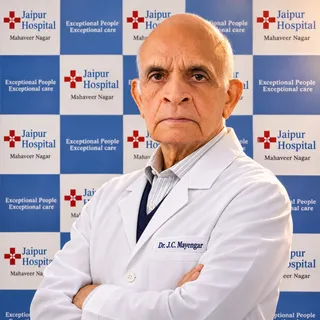
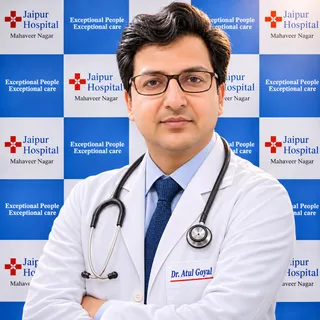
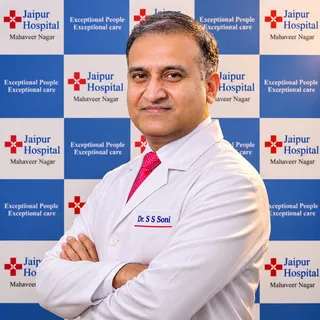
Your orthopaedics doctors
Explore our orthopaedic hospital in Jaipur: every treatment, the doctors and what to expect at your visit.

Frequently asked questions
Questions patients ask about partial knee replacement
What is partial knee replacement?
In short
Partial knee replacement replaces only the damaged compartment of the knee joint with a metal and plastic prosthesis. Jaipur Hospital performs this surgery for patients whose arthritis is limited to one area of the knee. The operation takes about one to one and a half hours under spinal or epidural anaesthesia.
In detail
The knee has three compartments: medial, lateral and patellofemoral. When osteoarthritis affects only one compartment, a unicompartmental or patellofemoral replacement can preserve the healthy bone, cartilage and ligaments.
Evidence shows that partial knee replacement is a safe and effective way to relieve long-term pain and stiffness, and most people regain mobility with an improved quality of life.
In studies, partial knee replacement was more effective and less expensive than total knee replacement over five years, with lower complication rates, though revision rates are higher than with total knee replacement. The surgeon will explain which technique suits your pattern of arthritis.
A common belief
Many people think every arthritic knee needs a total replacement.
What actually happens
In fact, if arthritis is confined to one compartment, a partial replacement preserves more natural movement and usually gives a faster recovery, though the chance of needing a revision later is higher than with a total knee replacement.
Your next step at Jaipur Hospital
If you have knee pain that limits daily activities, book a consultation at Jaipur Hospital. The orthopaedic team will examine your knee, review any X-rays and advise whether partial knee replacement is appropriate. Surgery can usually be scheduled within a few weeks.
Hospital stay is typically two to three nights, and you can walk on the same day. Desk work often resumes in three to four weeks.
Which specialist should I see for partial knee replacement?
In short
You should see an orthopaedic surgeon who specialises in knee replacement surgery. Jaipur Hospital has a dedicated orthopaedics department with surgeons who perform both partial and total knee replacements. The surgeon will assess whether your arthritis is suitable for a unicompartmental or patellofemoral replacement and discuss the expected outcomes.
In detail
Partial knee replacement is a type of knee arthroplasty that requires specific training and experience in patient selection, implant positioning and rehabilitation protocols. Evidence shows that accurate component positioning affects implant survival, and that surgeons who perform the procedure regularly achieve better results.
At Jaipur Hospital the orthopaedic team works with anaesthetists, physiotherapists and nursing staff who are familiar with the enhanced recovery pathway for partial knee replacement. The hospital is NABH-accredited and has modular operation theatres, a 24-hour intensive care unit and in-house pharmacy and laboratory support.
If you have other medical conditions, the team can coordinate with physicians, cardiologists or other specialists within the hospital before surgery.
A common belief
Some people go to a general physician or a physiotherapist first, which can delay the right assessment.
What actually happens
A surgeon who does knee replacements regularly can tell you quickly whether a partial replacement is an option and what the alternatives are. That saves time and avoids unnecessary treatments.
Your next step at Jaipur Hospital
To see an orthopaedic surgeon for a knee assessment, book a consultation at Jaipur Hospital. The surgeon will review your symptoms, examine your knee and look at your X-rays. If needed, an MRI can be arranged at an outside imaging centre. Surgery can be scheduled once you and the surgeon agree on the plan.
What treatment options are available for my situation with partial knee replacement?
In short
Options include non-surgical care, partial knee replacement, total knee replacement, and in some cases high tibial osteotomy. Jaipur Hospital offers medial, lateral and patellofemoral unicompartmental replacements. The choice depends on which compartment is affected, ligament status, alignment, age and activity level.
In detail
Non-surgical treatment such as physiotherapy, weight management, walking aids and pain relief is tried first. If symptoms remain severe and arthritis is confined to one compartment with intact ligaments, partial knee replacement is an option.
Medial unicompartmental replaces the inner compartment, lateral unicompartmental the outer, and patellofemoral replacement addresses the kneecap joint. Total knee replacement is considered if arthritis involves more than one compartment. High tibial osteotomy may suit younger, active patients with alignment deformity.
Evidence shows partial replacement gives less pain and faster recovery than total replacement, though revision rates are higher long term. The surgeon discusses each option based on your knee pattern and goals.
A common belief
Many assume total knee replacement is the only surgical option.
What actually happens
If arthritis is truly in one compartment, partial replacement preserves healthy bone and ligaments, giving a more natural feel and quicker recovery. However, it may need conversion to total replacement later if arthritis spreads. The surgeon helps you weigh this trade-off.
Your next step at Jaipur Hospital
At your consultation, the surgeon reviews imaging, examines your knee, and explains which options fit your situation. You will discuss expected recovery, implant longevity, and activity after surgery. A decision is made jointly. Call 0141-2551500 or 7414 001 001 to book. See costs, insurance and contact details.
What can I safely do at home to manage partial knee replacement symptoms?
In short
At home you can manage symptoms of knee arthritis with gentle low-impact exercises, weight control, ice packs for swelling, and prescribed pain relief. Using a walking aid reduces load on the joint. These measures help maintain mobility while you await assessment at Jaipur Hospital.
In detail
Evidence supports staying active within comfort limits. After surgery, patients are encouraged to walk with assistance right away and apply ice for 10 to 20 minutes every one to two hours for the first three days. Keeping the leg raised above heart level reduces swelling.
Compression stockings may be advised to lower clot risk. Pain management typically combines prescription medication, NSAIDs if safe, and paracetamol. Avoid twisting, deep bending and prolonged sitting.
A common belief
Many people rest completely, but inactivity weakens muscles and stiffens the joint.
What actually happens
Evidence shows early movement and regular icing improve comfort and prepare you for surgery.
Your next step at Jaipur Hospital
Start with short walks on flat ground, use a stick if needed, and do the home exercises your physiotherapist recommends. Take pain medicine as directed. If pain worsens or new swelling appears, contact the hospital.
How does the term UKR relate to partial knee replacement?
In short
UKR stands for unicompartmental knee replacement, which is another name for partial knee replacement. At Jaipur Hospital the terms are used interchangeably. The procedure replaces only the damaged compartment of the knee — medial, lateral or patellofemoral — leaving healthy bone and ligaments intact.
In detail
Evidence describes unicompartmental knee arthroplasty (UKA) as a safe and efficient alternative to total knee replacement with less postoperative pain and fewer complications. The Oxford Knee Score is used to assess function and pain after this surgery.
Studies compare UKR with total knee replacement and high tibial osteotomy, showing similar clinical outcomes but higher revision rates than total knee replacement. The hospital offers medial unicompartmental, lateral unicompartmental and patellofemoral replacement techniques.
A common belief
Some patients think UKR is a different, smaller procedure.
What actually happens
It is simply the technical term. The key point is that arthritis must be limited to one compartment for UKR to be an option.
Your next step at Jaipur Hospital
If you see UKR or UKA in reports or letters, they refer to the same operation. Ask your surgeon to clarify which compartment is involved.
How do I know whether I am ready for joint replacement?
In short
You may be ready for joint replacement when knee pain and stiffness limit your daily activities and non-surgical treatments no longer give enough relief. At Jaipur Hospital our orthopaedic team assesses your symptoms, X-rays and overall health to decide if partial knee replacement is appropriate.
In detail
Evidence indicates that a healthcare provider might recommend partial knee replacement if you have severe symptoms that do not improve after trying non-surgical treatments. The decision depends on which compartment is affected, your age, body mass index, activity level and the grade of osteoarthritis.
Most people who choose this surgery have osteoarthritis confined to one compartment. The surgeon checks that the ligaments are stable and the other compartments are healthy. If arthritis involves more than one compartment a total knee replacement may be advised instead.
A common belief
Some patients wait too long hoping the pain will go away while others rush into surgery before trying all non-surgical options.
What actually happens
The right timing balances your symptom severity, joint damage and overall health.
Your next step at Jaipur Hospital
The first step is an outpatient consultation where the surgeon examines your knee, reviews imaging and discusses your goals. Blood tests and a fitness check are done before surgery. The typical hospital stay is two to three nights and you can walk with support on the same day.
How will treatment affect my walking, movement, or independence?
In short
After partial knee replacement at Jaipur Hospital, you walk the same day with assistance. Most people regain independent walking within one to two weeks and return to desk work in three to four weeks. Long-term, many resume normal daily activities with less pain.
In detail
Evidence shows people who have partial knee replacements usually regain mobility and have an increased quality of life. You may be able to walk without a cane or walker after one or two weeks.
After recovery, normal daily activities, hiking, dancing and cycling are often possible. High-impact sports like jogging, jumping and contact sports are usually discouraged to protect the implant. The knee continues to improve for six months or longer with consistent rehabilitation.
A common belief
Some fear they will need a walker forever.
What actually happens
The evidence shows rapid progress: crutches for a short time, then a stick, then unaided walking. High-impact sports are limited, but everyday independence returns for most.
Your next step at Jaipur Hospital
Physiotherapy starts in hospital and continues at home. You will use a walker or crutches at first, then progress to a stick. Compression stockings are worn for several weeks. Driving may take several weeks. The typical hospital stay is two to three nights. Typical cost range in India is ₹1,50,000 to ₹2,80,000.
Which symptoms or changes should prompt me to seek medical advice for partial knee replacement?
In short
You should seek medical advice when knee pain and stiffness limit your daily activities, disturb sleep, or do not improve with rest, physiotherapy and simple pain relief. Jaipur Hospital sees many patients whose knee symptoms have gradually worsened over months or years. Swelling that returns after activity, a feeling of the knee giving way, or difficulty walking short distances are also reasons to consult a specialist.
In detail
Osteoarthritis is the most common condition leading to partial knee replacement. Typical symptoms include pain that is worse with weight-bearing and better with rest, morning stiffness lasting less than thirty minutes, and a gradual loss of knee movement.
When these symptoms persist despite non-surgical measures such as exercise, weight management and medication, the surgeon may discuss surgical options. Evidence shows that people who have severe symptoms not relieved by non-surgical treatment are the ones who benefit most from partial knee replacement. The decision is based on how much the symptoms affect your quality of life, not on X-ray findings alone.
A common belief
Some people wait until they can barely walk, thinking surgery is a last resort.
What actually happens
Others expect an X-ray alone to decide. In reality, the timing of surgery depends on your symptoms and how they affect your function. Early assessment helps you plan better and avoid unnecessary disability.
Your next step at Jaipur Hospital
If your knee pain stops you from doing the things you need or want to do, book a consultation at Jaipur Hospital. The orthopaedic surgeon will take a detailed history, examine your knee and review any recent X-rays.
Further imaging such as an MRI may be advised at an outside centre. Surgery can be planned once the diagnosis is confirmed and you have decided to proceed.
What will the doctor ask and check at the first visit for partial knee replacement?
In short
At the first visit the orthopaedic surgeon will ask about your knee pain, stiffness, swelling, walking distance, effect on daily activities and sleep, and any previous treatments you have tried. Jaipur Hospital follows a structured assessment that includes a detailed history, a physical examination of the knee and a review of standing weight-bearing X-rays.
In detail
The surgeon will want to know when the symptoms started, what makes them better or worse, whether you have pain at rest or at night, and how far you can walk.
They will ask about past injuries, surgeries, medical conditions such as diabetes or heart disease, and current medications. The examination checks knee range of motion, stability, alignment, tenderness and muscle strength.
Standing X-rays show the joint space narrowing, bone spurs and alignment in the affected compartment. Evidence shows that patient selection based on symptoms, examination and imaging is critical for good outcomes after partial knee replacement.
The surgeon will also discuss your activity goals and explain the risks, including the possibility of future revision to a total knee replacement if arthritis progresses in other compartments.
A common belief
Patients sometimes think the X-ray alone decides the surgery.
What actually happens
In reality, the surgeon matches your symptoms and examination findings to the imaging. A knee that looks worn on X-ray but causes little pain may not need surgery, while a knee with moderate changes but severe symptoms might. The conversation about your goals is just as important as the images.
Your next step at Jaipur Hospital
Bring any previous X-rays, MRI reports and a list of your medicines to the consultation at Jaipur Hospital. If you need new X-rays, they can be done in the hospital's radiology department. An MRI, if required, is performed at an outside imaging centre. After the assessment the surgeon will explain whether partial knee replacement is suitable and what the next steps are.
Can this problem improve without a procedure or operation for partial knee replacement?
In short
Symptoms may improve with non-surgical treatment, but the underlying arthritis does not reverse. Jaipur Hospital advises physiotherapy, weight management, activity modification, walking aids and pain relief as first steps. These can reduce pain and improve function for a period.
In detail
Osteoarthritis is a progressive condition. Non-surgical measures aim to control symptoms and delay surgery. Evidence shows a healthcare provider might recommend partial knee replacement if severe symptoms do not get better after trying non-surgical treatments.
Physiotherapy strengthens muscles around the knee, weight loss reduces joint load, and medicines manage pain. However, cartilage wear continues over time. If arthritis is limited to one compartment, these measures may keep you comfortable for months or years. The surgeon monitors progression with periodic X-rays and clinical review.
A common belief
Some people hope exercise or supplements will regrow cartilage.
What actually happens
Evidence does not support this. Non-surgical care manages symptoms and can delay surgery, but it does not reverse the wear. If arthritis stays in one compartment, partial replacement remains an option later. Waiting too long risks spread to other compartments.
Your next step at Jaipur Hospital
Try the non-surgical plan agreed with your surgeon for several weeks. If pain and limitation persist, return for reassessment. The surgeon will repeat examination and imaging to see if arthritis has spread. Surgery is considered when non-surgical care no longer controls symptoms. Call 0141-2551500 or 7414 001 001 to book. See costs, insurance and contact details.
FAQ library
Questions and answers about partial knee replacement
When you contact us
What you get at Jaipur Hospital
Call or email the hospital to book an OPD consultation and talk through your knee with an orthopaedic surgeon.
- A consultation with an orthopaedic surgeon in the OPD
- Your scans and reports reviewed, with tests done in-house if you need them (laboratory, X-ray and imaging)
- Your options explained in plain words, including whether you need surgery at all
- A cost estimate before you decide
- Help with cashless treatment under MAA Yojana, various government health care schemes and empanelled insurers and TPAs
- Follow-up visits after your treatment
Read more
Read more about partial knee replacement
- When is knee replacement advised after non-surgical care
Doctors usually suggest knee replacement when pain and stiffness stop you from doing everyday tasks and other treatments no longer help.
- What affects knee replacement cost and insurance cover
Explains the factors that change knee replacement cost and how Ayushman Bharat and private insurance work for the surgery.
- Floor sitting, kneeling and prayer after knee replacement
What to expect for cross-legged sitting, kneeling for namaz or puja, and using an Indian toilet after knee replacement surgery.
- Walking aids, stairs and physio after knee replacement
Week-by-week guide to walker, stick, stairs and home exercises after knee replacement surgery. A patient guide from Jaipur Hospital, Jaipur.
- Normal pain versus warning signs after knee replacement
A day-by-day guide to post-op pain, swelling, wound changes and red-flag symptoms so you know when to call the hospital or go to the emergency department.
- Partial versus total knee replacement: how surgeons choose
Your doctor will explain which option fits your knee. A patient guide from Jaipur Hospital, Jaipur. Explained in plain words for patients and families.
Overview
Partial Knee Replacement: what to know
What is partial knee replacement?
- Three compartments
- Knee has inner, outer and kneecap areas
- One part replaced
- Only the damaged compartment gets an implant
- Metal and plastic
- Artificial joint made of metal and plastic
Partial knee replacement is a type of knee arthroplasty, or joint replacement. The knee has three compartments. In this operation, your surgeon removes the damaged sections of the knee joint and replaces them with an artificial joint made of metal and plastic. Only the damaged part is replaced.
Partial knee replacement is an option when arthritis is limited to one compartment. A total knee replacement is more common because most people with knee arthritis have it in all three compartments at once. Arthritis is the most common condition that leads to partial knee replacement surgery. Most people who choose this operation have osteoarthritis.
Partial knee replacement can relieve long-term symptoms such as pain and stiffness in some people. If arthritis later affects the other compartments, a total knee replacement may be needed. Your surgeon will check which compartments are affected before advising surgery.
Partial knee replacement symptoms and warning signs
- Infection signs More pain, swelling, warmth, redness, red streaks, pus or fever
- Blood clot signs Calf pain, leg swelling or colour change
- Breathing or chest emergency Severe trouble breathing, chest pain, fainting or coughing blood
The symptoms that may lead to partial knee replacement are long-term knee pain and stiffness. The pain can be severe enough to affect daily life, and it may not improve with nonsurgical treatment. Some people still have pain and other symptoms after surgery.
After surgery, some pain and swelling are expected, especially in the first few weeks. Your surgeon will suggest pain medicine that is suitable for you. Tell your surgeon if the pain feels too much or if you are worried about the medicine.
A knee that is swollen, warm or red needs checking even if the pain is mild. Get urgent medical help the same day if you have severe trouble breathing. Get emergency help at once if you pass out, or if you have sudden chest pain with shortness of breath, or you cough up blood.
Contact your surgeon or hospital team right away if you have signs of infection. These include more pain, swelling, warmth or redness, red streaks from the incision, pus from the incision, or a fever. Also seek urgent review for signs of a blood clot in the leg.
These include pain in the calf, back of the knee, thigh or groin, swelling in the leg or groin, or a colour change in the leg.
Get help if the incision opens and bleeds, or if bleeding increases. Tell your surgeon if pain does not get better after pain medicine, or if you do not have a bowel movement after taking a laxative. Jaipur Hospital has a 24×7 emergency department and ambulance service.
Causes of knee arthritis and who may need partial knee replacement
Arthritis is the most common condition that causes people to need partial knee replacement surgery. Most people who choose this operation have osteoarthritis. Doctors look closely at whether the arthritis is limited to the inner, or medial, compartment of the knee.
A bow-legged alignment, called varus, can be caused by arthritis in the medial compartment. When arthritis affects all three compartments, total knee replacement is more common.
Your surgeon will consider your age, body mass index, grade of arthritis and activity level when discussing treatment. Some health conditions can make recovery from surgery more difficult. Tell your surgeon about your health history.
Studies looking at possible risk factors have given conflicting results, and better quality studies are needed.
People with severe symptoms that do not get better after nonsurgical treatment may be advised to have surgery.
How partial knee replacement is diagnosed and planned
- Examine knee and ask about pain Surgeon checks walking and daily activities
- Review health history Age, BMI, arthritis grade and activity level are considered
- Imaging if needed X-ray at hospital; CT or MRI at outside centre
Your surgeon will examine your knee and ask about your pain, walking and daily activities. Your surgeon will also review your health history. The knee has three compartments, and the aim is to find out which part is affected.
Your surgeon will consider your age, body mass index, grade of arthritis and activity level. These factors help your surgeon decide whether a partial or total knee replacement is likely to suit you.
Jaipur Hospital has X-ray and ECG services, an in-house diagnostic laboratory, and imaging and radiology services. It does not have a CT or MRI scanner. If your surgeon needs a CT or MRI, the scan is done at an imaging centre outside the hospital. Your surgeon advises the scan and reviews the result.
Jaipur Hospital does not have a DEXA machine. If a bone density scan is needed, it is done at an imaging centre outside the hospital, and the team reviews the result.
Before surgery, your surgeon will tell you what you need to do to get ready. You may need to stop some medicines or supplements. You will be told when to stop eating and drinking. Most people need to avoid food and drink for 12 hours before surgery.
Your surgeon will explain the likely result using diagrams, drawings and published study results. You can ask questions about the operation and the alternatives.
Treatment without surgery and when partial knee replacement is advised
Medial unicompartmental
- Inner compartment only
Lateral unicompartmental
- Outer compartment only
Patellofemoral
- Kneecap and trochlea joint surface
Your surgeon may advise a partial knee replacement if you have severe symptoms that do not get better after nonsurgical treatment. The choice depends on which compartments are affected, your age, body mass index, grade of arthritis and activity level.
Nonsurgical treatment means care without an operation. Your surgeon will explain the options that suit your knee and your health. Jaipur Hospital has a physiotherapy department.
Partial knee replacement can be done in different ways. A medial unicompartmental replacement treats the inner compartment only. A lateral unicompartmental replacement treats the outer compartment only. A patellofemoral replacement treats the kneecap and the trochlea joint surface. Your surgeon will advise which option suits your knee.
At Jaipur Hospital, the operation usually takes 1 to 1.5 hours. Spinal or epidural anaesthesia is usually used. The typical plan is to help you walk on the same day. Hospital stay is typically 2 to 3 nights, and desk work is usually possible in 3 to 4 weeks.
Partial knee replacement at Jaipur Hospital uses standard instruments and alignment guides. The hospital does not use a surgical robot or navigation system for joint surgery.
Most people need around six weeks to recover, but you can start moving and walking with assistance right away. You may need crutches or a walking frame at first. Before you leave, a physiotherapist will talk to you about daily activities and a home exercise programme. Your knee may continue to improve for six months or longer. Plan ahead so an attendant can help you at home after surgery.
Arthritis can later affect other compartments, and some people may need a total knee replacement in the future. Studies do not all agree about revision, which means a second operation. One review found a higher revision rate after partial replacement than after total replacement. Another study found similar re-operation and complication rates with both. Your surgeon will discuss these points with you.
Many people live with the artificial parts for 10 years or longer. After recovery, you may be able to do normal daily activities with less pain.
Preparing for partial knee replacement
Do
- Tell surgeon your full health history
- Arrange an attendant for home help
- Bring medicine list and insurance papers
Your surgeon and doctor will tell you what you need to do to get ready for surgery. In general, you will need to stop taking some medicines or supplements before the operation. Do not stop any medicine on your own. Your doctor will say which ones to pause and for how long.
Tell your surgeon about your full health history. Some health conditions can make recovery from a partial knee replacement more difficult. This is the time to mention diabetes, heart problems, bleeding problems, or any medicine you take, including herbs and supplements.
You will be told when to stop eating and drinking. Most people need to avoid food and drink for 12 hours before surgery. Follow the exact time the hospital gives you.
Arrange for a family member or attendant to help you at home after surgery. Plan ahead so that someone can help you with daily tasks. It also helps to prepare your home before the day of surgery. Keep your phone, medicines and water within easy reach.
Bring your medicine list and your insurance or scheme papers. Ask your surgeon any question you have about the plan.
How partial knee replacement is done
- Remove damaged sections Only the affected compartment is replaced
- Choose implant type Medial, lateral or patellofemoral replacement
- Anaesthesia and surgery Spinal or epidural; operation takes 1 to 1.5 hours
- Standard instruments used No robot or computer navigation at this hospital
- Walk on same day Most people start walking after surgery
Partial knee replacement is a type of knee arthroplasty, or joint replacement. Your knee joint has three compartments. In this operation, your surgeon removes only the damaged sections of the knee and replaces them with an artificial joint made of metal and plastic.
Most people who need this operation have arthritis, and in most of them it is osteoarthritis. Total knee replacement is more common than partial knee replacement, because many people have arthritis in all three compartments at once. Your surgeon will check which part of your knee is affected before advising an operation.
There are three main types. A medial unicompartmental replacement replaces the inner compartment only. A lateral unicompartmental replacement replaces the outer compartment only. A patellofemoral replacement replaces the kneecap and the groove it moves in. Surgeons perform partial replacements on the medial and lateral compartments. Your surgeon will advise which type suits your knee.
The operation usually takes 1 to 1.5 hours. Spinal or epidural anaesthesia is usually used. Our anaesthesia team cares for you during the operation.
Jaipur Hospital does not use a surgical robot or computer navigation for joint replacement. Knee replacement here uses standard instruments and alignment guides. Robotic-assisted surgery has been studied, and in one trial it improved the accuracy of implant positioning compared with conventional surgery. It is not offered here.
After surgery you will be moved to a recovery room. The team watches you for a few hours as you wake up from the anaesthesia. At Jaipur Hospital, most people start walking on the same day.
Risks and complications of partial knee replacement
- Higher revision rate
- More than double the revision chance of total knee replacement
- Ongoing pain possible
- Some people still have pain after surgery
- Infection and blood clots
- Rare but serious complications
- Arthritis may spread
- Other compartments can be affected later
All operations carry some risk. In studies, the chance of revision surgery with partial knee replacement is more than double that with total knee replacement. Higher revision rates have been reported after partial knee replacement than after total knee replacement. Some people who have a partial replacement may need a total replacement later if arthritis starts in the other compartments.
Some people still have pain and other symptoms in the knee after partial knee replacement. Poor positioning of the implant is one factor in implant failure.
Rare complications include infection, blood clots and problems with the wound. Call your surgeon or doctor straight away if you have signs of infection, such as increased pain, swelling, warmth or redness, red streaks from the incision, pus from the incision, or a fever.
Also call if you have symptoms of a blood clot in the leg, such as pain in the calf, back of the knee, thigh or groin, swelling in the leg or groin, or a colour change in the skin that may be reddish or purplish. Get help if the incision opens and bleeds, or if the bleeding increases.
Get emergency care if you pass out, have severe trouble breathing, or have sudden chest pain and shortness of breath, or cough up blood. Call your surgeon if pain does not get better after pain medicine.
Recovery after partial knee replacement
You will feel pain after surgery, especially in the first few weeks. Some mild pain and swelling can last for weeks. Your surgeon will suggest a combination of pain medicines. Talk to your surgeon if the pain is too much or if you are worried about the medicines.
You will go home with a bandage and stitches, staples, skin glue or tape strips. Stitches or staples are usually removed about 2 weeks after surgery. Glue or tape strips fall off on their own. A nurse may remove stitches or clips after about 10 days.
You will be able to walk with a walker right after surgery. Many people can walk without a cane or walker after 1 or 2 weeks. Others take about 6 weeks to walk without an aid, if they feel ready.
Most people need to rest at home for a week or two. You will need months of physiotherapy after a knee replacement. Rehab helps you strengthen the knee muscles and regain movement. Do the exercises as your therapist tells you. A physiotherapist will talk to you about daily activities and home exercise programmes. Physiotherapy is one of the departments at Jaipur Hospital.
For the first 3 days, put ice or a cold pack on the area for 10 to 20 minutes at a time, every 1 to 2 hours when you are awake. Keep the leg raised on a pillow when you sit or lie down. Wear compression stockings if your doctor tells you to, and for as long as advised. Most people wear them for at least 6 weeks.
Do not sit for more than 1 hour at a time. If you must sit for long, prop up your leg to avoid swelling. Do not sit with your legs crossed for the first 6 weeks. Do not sleep with a pillow under your knee. Do not kneel on the new knee until your doctor says you can.
Avoid twisting the knee, bending down and reaching up as much as possible. Avoid heavy household tasks such as vacuuming or carrying shopping for the first 3 months.
At Jaipur Hospital, a hospital stay of 2 to 3 nights is usual. Desk work is usually possible in 3 to 4 weeks. You may need 4 to 12 weeks off from work, depending on the type of work. You will usually have a follow-up appointment about 6 weeks after the operation.
Ask your doctor when you can drive again. It may take several weeks. Your knee will keep improving for 6 months or longer. Carry a medical alert card that says you have an artificial joint, as the metal parts may set off airport metal detectors.
How well partial knee replacement works
Partial knee replacement is a safe and effective way to relieve long-term symptoms such as pain and stiffness. People who have it usually regain mobility and report a better quality of life. Many people live with the prosthetic pieces for a long time, usually 10 years or longer.
In a large trial done at 27 UK sites, people with arthritis in the inner compartment were randomly assigned to partial or total knee replacement. At 5 years, both groups had similar Oxford Knee Scores, a questionnaire that measures knee function and pain. Both operations were effective and gave similar results, with a similar number of re-operations and complications. Studies of satisfaction showed a high level for most patients.
The main trade-off is revision. In studies, partial replacement has a higher revision rate than total replacement. Revision means another operation on the same knee. Some people need a total replacement later if arthritis spreads to the other compartments. Your surgeon will discuss this with you before you decide.
Recovery is often faster after a partial replacement than after a total replacement. After recovery, many people do normal daily activities with less pain or no pain. You may be able to hike, dance or ride a bike, depending on your knee and the advice you receive.
Studies found lower surgery costs and lower follow-up health-care costs with partial replacement than with total replacement.
Cost of partial knee replacement in Jaipur
The typical range for partial knee replacement in India is ₹1,50,000 to ₹2,80,000. The final cost depends on which compartment is replaced, the implant used, your hospital stay and any extra care you need. You can ask us for an estimate.
Studies found lower costs of surgery and lower follow-up health-care costs with partial knee replacement than with total knee replacement. The cost also depends on the tests and treatment you need before surgery.
Jaipur Hospital is a NABH-accredited, privately run multispeciality hospital, established in February 1991. It has modular operation theatres, an Intensive Care Unit, an in-house pharmacy, and an in-house diagnostic laboratory and imaging service with X-ray. It does not have a CT or MRI scanner.
If you need a CT or MRI, your doctor will advise it and it is done at an imaging centre outside the hospital. There is no DEXA machine here either, so a bone density scan is done at an outside centre and the team reviews the result.
The hospital works with MAA Yojana, various government health care schemes and a panel of private insurers and TPAs. Cover depends on your scheme and policy, so check the rules before you plan surgery. The hospital also has a 24×7 emergency department and a 24×7 ambulance service.