

Obstetrics and Gynaecology · Jaipur Hospital
Endometrial Polyp Removal in Jaipur
Irregular bleeding or trouble conceiving? We assess, explain options and plan your hysteroscopic polyp removal.
- Serving Jaipur since 1991 (35 years)
- NABH accredited
- 24×7 emergency & ICU
- Cashless: MAA Yojana + 32 insurers
- Procedure time
- 15 to 30 minutes
- Anaesthesia
- Short general or IV sedation
- Recovery
- Next day normal activity
- Price
- ₹25,000 to ₹60,000typical range in India; ask us for an estimate
Bleeding, infertility, worry
Polyps cause irregular bleeding and can block pregnancy
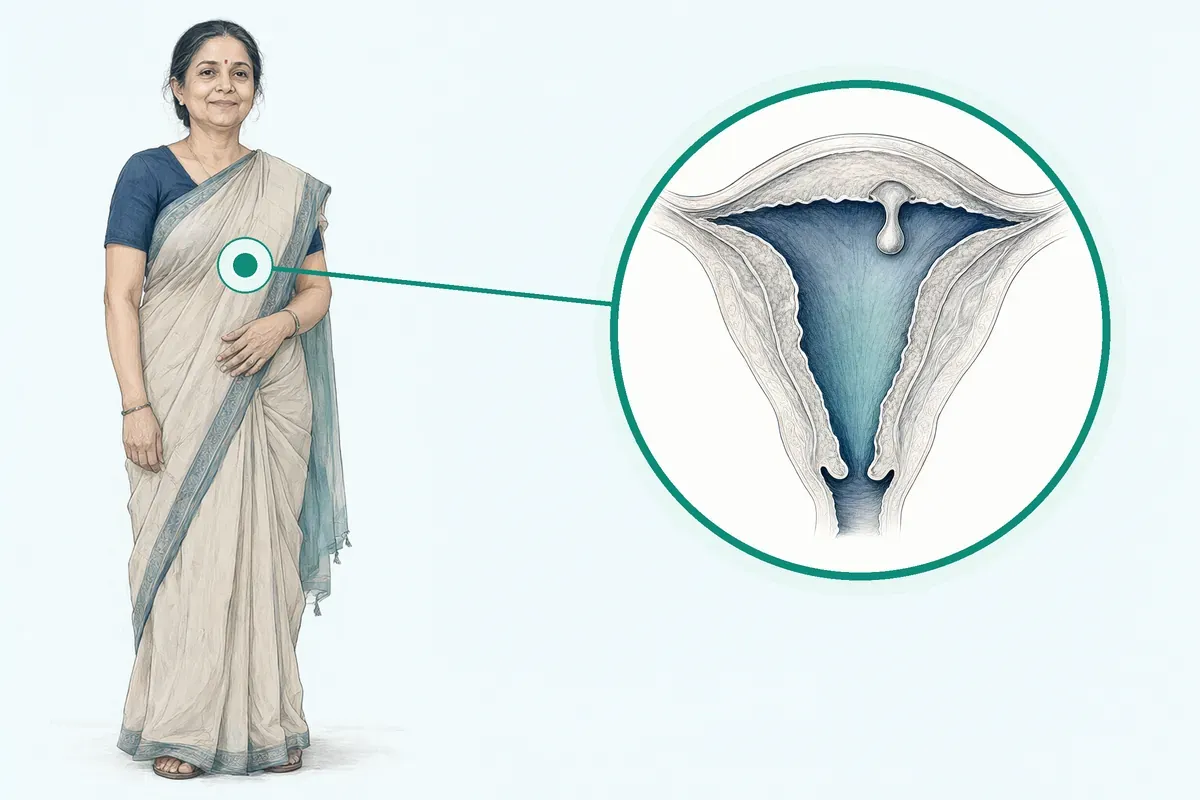
Endometrial polyps are benign overgrowths in the uterine cavity. They often cause heavy or irregular periods, bleeding between cycles or after menopause. They can also interfere with sperm transport or embryo implantation, contributing to infertility. Many women feel anxious about the bleeding or the delay in conceiving.
-
Unpredictable bleeding
Heavy periods, spotting between cycles or postmenopausal bleeding disrupt daily life and cause worry.
-
Difficulty conceiving
Polyps may block the cervical canal or fallopian tube entrance and create an inflammatory environment that hinders implantation.
-
Cancer concern
A small fraction of polyps can show malignant change, especially after menopause, so removal allows histology.
-
Recurrent symptoms
Polyps may persist or recur if not completely removed under direct vision.
Endometrial polyps have been implicated in about 50% of cases of abnormal uterine bleeding.
Why Jaipur Hospital
You want the bleeding to stop or the chance to conceive, without a long hospital stay or hidden costs.
Your care plan
Your first steps with us
- 1 Call or visit OPD for gynaecology consultation
- 2 Review scans and plan hysteroscopic removal
- 3 Undergo daycare procedure under short anaesthesia
- 4 Resume normal activity the next day
Insurance and schemes
How cashless works
Cashless treatment under MAA Yojana and with 32 insurers.
-
Tell us when you book
Say you are insured or have a scheme card, and send a photo of the card on WhatsApp so our insurance desk can check it in advance.
-
We get the approval
Once your doctor advises admission, the insurance desk sends the pre-authorisation request to your insurer or TPA; for planned surgery, approval can come before you are admitted.
-
Settled at discharge
The approved amount is settled between the insurer and the hospital; you pay only what the policy does not cover.
How the operation is done
A thin telescope is passed through the cervix into the uterus. The polyp is visualised and removed using specialised instruments. The procedure takes 15 to 30 minutes under short general or IV sedation. You go home the same day.
-
Hysteroscopic Polypectomy (Scissors/Forceps)
Small polyps are grasped and cut out under direct vision using mechanical instruments.
-
Hysteroscopic Resection (Loop/Electrode)
Larger or multiple polyps are shaved away with an electrified loop resectoscope.
-
Office Hysteroscopy Polypectomy
Selected small polyps can be removed in the clinic without anaesthesia, walk-in walk-out.
Why patients trust us
- 1991 Serving Jaipur for 35 years
- NABH Accredited hospital
- 3 Obstetrics and Gynaecology consultants
- 24×7 Emergency, ICU and ambulance
- 32 Cashless insurers, plus MAA Yojana
What research shows about this treatment
-
98.2% complete resection rate
Cold snare polypectomy achieved a 98.2% complete resection rate in studies.
-
60 seconds resection time
Mean resection time was significantly shorter for cold snare (60 s) versus hot snare (83 s).
-
Two-fold pregnancy rate improvement
Post-polypectomy pregnancy rates improved two-fold in intrauterine insemination patients.
If it is left untreated
If left untreated, polyps can continue to cause heavy or irregular bleeding, lead to anaemia, and maintain a hostile uterine environment that reduces the chance of natural conception or success with fertility treatment. A very small fraction (about 1%) may undergo malignant transformation, particularly after menopause.
Life after treatment
Most women return to normal routine the next day. Bleeding usually settles and fertility prospects often improve.
-
Regular cycles
Most people find their periods become lighter and more predictable within a cycle or two.
-
Better fertility chances
Removal clears the cavity, and studies show improved pregnancy rates for previously infertile women.
-
Peace of mind
The removed tissue is sent for histology, ruling out the small risk of malignant change.
-
Quick recovery
Daycare procedure means you rest at home and resume work or household duties the next day.
Meet the team
Your obstetrics and gynaecology doctors
Explore our gynaecology and maternity hospital in Jaipur: every treatment, the doctors and what to expect at your visit.



Frequently asked questions
Questions patients ask about endometrial polyp removal
What does endometrial polyp removal involve?
In short
Endometrial polyp removal at Jaipur Hospital is a hysteroscopic daycare procedure that takes 15 to 30 minutes under short general anaesthesia or IV sedation. The surgeon passes a thin telescope through the cervix into the uterus, sees the polyp on a screen and removes it with scissors, forceps or an electric loop. You go home the same day and resume normal activity the next day.
In detail
The technique depends on the polyp size and number. Small polyps are cut out with scissors or forceps under direct vision. Larger or multiple polyps are shaved off with a resectoscope loop or electrode.
In selected cases a small polyp can be removed during an office hysteroscopy without anaesthesia. Evidence shows hysteroscopic polypectomy is the mainstay of management and blind removal is not indicated when guided instruments are available. Complete resection rates are high with both cold and hot techniques.
A common belief
Some people think it needs a cut on the abdomen or a long hospital stay.
What actually happens
It does not. No abdominal incision, no overnight stay, and normal activity resumes the next day.
Your next step at Jaipur Hospital
Your gynaecologist will review your ultrasound or hysteroscopy images, explain the method suited to your polyp and give a typical cost range of ₹25,000 to ₹60,000 in India. The procedure is scheduled as daycare; you need an attendant for the day of surgery.
Which tests and scans do I need before endometrial polyp removal?
In short
Before endometrial polyp removal at Jaipur Hospital, you will need a transvaginal ultrasound, ideally on day 10 of your menstrual cycle when the endometrium is thinnest. This is the primary tool for initial diagnosis and shows the polyp as a hyperechogenic lesion.
In detail
If the ultrasound is not clear, the doctor may order saline infusion sonography to outline small polyps missed on standard ultrasound. Diagnostic hysteroscopy may also be used for a direct view of the cavity.
Routine pre-anaesthesia blood tests such as haemoglobin, coagulation profile, and blood group are done. If you have medical conditions, additional tests may be advised.
The hospital has an in-house laboratory and X-ray; CT and MRI scans are done at an outside imaging centre if the surgeon requests them.
A common belief
A single ultrasound can miss small polyps or confuse them with fibroids.
What actually happens
Adding saline or doing a hysteroscopy helps the surgeon see the exact size, number, and location before removal.
Your next step at Jaipur Hospital
Schedule the ultrasound for day 10 of your cycle. Bring any previous scan reports. Pre-anaesthesia tests are done a day or two before the procedure.
How painful is endometrial polyp removal and the early recovery?
In short
At Jaipur Hospital, hysteroscopic polyp removal is done under short general anaesthesia or IV sedation, so you do not feel pain during the procedure. Afterward, most women have mild cramping similar to a period for a few hours. Simple pain relief such as paracetamol or ibuprofen is usually enough.
In detail
The hysteroscope passes through the cervix into the uterine cavity; no cuts are made on the abdomen.
Because the procedure takes 15 to 30 minutes and uses fluid to expand the uterus, some cramping or a feeling of fullness is common once the anaesthesia wears off.
In studies, most patients rate the discomfort as low and return to normal activity the next day. Office hysteroscopy without anaesthesia is an option only for very small polyps and may cause more discomfort. Your surgeon will discuss the expected sensation based on the technique used.
A common belief
Some people expect severe pain because it is uterine surgery, but no abdominal cuts are made.
What actually happens
The discomfort comes from the fluid used to see inside the uterus and usually settles quickly. Office hysteroscopy without anaesthesia can be more uncomfortable and is only for selected small polyps.
Your next step at Jaipur Hospital
Plan to rest for the remainder of the day after surgery. Take prescribed pain relief as needed. Light bleeding or spotting may last a few days. If pain becomes severe, you develop a fever, or bleeding soaks a pad in an hour, contact the hospital.
How long does recovery usually take after endometrial polyp removal?
In short
Recovery after endometrial polyp removal at Jaipur Hospital is quick. The procedure is daycare; you go home a few hours after surgery. Most women return to normal activity the next day. Light spotting and mild cramps may last two to five days. Full healing of the uterine lining takes about two weeks. Heavy lifting, intercourse, and swimming are avoided for five to seven days.
In detail
The procedure lasts 15 to 30 minutes under short general anaesthesia or IV sedation. After waking, you are observed for two to three hours until the anaesthesia wears off and vital signs are stable.
Evidence shows immediate bleeding is more common with conventional polypectomy, so the team watches for this before discharge. Pain is managed with oral tablets. The uterine lining regenerates over ten to fourteen days.
Office hysteroscopy for selected small polyps allows walk-in walk-out recovery with minimal downtime. Return to work is usually the next day for desk jobs; physically demanding work may need two to three days.
A common belief
Patients often expect a week of bed rest.
What actually happens
In reality, hysteroscopic removal is daycare surgery with next-day recovery. Only heavy physical work may need an extra day or two. Office hysteroscopy for tiny polyps has almost no downtime.
Your next step at Jaipur Hospital
Rest for the remainder of surgery day. Take pain tablets regularly for 24 hours. Use pads, not tampons, until bleeding stops completely. Avoid douching, intercourse, and strenuous exercise for five to seven days. Attend the two-week follow-up at Jaipur Hospital for histology review and examination. If you develop heavy bleeding, fever, or severe pain before then, call the hospital.
Does an endometrial polyp need treatment if I have few symptoms?
In short
Not every endometrial polyp requires immediate removal. Small, asymptomatic polyps may be watched, especially in premenopausal women where spontaneous regression occurs in up to 25 percent of cases. At Jaipur Hospital, your gynaecologist will assess size, symptoms, age and fertility plans before advising treatment.
In detail
Evidence shows most polyps are benign and many cause no symptoms. However, polyps are linked to abnormal uterine bleeding in about 50 percent of cases and can affect fertility by mechanical obstruction, inflammation or altered endometrial receptivity.
Postmenopausal women with any bleeding should have the polyp removed for histology. Polyps larger than 15 mm, those on tamoxifen, or those in women with obesity or hypertension carry a higher malignant potential. The decision balances symptom burden, cancer risk and reproductive goals.
- However, polyps are linked to abnormal uterine bleeding in about 50 percent of cases and can affect fertility by mechanical obstruction, inflammation or altered endometrial receptivity.
A common belief
Many assume any growth must be removed.
What actually happens
But evidence shows most polyps are benign and some shrink without treatment. Removal is advised if you have bleeding, infertility, are postmenopausal, or the polyp is large or has risk factors for cancer.
Your next step at Jaipur Hospital
If you have no bleeding and are not trying to conceive, a repeat scan in three to six months may be offered. If you have irregular bleeding, infertility, are postmenopausal, or the polyp is large, hysteroscopic removal is usually advised. The procedure is daycare, 15 to 30 minutes, with next-day recovery.
How could an endometrial polyp or its removal affect future pregnancy?
In short
An endometrial polyp can reduce fertility by blocking sperm transport, preventing embryo implantation, or creating an inflammatory environment. Hysteroscopic removal at Jaipur Hospital improves pregnancy rates in previously infertile women, with benefit seen regardless of polyp size. The uterus is preserved.
In detail
Polyps are found in 3.8 to 38.5 percent of primary infertility and 1.8 to 17 percent of secondary infertility. They alter endometrial receptivity through increased MMPs, interferon gamma and glycodelin, and reduced placental protein 14. Removal restores a normal cavity.
Studies report two-fold pregnancy rate improvement after polypectomy in IUI patients and spontaneous pregnancies while awaiting IVF. The procedure itself carries low surgical risk and does not damage the endometrium when performed under vision. Fertility benefit is not dependent on polyp size.
A common belief
Some worry that scraping the uterus causes scarring.
What actually happens
Hysteroscopic removal under direct vision is precise and low-risk. Evidence shows fertility improves after polypectomy, and many women conceive spontaneously while waiting for further treatment.
Your next step at Jaipur Hospital
If you are trying to conceive, removal before fertility treatment is often advised. The procedure is daycare, 15 to 30 minutes, with next-day recovery. You can usually attempt pregnancy after your next normal cycle. Your surgeon will review histology and advise timing.
Why might my doctor recommend endometrial polyp removal?
In short
Your doctor may recommend endometrial polyp removal at Jaipur Hospital if you have abnormal uterine bleeding, postmenopausal bleeding, or infertility linked to polyps. Polyps can cause irregular periods, heavy bleeding, or bleeding between periods. They may also block sperm transport or prevent embryo implantation, and removal has been shown to improve pregnancy rates in infertile women.
In detail
Evidence indicates endometrial polyps are implicated in about 50 percent of abnormal uterine bleeding cases.
They can cause infertility by mechanical obstruction of the cervical canal or tubal openings, by acting as a space-occupying lesion that prevents implantation, and by creating an inflammatory endometrial response similar to an intrauterine device.
Polyps also show increased levels of matrix metalloproteinases, interferon gamma and glycodelin, which are toxic to sperm and embryos, while placenta protein 14, which supports immune acceptance of the embryo, is lower.
Hysteroscopic polypectomy appears to improve pregnancy rates irrespective of polyp size or number, and pregnancy rates improved two-fold in intrauterine insemination patients after removal.
- Evidence indicates endometrial polyps are implicated in about 50 percent of abnormal uterine bleeding cases.
A common belief
Some women are told to just watch and wait.
What actually happens
But if you are bleeding irregularly, bleeding after menopause, or struggling to get pregnant, leaving the polyp in place may delay the right treatment.
Your next step at Jaipur Hospital
If you have persistent bleeding, bleeding after menopause, or have been trying to conceive without success, an evaluation is appropriate. The surgeon will review your scans and symptoms, discuss whether removal is indicated, and plan the procedure if needed.
How should I prepare in the days before endometrial polyp removal?
In short
In the days before endometrial polyp removal at Jaipur Hospital, follow the surgeon's instructions on any medicines to stop or continue. Arrange for an attendant to accompany you on the day of the procedure. Keep the vaginal area clean; avoid douching or using vaginal medications unless told otherwise.
In detail
You will receive a pre-anaesthesia check-up where the anaesthetist reviews your health and blood tests. If you take blood thinners, hormonal medicines, or herbal supplements, the surgeon will advise when to pause them. Smoking can affect healing, so reducing or stopping is advised.
The procedure is scheduled in the first half of the menstrual cycle when the endometrium is thin, usually between day 7 and day 12, to give the clearest view.
A common belief
Some women continue blood thinners or herbal products without telling the doctor, which can increase bleeding.
What actually happens
The anaesthetist needs a full list of everything you take to keep you safe.
Your next step at Jaipur Hospital
Complete any prescribed blood tests a day or two before. Do not eat or drink after the fasting time given by the anaesthetist. Wear loose clothing and leave valuables at home.
What are the common side effects and the less common serious complications of endometrial polyp removal?
In short
Common side effects after endometrial polyp removal at Jaipur Hospital include light vaginal bleeding or spotting for two to five days, mild cramping, and watery discharge from the distension fluid. Less common serious complications are heavy bleeding needing a return to theatre, infection with fever or foul discharge, uterine perforation (a small hole in the womb), and fluid overload from the distension medium. The surgical team monitors for these during and after the procedure.
In detail
Evidence shows immediate bleeding during conventional polypectomy is more frequent than with cold techniques. Delayed bleeding occurred in 14% of conventional cases versus none with cold polypectomy. Uterine perforation is rare but recognised; the risk rises with larger polyps or a thin uterine wall.
Infection rates are low with sterile technique and prophylactic antibiotics when indicated. Fluid overload is prevented by careful monitoring of fluid deficit during surgery. The removed polyp is sent for histology; malignancy is found in about 1% of polyps.
- Delayed bleeding occurred in 14% of conventional cases versus none with cold polypectomy.
- The removed polyp is sent for histology; malignancy is found in about 1% of polyps.
A common belief
Patients often worry about cancer.
What actually happens
Malignancy in a polyp is rare, about one in a hundred. The polyp is always sent for testing. Another fear is infertility after surgery; hysteroscopic removal actually improves pregnancy chances in studies.
Your next step at Jaipur Hospital
Expect spotting for up to a week; use pads, not tampons. Take prescribed antibiotics if given. Avoid heavy lifting, intercourse, and swimming for five to seven days.
Seek urgent care at Jaipur Hospital if you soak a pad in an hour, pass large clots, develop fever above 38°C, have severe abdominal pain not relieved by pain tablets, or notice foul-smelling discharge. A follow-up visit is scheduled at two weeks.
Which symptoms are expected after endometrial polyp removal, and which need urgent medical attention?
In short
Expected symptoms after endometrial polyp removal at Jaipur Hospital include light vaginal bleeding or spotting for two to five days, mild cramping like a period, and watery pink discharge from the distension fluid. Urgent symptoms are soaking a pad in an hour, passing large clots, fever above 38°C, severe abdominal pain not relieved by pain tablets, foul-smelling discharge, or feeling faint. These need immediate assessment.
In detail
Light bleeding occurs as the uterine lining heals; it should decrease daily. Mild cramps respond to paracetamol or ibuprofen. Watery discharge is residual saline or glycine fluid.
Evidence shows delayed bleeding occurred in 14% of conventional polypectomy cases, so a sudden increase after 24 hours is a warning sign. Infection presents with fever, offensive discharge, and worsening pain. Uterine perforation, though rare, causes severe pain and shoulder tip pain from diaphragmatic irritation. Fluid overload causes breathlessness and swelling; it is prevented by intraoperative monitoring.
- Evidence shows delayed bleeding occurred in 14% of conventional polypectomy cases, so a sudden increase after 24 hours is a warning sign.
A common belief
Many women think any bleeding means failure.
What actually happens
Spotting is expected healing. Others ignore fever or foul discharge, thinking it is part of recovery. Those are infection signs and need same-day review.
Your next step at Jaipur Hospital
Use pads only; change every four to six hours. Take prescribed antibiotics if given. Rest today; resume light activity tomorrow. Avoid tampons, intercourse, and swimming for five to seven days. If any urgent symptom appears, call Jaipur Hospital or go to the 24×7 emergency department. Do not wait for the scheduled follow-up.
FAQ library
Questions and answers about endometrial polyp removal
When you contact us
Get your assessment and cost estimate
Contact Jaipur Hospital for a gynaecology consultation, scan review, plain explanation of options, a cost estimate before you decide, and help with cashless treatment under MAA Yojana and empanelled insurers and TPAs.
- A consultation with a gynaecologist in the OPD
- Your scans and reports reviewed, with tests done in-house if you need them (laboratory, X-ray and imaging)
- Your options explained in plain words, including whether you need surgery at all
- A cost estimate before you decide
- Help with cashless treatment under MAA Yojana and empanelled insurers and TPAs
- Follow-up visits after your treatment
Read more
Read more about endometrial polyp removal
- When does a fibroid need treatment? Size, location, symptoms
Understand how fibroid size, position and symptoms guide the decision between watchful waiting and treatment. Plain facts for women in India.
- Fibroids and pregnancy: fertility, risks and delivery planning
How fibroids affect getting pregnant, pregnancy risks, and delivery choices. Clear answers on location, size, and when surgery helps.
- Why fibroids return after surgery and what to do next
Why fibroids return after surgery and what to do next: the uterus stays and hormones can cause new growth. Options depend on age, symptoms and fertility plans.
- Adenomyosis treatment: medicines, embolisation, hysterectomy
Compare adenomyosis treatment options — why medicines may stop working, when embolisation helps, and how hysterectomy gives a definitive answer.
- Choosing the right fibroid treatment for you
Choosing the right fibroid treatment for you compares medicine, myomectomy, embolisation and hysterectomy on fertility, recovery and recurrence.
- Fibroids or adenomyosis: how to tell the difference
Learn the distinct symptoms, imaging clues, and treatment differences between fibroids and adenomyosis, and when to see a doctor.
Overview
Endometrial Polyp Removal: what to know
What is an endometrial polyp and how it forms
- Overgrowth of uterine lining
- Protrudes into the uterine cavity
- Pedunculated or sessile
- Narrow stalk or broad flat base
- Size range
- From about 5 mm to filling the whole cavity
- Common location
- Upper uterus near fallopian tube openings
An endometrial polyp is an overgrowth of the lining of the uterus that protrudes into the uterine cavity. These growths are usually benign and can appear in women of reproductive age as well as after menopause. They may be attached by a narrow stalk, which is called pedunculated, or have a broad flat base, which is called sessile.
Their size ranges from about 5 mm to large enough to fill the whole cavity. Most are found in the upper part of the uterus, often near the corners where the fallopian tubes open. The surface looks smooth and is tan to yellow in colour. Inside, the tissue can vary from normal cycling endometrium to simple or complex hyperplasia.
Many polyps cause no symptoms and are found by chance during tests for other reasons. Some may shrink or disappear on their own, especially in younger women who are still having regular cycles. The bleeding that polyps cause is thought to come from congestion of blood vessels inside the polyp, leading to venous stasis and damage at the tip.
Polyps also show higher levels of certain proteins and growth factors such as matrix metalloproteinases, interferon gamma and glycodelin, while a protective protein called placenta protein 14 is lower than in normal endometrium. An increase in vascular endothelial growth factor and other angiogenic factors leads to more blood vessels in the polyp.
At the same time, there is less programmed cell death, or apoptosis, in polyp tissue compared with normal endometrium, which may explain why the polyp does not shed during a normal menstrual cycle.
Symptoms of endometrial polyps and when to seek care the same day
- Heavy bleeding Soaks a pad in an hour or less
- Bleeding with dizziness or fainting May mean significant blood loss
- Severe lower abdominal pain Pain that does not settle
- Fever with vaginal discharge May mean infection
Abnormal vaginal bleeding is the most common symptom and occurs in about 68 percent of women who have polyps, whether they are still having periods or are postmenopausal.
This can include:
- Heavy periods
- Bleeding between periods
- Spotting after intercourse
- Any bleeding after menopause
Bleeding tends to increase with age; postmenopausal women report it more often than premenopausal women. In women who complain of abnormal bleeding, polyps are found in 13 to 50 percent of premenopausal women and in about 30 percent of postmenopausal women. Other women have no symptoms at all; in one study 82 percent of women with confirmed polyps were asymptomatic.
Postmenopausal bleeding or menstrual disorders were the main complaints in 44 percent of postmenopausal and 82 percent of premenopausal women, while the rest had no symptoms. Multiple polyps are present in about 26 percent of postmenopausal and 15 percent of premenopausal women.
You should seek medical care the same day if you have heavy bleeding that soaks a pad in an hour or less, bleeding with dizziness or fainting, severe lower abdominal pain that does not settle, or fever with vaginal discharge. These signs may mean significant blood loss or infection and need urgent assessment.
Causes of endometrial polyps and who is at higher risk
- Increasing age
- Most important risk factor
- Tamoxifen use
- Linked to polyp formation
- Obesity
- Increases oestrogen exposure of the uterus
- Hormone replacement therapy
- Associated with polyps after menopause
The exact cause is not fully known, but several factors raise the chance of developing a polyp. Increasing age is the most important risk factor. Use of tamoxifen, a medicine for breast cancer, is also linked to polyp formation. Women who are having difficulty conceiving are more likely to have polyps.
Obesity may contribute because fat tissue converts androgens to oestrogen, increasing oestrogen exposure of the uterus. Hypertension often goes along with higher body mass index and is noted as a risk factor. Hormone replacement therapy after menopause is associated with polyps. The risk that a polyp might become cancerous is very small, about 1 percent overall.
That risk rises with age, with postmenopausal bleeding, with larger polyps (especially above 15 mm), with obesity, hypertension, tamoxifen use and hormone replacement therapy. Some studies have found no clear link between polyp size and malignant change, so the evidence is not settled.
In older women the prevalence of cancer within a polyp can be higher; one series reported cancer in 9 percent of geriatric women with polyps. Polyps are also implicated in about half of all cases of abnormal uterine bleeding.
Infertility is associated with polyps; the condition is found in 3.8 to 38.5 percent of women with primary infertility and 1.8 to 17 percent with secondary infertility.
How endometrial polyps are diagnosed: examination and tests
The first test is usually a transvaginal ultrasound scan. On the scan a polyp appears as a bright, well-defined mass or as a focal thickening of the endometrium. Cystic spaces may be seen inside the polyp.
The scan is most accurate around the tenth day of the menstrual cycle when the endometrium is thinnest, which reduces false positive and false negative results. Adding colour or power Doppler can show the single feeding vessel that is typical of a polyp and improves diagnostic accuracy.
Power Doppler has been reported to raise sensitivity to around 97 percent and specificity and negative predictive value to 95 and 94 percent. Overall, transvaginal ultrasound sensitivity ranges from 19 to 96 percent and specificity from 53 to 100 percent. If the ultrasound is unclear, saline infusion sonography (also called sonohysterography) may be used.
Fluid is passed into the uterus through a thin catheter to outline the cavity; polyps show up as smooth bright masses. This method picks up small polyps that plain ultrasound can miss. It can be hard to tell a polyp from a submucosal fibroid on saline sonography.
The advantage is that the same scan also shows the ovaries and other pelvic structures. Hysteroscopy gives the most direct view. A thin telescope is passed through the cervix into the uterus, allowing the doctor to see the polyp and remove it in the same sitting if needed.
Blind removal without a camera is not recommended when guided instruments are available. The final diagnosis is confirmed by sending the removed tissue for histopathology. Hysterosalpingography is sometimes used as a first test when infertility is the main concern.
Treatment options without surgery and when surgery is advised
Small polyps that cause no symptoms may be watched without immediate treatment. Up to 25 percent of polyps, especially those under 10 mm, can regress on their own. This conservative approach is reasonable for asymptomatic women of reproductive age. Medical treatment with hormones is sometimes used to control bleeding, but it does not reliably make the polyp disappear.
Surgery is advised when the polyp causes abnormal bleeding, when it is found in a postmenopausal woman with bleeding, when it is large, when there are multiple polyps, or when infertility is being investigated and the polyp may be interfering with implantation.
Removing the polyp improves fertility outcomes; pregnancy rates have been shown to rise after hysteroscopic polypectomy, and the benefit does not depend on the size of the polyp. In women having intrauterine insemination, removal before the procedure increases the chance of a clinical pregnancy compared with only diagnosing the polyp.
Some analyses have not found randomised trial evidence strong enough to draw firm conclusions for all subfertile women. The standard surgical method is hysteroscopic polypectomy, done under direct vision. Techniques include mechanical removal with scissors or forceps for small polyps, and resection with a loop electrode for larger or multiple polyps.
In selected cases a small polyp can be removed in the outpatient setting without anaesthesia. The procedure takes about 15 to 30 minutes under short general anaesthesia or intravenous sedation, and you go home the same day. Normal activity can usually be resumed the next day. The typical cost range in India is ₹25,000 to ₹60,000; ask us for an estimate based on your situation.
Preparing for Endometrial Polyp Removal
Your doctor will review your medical history and any medicines you take, especially blood thinners or hormonal treatments.
You may need:
- A blood count
- Coagulation profile
- A pregnancy test if you are of reproductive age
A transvaginal ultrasound or saline infusion sonography done within the past few months helps the surgeon plan the procedure. If you are on tamoxifen or hormone replacement therapy, tell your doctor; these can affect the lining of the uterus. Fasting for six hours before the procedure is required when general anaesthesia or IV sedation is planned.
Wear loose, comfortable clothing and bring a list of your current medicines, any recent imaging reports and your insurance or scheme card. An attendant should accompany you to take you home after the procedure.
How Endometrial Polyp Removal Is Done
The procedure is performed through the vagina and cervix using a thin telescope called a hysteroscope; no cuts are made on the abdomen. Your surgeon will choose the technique based on the size, number and type of polyps seen during the procedure.
- Hysteroscopic Polypectomy (Scissors or Forceps): Used for small polyps. The polyp is grasped and removed mechanically under direct vision.
- Hysteroscopic Resection (Loop or Electrode): Used for larger or multiple polyps. A resectoscope with an electric loop shaves the polyp away from the uterine wall.
- Office Hysteroscopy Polypectomy: For selected small polyps. This is done without anaesthesia as a walk-in, walk-out procedure.
On the day of the procedure you will change into a hospital gown. An IV line may be placed for fluids and sedation. The procedure takes 15 to 30 minutes. After the polyp is removed, the tissue is sent for histopathology to confirm it is benign. You will rest in the recovery area for a short time before going home the same day.
Risks and Possible Complications of Endometrial Polyp Removal
- Immediate bleeding
- More common with hot resection than cold mechanical removal
- Delayed bleeding
- About 14% after conventional resection; none after cold polypectomy
- Uterine wall injury (perforation)
- Rare
- Infection
- Uncommon
Surgical risks associated with hysteroscopic polypectomy are low. Immediate bleeding during the procedure can occur; in studies it was more common with conventional (hot) resection than with cold mechanical removal. Delayed bleeding requiring endoscopic haemostasis was seen in about 14% of patients after conventional resection, while no delayed bleeding occurred after cold polypectomy.
Injury to the uterine wall (perforation) is rare. Infection is uncommon. Fluid overload from the distension medium is a known but infrequent risk with longer procedures. Your surgeon takes steps to minimise these risks, including careful visualisation and the choice of technique suited to your polyp.
Recovery and Aftercare After Endometrial Polyp Removal
- Next day Return to normal activity
- Few days Mild cramping or light spotting; paracetamol usually enough
- About one week Avoid tampons, douching and sexual intercourse
- Two to four weeks Follow-up visit after next period
Most women return to normal activity the next day. You may have mild cramping or light vaginal spotting for a few days; simple pain relief such as paracetamol is usually enough. Avoid tampons, douching and sexual intercourse for about one week or until any discharge stops, to reduce the risk of infection.
Showering is fine; avoid soaking in a bath for the first few days. Your doctor will discuss the histopathology result when it is available, usually within a few days. A follow-up visit is typically scheduled after your next period or within two to four weeks.
Contact the hospital if you develop:
- Heavy bleeding (soaking a pad in an hour)
- Fever above 38°C
- Severe lower abdominal pain not relieved by simple painkillers
- Foul-smelling vaginal discharge
Results of Endometrial Polyp Removal
- 98.2% cold snare, 97.4% hot snare Complete resection rates
- 98% to 99% Polyp retrieval rates
Hysteroscopic polypectomy remains the mainstay of management for endometrial polyps. In studies, complete resection rates are high: 98.2% with cold snare polypectomy and 97.4% with hot snare polypectomy. Polyp retrieval rates are similarly high, 98% to 99%.
For women with abnormal uterine bleeding, removal of the polyp usually resolves the symptom. For infertility, hysteroscopic polypectomy appears to improve pregnancy rates in previously infertile patients irrespective of polyp size or number. Restoration of reproductive ability is not dependent on the size of the polyp excised.
In IVF patients, hysteroscopic polypectomy prior to IVF resulted in a better chance of becoming pregnant. Pregnancy after polypectomy was frequently obtained spontaneously while waiting for treatment. Post-polypectomy, pregnancy rates improved two-fold in intrauterine insemination patients. Hysteroscopic removal of polyps prior to IUI can increase the chance of a clinical pregnancy compared with diagnostic hysteroscopy and biopsy alone.
Recurrence of polyps can occur; in studies up to 25% of polyps may regress spontaneously, particularly those less than 10 mm. Regular follow-up as advised by your doctor helps detect any new polyps early.
Cost and Insurance for Endometrial Polyp Removal in Jaipur
The typical price range for hysteroscopic endometrial polyp removal in India is ₹25,000 to ₹60,000. The final cost depends on the technique used (mechanical polypectomy, resection or office hysteroscopy), the type of anaesthesia (general, IV sedation or none), the size and number of polyps, whether histopathology is needed, and the length of hospital stay (daycare, a few hours).
Jaipur Hospital is a NABH-accredited multispeciality hospital in service since 1991. Cashless treatment is available under MAA Yojana and a panel of private insurers and TPAs.
For an estimate specific to your case, please contact the hospital on:
- 0141-2551500
- 0141-2554139
- 7414 001 001
- Email [email protected]
खर्च, बीमा और संपर्क की जानकारी देखें।
